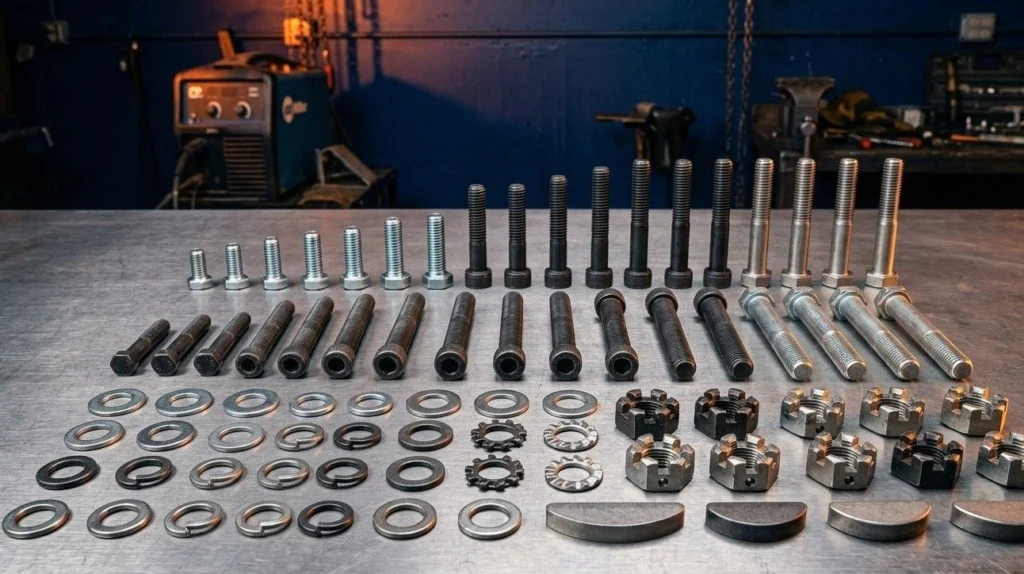
Fasteners types and applications are fundamental mechanical components used to join two or more machine parts securely in fitting shops and industrial assembly lines. Mastering various fasteners types and applications enables ITI fitter trainees, design engineers, and maintenance technicians to select the correct threaded bolts, locking nuts, keys, and pins for specific load conditions. This comprehensive selection guide details essential fasteners types and applications under National Council for Vocational Training (NCVT) Craftsmen Training Scheme (CTS) standards, covering temporary, semi-permanent, and permanent fasteners, standard thread profiles, washer locking mechanisms, and shop-floor assembly protocols.
📌 Guide Navigation Index
1. Major Classifications of Fasteners Types and Applications (Temporary, Semi-Permanent & Permanent)
In mechanical engineering, a fastener is a hardware device that mechanically joins or affixes two or more objects together. Analyzing fasteners types and applications requires grouping them by their disassembly characteristics without damaging parent components. Understanding different fasteners types and applications allows technicians to choose between non-destructive maintenance joints and permanent structural bonds.
1.1 Temporary Fasteners Types and Applications Overview
Temporary fasteners types and applications allow frequent assembly and disassembly of machine components without damaging either the joining elements or the parent metals.
Primary Examples: Threaded bolts, nuts, machine screws, studs, setscrews, keys, cotters, and circlips. They are used in gearboxes, engine covers, and removable access panels. Selecting the correct temporary fasteners types and applications ensures reliable machinery service life.
1.2 Semi-Permanent Fasteners
Semi-permanent fasteners types and applications hold parts securely during normal operation but can be removed by destroying the fastener itself while keeping parent components intact.
Primary Examples: Solid rivets, pop rivets, and soft soldered joints. Used in sheet metal ducting, boiler plates, and aircraft skins.
1.3 Permanent Fasteners
Permanent fasteners types and applications fuse component edges together into a single monolithic unit. Separation requires cutting or destroying parent metal structures.
Primary Examples: Electric arc welded joints, brazed joints, and high-strength adhesive bonding.
1.4 Structural Comparison Matrix
Understanding the temporary semi permanent permanent fasteners difference is critical for evaluating fasteners types and applications in trade theory assessments:
2. Threaded Fasteners (Types of Nuts, Bolts, and Studs in Fitter Shop)
Threaded elements constitute the largest group of mechanical hardware used in fitting shops. Selecting proper hardware requires knowing the types of nuts, bolts, and studs in fitter shop environments as part of standard fasteners types and applications.
2.1 Bolts and Machine Screws
A bolt is a threaded fastener designed to pass through clearance holes in mating parts and tighten using a nut. A machine screw is threaded directly into a tapped blind hole in a parent component. Both represent widely used threaded fasteners types and applications.
2.1.1 Hexagonal Head Bolt
The standard 6-sided head bolt used for general machinery construction. Tightened using open-ended spanners, ring spanners, or socket wrenches.
2.1.2 Square Head Bolt
Features a 4-sided head providing a large bearing surface. Widely used in T-slots of machine tables to clamp workpieces securely.
2.1.3 Socket Head Cap Screw (Allen Bolt)
Features a cylindrical head containing a recessed hexagonal socket. It is tightened below surface level using an Allen key, saving space in compact machine housings.
2.2 Studs (Stud Bolts)
A stud is a headless cylindrical steel rod threaded on both ends with a plain unthreaded shank in the middle.
2.2.1 Application Mechanics
The metal end (short thread) is screwed permanently into a tapped hole in a heavy component (e.g., an engine cylinder block), while the nut end (longer thread) secures the mating cover plate using a standard nut.
2.3 Types of Nuts
- Hexagonal Nut: Standard 6-sided internal threaded fastener used with bolts and studs.
- Square Nut: 4-sided nut providing greater wrench engagement surface for heavy-duty farm machinery.
- Flange Nut: Features a wide integrated circular washer face at one end to distribute clamping pressure over enlarged clearance holes.
- Wing Nut (Butterfly Nut): Contains two wings extending from the nut body, allowing manual hand tightening without wrenches. Used on hacksaw frames and light adjusters.
- Cap Nut (Acorn Nut): Features a domed crown covering the bolt end to prevent fluid leakage and protect against sharp thread injuries.
- T-Nut: T-shaped nut used in milling machine T-slots for mounting work-holding vices.
Before drilling clearance holes for heavy hex bolts, fitters perform accurate layout steps using guidelines from our guide on ITI fitter marking tools and layout practice.
3. Locking Devices and Types of Washers Used in Machine Assembly
Vibrations from rotating spindles and reciprocating pistons can cause standard nuts to loosen over time. Utilizing types of washers and locking devices prevents structural failure across high-vibration fasteners types and applications.
3.1 Flat Plain Washers
Flat steel washers are placed under bolt heads or nuts to distribute clamping loads over a larger area, prevent surface scratching, and bridge oversized clearance holes.
3.2 Spring Washers
Helical split spring washers exert continuous elastic tension against the nut face, increasing frictional resistance to prevent loosening under moderate vibration in everyday fasteners types and applications.
3.3 Specialized Positive Locking Devices
3.3.1 Castle Nut and Slotted Nut
Features cylindrical slots cut into an upper collar. A split cotter pin is inserted through the nut slots and a drilled hole in the bolt shank, providing positive mechanical locking for automobile wheel hubs.
3.3.2 Lock Nut (Check Nut)
Uses a thin secondary nut screwed down firmly against a standard main nut. Tightening the two nuts in opposite directions locks them together by thread flank friction.
3.3.3 Nylon Insert Lock Nut (Nyloc Nut)
Contains a captive nylon collar at its top. As the bolt threads pass through the nylon insert, it forms a tight friction grip that resists severe machine vibrations.
3.3.4 Tab Washer & Toothed Lock Washers
Tab washers feature bendable tabs bent against the flat face of the nut and component edge. Toothed washers feature internal or external radial teeth that bite into mating metal surfaces.
For preparing accurate cylindrical shaft ends before cutting external threads for lock nuts, turners consult centre lathe machine parts and operations setups.
4. Keys and Keyways (Sunk Key vs Feather Key vs Woodruff Key)
A key is a piece of mild steel inserted between a rotating shaft and the hub of a pulley, gear, or flywheel to transmit rotary torque without relative slippage.
4.1 Comparative Key Geometry & Application Analysis
Understanding the sunk key vs feather key vs Woodruff key difference is essential for evaluating power transmission fasteners types and applications in trade theory exams:
4.1.1 Gib-Head Key
A tapered sunk key featuring a raised head at one end. The gib head facilitates easy removal using a wedge drift when the rear end of the keyway is inaccessible.
4.1.2 Saddle Keys (Flat & Hollow)
Saddle keys drive light power purely by friction against the shaft surface without cutting a keyway into the shaft, preserving shaft structural strength.
5. Cotter Joints and Precision Alignment Pins
Cotters and alignment pins secure parts subject to axial tensile or compressive forces along their shaft axes. These represent specialized non-threaded fasteners types and applications.
5.1 Cotter Joints
A cotter is a flat wedge-shaped steel piece featuring a 1:24 to 1:32 taper along one edge. It is driven at right angles through matching slots in a socket-and-spigot joint to connect two coaxial rods.
5.2 Precision Dowel and Taper Pins
5.2.1 Dowel Pins
Precision-ground cylindrical hardened steel pins used to align mating die plates, machine housings, and split gearboxes before tightening main body bolts.
5.2.2 Taper Pins
Solid steel pins featuring a standard 1:50 metric taper. Used to pin levers, handwheels, and gears permanently to shafts.
5.2.3 Split Cotter Pins
Half-round folded wire pins inserted through clevis pins or castle nuts, with the split legs bent outwards to prevent axial movement.
Before drilling precision hole locations for dowel pins, operators follow setups outlined in our guide on drilling machine types and operations.
6. ISO Metric Thread Profiles and Fastener Designations
Threaded fasteners in India follow International Organization for Standardization (ISO) metric standards under Bureau of Indian Standards (BIS) codes to standardize commercial fasteners types and applications.
6.1 ISO Metric Thread Geometry
The standard ISO metric thread features a 60-degree included V-angle with flat crests and rounded roots.
6.1.1 Metric Fastener Designation (e.g., M12 × 1.75)
- M: Designates an ISO Metric thread profile.
- 12: Represents the nominal major diameter of the thread in millimeters.
- 1.75: Represents the thread pitch distance in millimeters (distance from crest to crest).
6.1.2 Coarse vs Fine Threads
Coarse threads (e.g., M10 × 1.5) are used for general engineering assembly. Fine threads (e.g., M10 × 1.25) offer higher fatigue resistance and fine adjustment capability in automotive applications.
To verify thread tolerances on studs and bolts, quality control teams apply the limit fit and tolerance hole basis system.
7. Fastener Assembly Defect Troubleshooting & Torque Rules
Improper tightening torque causes fastener shearing, thread stripping, or joint leakage. The matrix below details corrective measures when assembling various fasteners types and applications:
Before assembling thin metal casings with bolts or rivets, technicians check sheet thickness using methods from our sheet metal tools and joints practical manual.
8. NCVT, DGT & MSDE Exam Syllabus Alignment
Under the Directorate General of Training (DGT) and Ministry of Skill Development and Entrepreneurship (MSDE) curriculum guidelines, mastering fasteners types and applications forms a core syllabus topic for ITI Fitter, Turner, and Machinist trainees.
8.1 NIMI Pattern Exam Weightage
Questions covering key profiles, locking devices, thread designations, and fasteners types and applications account for 10% to 14% of total marks in NCVT AITT online Computer-Based Tests (CBT).
8.1.1 Public Sector Recruitment Relevance
Candidates preparing for Indian Railways RRB ALP/Technician trade tests, BHEL, ISRO, and DRDO technical skill exams must demonstrate proficiency in selecting and installing fasteners types and applications. Official curriculum frameworks can be accessed via the Bharat Skills Official Portal and the MSDE Official Portal.
To verify dimensional accuracy when inspecting fastener hole patterns, technicians use precision measurement tools and inspect component fits using types of gauges used in fitter shop metrology stations.
9. NIMI Pattern Mock Tests & Category Navigation
Master all technical questions regarding fasteners types and applications for your upcoming NCVT AITT online Computer-Based Tests (CBT) across our main study categories:
10. Frequently Asked Questions (NCVT CBT Exam Focus)
Q1: What is the main structural difference between a bolt and a stud in standard fasteners types and applications?
Ans: A bolt features a formed head at one end and threads at the other, whereas a stud is a headless rod threaded on both ends with an unthreaded central shank.
Q2: Which key type is shaped like a semi-circular disc segment in power transmission fasteners types and applications?
Ans: The Woodruff key is semi-circular in shape and fits into a matching semi-circular milled seat on a shaft.
Q3: Why are spring washers used under nuts in vibrating fasteners types and applications?
Ans: Spring washers exert continuous elastic tension against the nut face, preventing the nut from backing off or loosening under vibration.
Q4: What does the metric thread designation M12 × 1.75 mean?
Ans: It represents an ISO Metric thread (M) with a 12 mm nominal major diameter and a 1.75 mm thread pitch distance.
Q5: How does a castle nut provide positive locking on automobile wheel spindles?
Ans: A split cotter pin is inserted through slots in the castle nut collar and a drilled hole in the bolt shank, creating a positive mechanical lock.
🚀 Ace Your NCVT AITT Online Examinations!
Practice official NIMI pattern mock tests across Trade Theory, Workshop Calculation & Science, and Employability Skills on Info ITI.