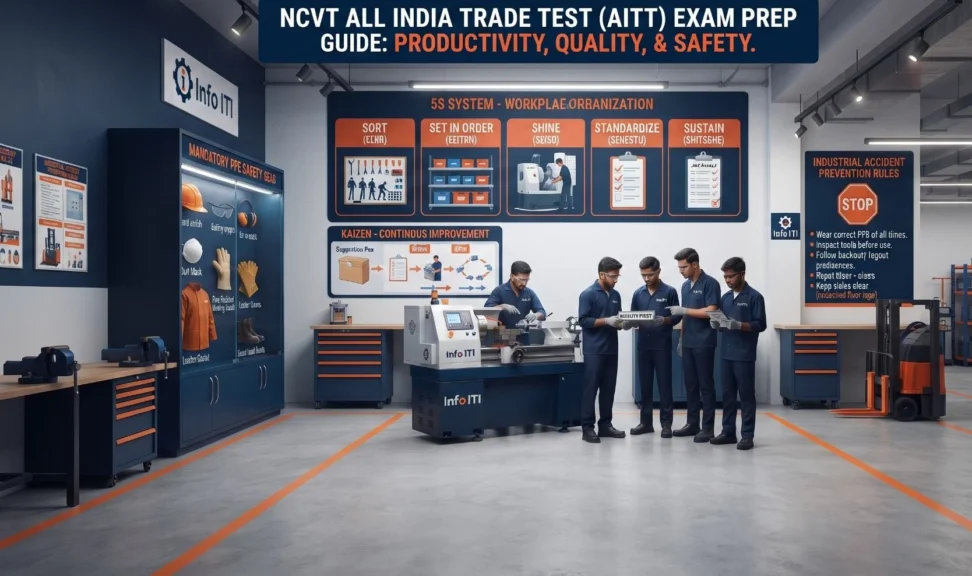
Productivity quality and accident prevention in workplace environments form the absolute core of safe, efficient manufacturing operations. Mastering productivity quality and accident prevention in workplace standards empowers fitter, electrician, welder, and machinist graduates to optimize shop-floor output, maintain zero-defect quality, and eliminate industrial hazards. Applying productivity quality and accident prevention in workplace practices ensures regulatory compliance and personal safety during daily machine handling. This comprehensive guide details productivity quality and accident prevention in workplace principles under National Council for Vocational Training (NCVT) and Directorate General of Training (DGT) standards, covering the 5S system, Kaizen methodologies, PPE usage, and emergency response protocols.
📢 Share This Study Guide With Your Classmates & Friends!
📌 Guide Navigation Index
Productivity Quality and Accident Prevention in Workplace Overview
Industrial manufacturing demands a careful balance between high production output, defect-free component quality, and absolute worker safety through productivity quality and accident prevention in workplace systems. Maintaining productivity quality and accident prevention in workplace procedures ensures that industrial plants operate efficiently without unexpected downtime or employee injuries.
Productivity is measured as the ratio of output produced to input resources utilized, while quality guarantees that manufactured goods comply strictly with engineering blueprints. Applying productivity quality and accident prevention in workplace guidelines enables technicians to minimize material wastage and prevent hazardous shop-floor mishaps.
Before establishing independent enterprise production lines or workshop units, trainees must review foundational business strategies outlined in our Entrepreneurship Startup Basics Guide.
Core Pillars Under Productivity Quality and Accident Prevention in Workplace
- Resource Optimization: Maximizing raw material usage and machine runtime under productivity quality and accident prevention in workplace targets.
- Zero Defect Manufacturing: Ensuring strict adherence to dimensional tolerances and geometric accuracy.
- Hazard Elimination: Identifying unsafe working conditions and eliminating them before accidents occur via productivity quality and accident prevention in workplace rules.
- Continuous Training: Educating machine operators on safety protocols and quality standards regularly.
Productivity Quality and Accident Prevention in Workplace: The 5S System
Japanese management methodology utilizes the 5S framework to organize, clean, and maintain workshop floors. Evaluating 5s methodology steps for workshop organization under productivity quality and accident prevention in workplace standards helps eliminate clutter and wasted motion.
Productivity Quality and Accident Prevention in Workplace: Kaizen
Achieving long-term manufacturing excellence requires continuous incremental improvements. Implementing kaizen continuous improvement process in industry under productivity quality and accident prevention in workplace frameworks empowers workers to suggest small daily workflow enhancements.
Core Principles of Kaizen
- Good Processes Bring Good Results: Focus on refining operational steps rather than blaming individual workers for mistakes.
- Eliminate Waste (Muda): Identify and remove unnecessary movements, excessive waiting times, and material scrap.
- Standardization: Document successful improvements so they become standard operating procedures for all batches.
When recording production improvement metrics and calculating quality control statistics on spreadsheets, trainees utilize skills from our IT Literacy and Computer Skills Guide.
Productivity Quality and Accident Prevention in Workplace: Safety Rules
Industrial accidents cause severe injuries, equipment damage, and lost work hours. Understanding causes of industrial accidents and prevention protocols through productivity quality and accident prevention in workplace policies is vital for every technician.
Primary Causes of Workshop Accidents
- Unsafe Acts: Careless machine operation, failure to wear PPE, horseplay, and bypassing safety guards.
- Unsafe Conditions: Faulty electrical wiring, slippery oil spills on floors, inadequate lighting, and broken machine parts.
Golden Rules of Accident Prevention
Trainees must strictly follow shop-floor safety instructions:
- Never clean or adjust a running machine tool; always disconnect power before maintenance.
- Keep gangways and walkways clear of scrap metal chips, tools, and material bundles.
- Report any damaged electrical switches or exposed wiring to the workshop instructor immediately.
Productivity Quality and Accident Prevention in Workplace: PPE & First Aid
Personal Protective Equipment (PPE) serves as the last line of defense against physical hazards. Adhering to personal protective equipment ppe standards for iti trainees under productivity quality and accident prevention in workplace regulations prevents bodily harm.
Standard Personal Protective Equipment (PPE)
- Safety Helmet: Protects the head from falling objects in construction and heavy fabrication areas.
- Safety Goggles: Shields eyes from flying metal chips during chipping, grinding, and welding operations.
- Leather Hand Gloves: Protects hands from sharp metal burrs, hot workpieces, and electrical shocks.
- Safety Boots: Steel-toe boots protect feet from heavy dropped components and sharp scrap materials.
Productivity Quality and Accident Prevention in Workplace: NCVT Exams
Under Directorate General of Training (DGT) guidelines, mastering productivity quality and accident prevention in workplace concepts is a mandatory core module across all ITI trade syllabi.
NIMI Pattern Exam Weightage
Questions on 5S methodology, Kaizen principles, PPE equipment, and industrial safety rules account for 20% to 25% of total marks in NCVT All India Trade Test (AITT) Employability Skills examinations. Official curriculum frameworks can be accessed on the Bharat Skills Official Portal and the MSDE Official Portal.
Productivity Quality and Accident Prevention in Workplace: Mock Tests
Practice official mock test questions on productivity quality and accident prevention in workplace across our study portals:
Frequently Asked Questions
Q1: What does the first ‘S’ (Seiri) stand for in the 5S workplace organization system?
Ans: Seiri stands for ‘Sort’, which means separating necessary tools and items from unneeded clutter in the workspace.
Q2: What is the primary objective of Kaizen in industrial manufacturing?
Ans: Kaizen aims for continuous incremental improvement in processes, eliminating waste, and enhancing overall quality.
Q3: Why must safety goggles be worn during grinding operations?
Ans: Safety goggles protect the eyes from high-speed flying metal sparks and abrasive wheel particles.
Q4: What is the difference between an unsafe act and an unsafe condition?
Ans: An unsafe act is caused by human carelessness or violation of rules, whereas an unsafe condition refers to physical workplace hazards like faulty wiring or slippery floors.
Q5: What do steel-toe safety boots protect against in heavy workshops?
Ans: Steel-toe boots protect feet from heavy dropped components, rolling stock, and sharp scrap materials.
🚀 Ace Your NCVT AITT Online Examinations!
Practice official NIMI pattern mock tests across Employability Skills, Trade Theory, and Workshop Calculation on Info ITI.