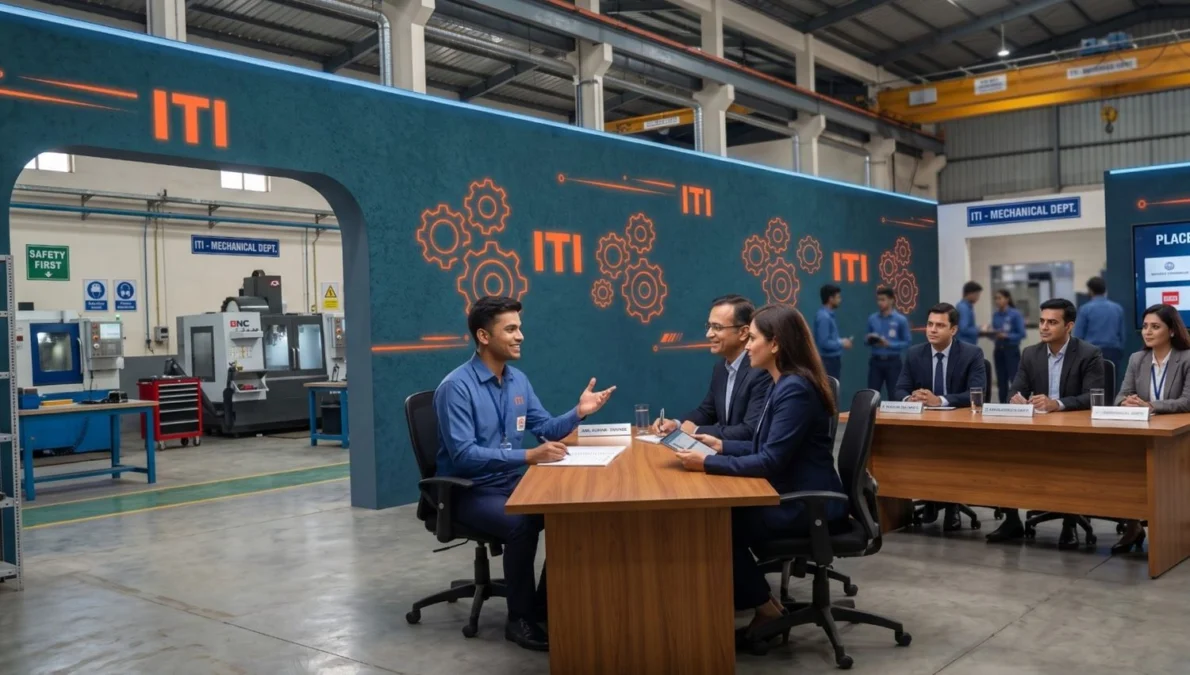
Mastering communication skills in employability skills for ITI trainees is essential for transitioning successfully from industrial training institutes into modern factory environments and corporate workplaces. Developing communication skills in employability skills for ITI trainees enables fitter, electrician, welder, and turner graduates to clear NCVT AITT online Computer-Based Tests (CBT), perform confidently during job interviews, and interact efficiently with shop-floor supervisors. This comprehensive technical guide details communication skills in employability skills for ITI trainees under National Council for Vocational Training (NCVT) and Directorate General of Training (DGT) standards, covering verbal vs non-verbal communication, the 7 Cs framework, active listening rules, professional email etiquette, and workplace feedback mechanisms.
📢 Share This Study Guide With Your Classmates & Friends!
📌 Guide Navigation Index
Communication Skills for ITI Trainees Overview
In technical industries, technical knowledge alone is not sufficient for career progression. Learning communication skills in employability skills for ITI trainees bridges the gap between hands-on trade expertise and professional workplace expectations.
Communication is defined as the process of transmitting information, ideas, feelings, and technical instructions from a sender to a receiver through a chosen medium. Developing communication skills in employability skills for ITI trainees ensures that technicians can convey machine status reports, safety hazards, and maintenance requests accurately.
The Communication Process Cycle
- Sender: The individual who initiates the technical message or instruction.
- Encoding: Translating thoughts into clear words, written symbols, or visual gestures.
- Message: The actual information, technical data, or safety report being transmitted.
- Channel/Medium: The path through which the message travels (spoken words, written memos, emails, hand signals).
- Receiver: The targeted operator, supervisor, or interviewer receiving the message.
- Decoding: Interpreting the message to understand its true meaning.
- Feedback: The response provided by the receiver confirming accurate understanding.
Verbal vs Non-Verbal Communication Comparison
Workplace interactions rely on both spoken words and unspoken physical cues. Evaluating verbal vs non-verbal communication in workplace environments helps trainees maintain professional conduct.
The 7 Cs of Effective Communication
To ensure technical messages are understood without confusion, trainees apply the 7 cs of effective communication in industry guidelines across all professional interactions.
Breakdown of the 7 Cs
- Clear: State the main objective clearly using simple language; avoid confusing technical jargon when speaking to non-technical staff.
- Concise: Express thoughts using the minimum required words without omitting necessary safety details.
- Concrete: Provide specific facts, exact numerical dimensions, and measured values rather than vague descriptions.
- Correct: Ensure grammatical accuracy, correct technical terminology, and verified machine data.
- Coherent: Organize ideas logically so that paragraphs and sentences flow smoothly from one point to the next.
- Complete: Include all necessary information so the receiver can take immediate action without asking follow-up questions.
- Courteous: Maintain a respectful, polite, and professional tone toward coworkers and senior staff.
Active Listening Rules for Technical Interviews
Listening is not merely hearing sounds; it involves actively processing and understanding spoken information. Practicing active listening techniques for technical interviews significantly increases selection rates during campus recruitment drives.
Active Listening vs Passive Hearing
Passive hearing is accidental and involuntary, where sound waves hit the eardrums without mental focus. Active listening requires conscious effort, focused attention, and mental processing to decode the speaker’s true intent.
Four Rules for Active Listening
- Maintain Eye Contact: Look directly at the interviewer or speaker to demonstrate engagement and confidence.
- Avoid Interruptions: Allow the speaker to finish their question before formulating a response.
- Paraphrase and Summarize: Repeat key points in your own words to confirm accurate understanding of complex instructions.
- Note Down Key Details: Write down dimensions, job order numbers, or safety warnings during shop-floor briefings.
Professional Email Writing and Workplace Etiquette
Writing professional emails is a mandatory digital literacy skill for modern technicians. Applying professional email writing rules for job application emails ensures a positive first impression with HR managers.
Structure of a Professional Email
- Subject Line: Short, specific, and clear (e.g., Application for ITI Fitter Apprentice – Rahul Kumar).
- Salutation: Formal greeting using professional titles (e.g., Dear Hiring Manager, or Dear Sir/Madam).
- Body Paragraphs: Concise explanation stating your qualification, trade expertise, and purpose of writing.
- Sign-Off: Professional closing (e.g., Sincerely, or Best Regards) followed by full name, trade name, and contact details.
- Attachments: Properly named PDF files (e.g., Rahul_Kumar_Fitter_Resume.pdf).
Before applying for apprentice posts, candidates should review the rules in our Railway ITI Apprentice Recruitment Guide.
🛠️
NCVT Exam Syllabus Alignment
Under Directorate General of Training (DGT) guidelines, mastering communication skills in employability skills for ITI trainees is a mandatory core requirement across all 1-year and 2-year ITI trades.
NIMI Pattern Exam Weightage
Questions on communication barriers, non-verbal cues, 7 Cs rules, and workplace etiquette account for 20% to 25% of total marks in NCVT All India Trade Test (AITT) Employability Skills online Computer-Based Tests (CBT). Official syllabus structures can be verified on the Bharat Skills Official Portal and the MSDE Official Portal.
NIMI Pattern Mock Tests
Practice official mock test questions on communication skills in employability skills for iti trainees across our study portals:
Frequently Asked Questions
Q1: What are the two primary channels of communication in the workplace?
Ans: Verbal communication (spoken and written words) and non-verbal communication (body language, gestures, eye contact).
Q2: What does the ‘Concise’ principle mean in the 7 Cs of communication?
Ans: Expressing information using the minimum required words without omitting essential facts or safety details.
Q3: How does active listening differ from passive hearing?
Ans: Active listening requires mental concentration, understanding, and feedback, whereas passive hearing is the involuntary receiving of sound waves.
Q4: Why is eye contact important during job interviews?
Ans: Direct eye contact demonstrates confidence, sincerity, active engagement, and trustworthiness to the interviewer.
Q5: What is the purpose of a subject line in a professional email?
Ans: The subject line clearly states the main purpose of the email so the receiver can prioritize and understand the message immediately.
🚀 Ace Your NCVT AITT Online Examinations!
Practice official NIMI pattern mock tests across Employability Skills, Trade Theory, and Workshop Calculation on Info ITI.