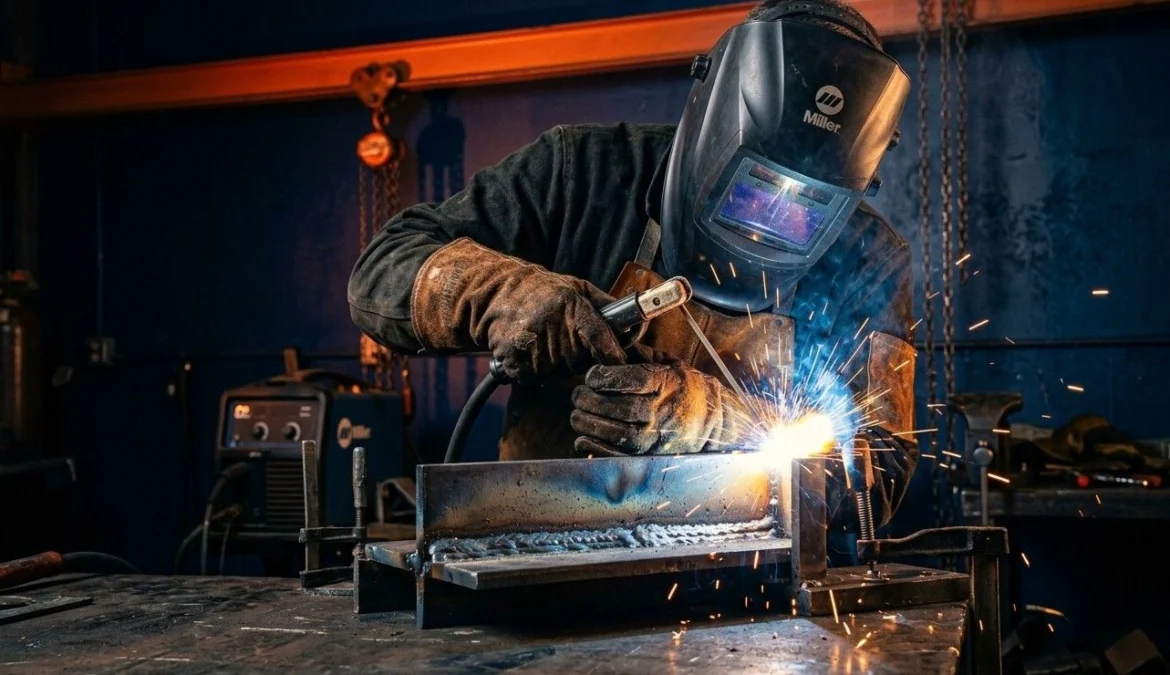
Welding process types and safety rules are essential for joining structural steel plates, piping networks, and machinery components safely across modern industrial workshops. Mastering all fundamental welding process types and safety rules equips ITI fitter trainees, welder fabricators, and inspection engineers with the practical metallurgical parameters and personal protection protocols needed for zero-defect joining. This comprehensive technical guide details essential welding process types and safety rules under National Council for Vocational Training (NCVT) Craftsmen Training Scheme (CTS) standards, covering fusion welding power sources, electrode selection specifications, oxy-acetylene flame chemistry, inspection defect remedies, and workshop safety regulations.
📌 Guide Navigation Index
1. Major Fusion Welding Classifications & Electric Arc Fundamentals
Welding is a subtractive and additive metal joining process that fuses parent metals by heating them to a molten state, with or without the application of pressure and filler material. Executing successful welding processes, types, and safety rules requires recognizing the specific energy source used to generate localized fusion heat. Understanding basic welding process types and safety rules ensures that fabricators select the correct electrical polarity for different plate thicknesses.
1.1 Electric Arc Welding Physics
Electric arc welding creates an intense electric arc between an electrode and the workpiece metal. The high temperature of the arc (ranging from 3600 degrees Celsius to 5500 degrees Celsius) instantly melts the base metal edges and the consumable electrode tip, forming a liquid weld pool that cools into a solid structural joint. Applying proper welding process types and safety rules prevents arc blow and uneven penetration during heavy production runs.
1.1.1 Direct Current Straight Polarity (DCSP / DCEN)
In Direct Current Electrode Negative (DCEN) setups, the electrode is connected to the negative terminal and the workpiece to the positive terminal. Approximately two-thirds (67%) of the arc heat is concentrated at the workpiece, resulting in deep weld penetration.
1.1.2 Direct Current Reverse Polarity (DCRP / DCEP)
In Direct Current Electrode Positive (DCEP) setups, the electrode is connected to the positive terminal and the workpiece to the negative terminal. Two-thirds of the heat develops at the electrode, making DCEP ideal for welding thin sheets and non-ferrous alloys.
1.2 Transformer vs Inverter Welding Power Sources
Modern workshops use static Step-Down Transformers, Rectifiers, or Inverter-based power sources. Inverters convert single-phase AC to high-frequency DC, providing smooth arc stability and reducing electrical power consumption.
Before clamping heavy steel plates for arc welding, fitters perform edge preparation using accurate types of files used in fitter shop deburring and filing techniques[cite: 1].
2. Shielded Metal Arc Welding vs MIG vs TIG (SMAW, GMAW, GTAW)
Industrial fabrication relies on three primary electric arc welding variants. Understanding the shielded metal arc welding vs MIG vs TIG difference allows operators to align their daily welding process types and safety rules for optimal speed, clean appearance, and structural integrity[cite: 1].
2.1 Shielded Metal Arc Welding (SMAW / Manual Metal Arc)
SMAW uses a consumable stick electrode coated in chemical flux. As the arc burns, the flux decomposes into a protective gas shield and molten slag cover, guarding the cooling metal against atmospheric oxidation. Following standard welding process types and safety rules requires chipping this slag only after it has cooled sufficiently.
2.2 Gas Metal Arc Welding (GMAW / MIG)
GMAW feeds a continuous solid wire electrode automatically through a welding gun while an external shielding gas (Argon, CO2, or Helium) protects the weld zone. It offers high deposition rates for production lines.
2.3 Gas Tungsten Arc Welding (GTAW / TIG)
GTAW uses a non-consumable pure tungsten or thoriated tungsten electrode to establish the arc. An inert gas shield (Argon) protects the arc, while the filler rod is fed manually into the pool. It delivers superior aesthetic quality for stainless steel and aluminum.
2.4 Comparative Arc Welding Matrix
Analyzing process traits clarifies trade theory exam concepts:
2.4.1 Submerged Arc Welding (SAW)
For heavy pressure vessels, SAW buries a continuous wire electrode under a blanket of granular fusible flux, eliminating arc flash and spatter.
3. Oxy-Acetylene Welding Flame Types (Neutral, Carburizing & Oxidizing)
Gas welding mixes Oxygen (O2) and Acetylene (C2H2) gases in a blowpipe torch to generate heat up to 3200 degrees Celsius. Adjusting the ratio of gas mixture yields three distinct oxy-acetylene welding flame types: neutral, carburizing, and oxidizing[cite: 1]. Correctly setting up the gas apparatus is a key component of essential welding process types and safety rules[cite: 1].
3.1 Neutral Flame (1:1 Ratio)
Formed by burning equal volumes of Oxygen and Acetylene (1:1 ratio). It produces a sharp white inner cone surrounded by a blue outer envelope with a maximum temperature of 3125 degrees Celsius.
Primary Use: Used for welding mild steel, cast iron, copper, and aluminum without altering the metal’s chemical composition.
3.2 Carburizing Flame (Excess Acetylene)
Formed when Acetylene exceeds Oxygen volume. It features three flame zones: a bright inner cone, an intermediate white acetylene feather zone, and a bluish outer envelope.
Primary Use: Used for hard-facing alloy steel, nickel, and high-carbon steel to prevent burning carbon out of the base metal.
3.3 Oxidizing Flame (Excess Oxygen)
Formed when Oxygen volume exceeds Acetylene. It produces a short, pointed inner cone that emits a loud roaring hiss, reaching temperatures up to 3300 degrees Celsius.
Primary Use: Used for welding brass, bronze alloys, and zinc castings because the oxidized surface film prevents zinc evaporation.
3.3.1 Gas Cylinder Color Coding Regulations
To prevent cross-connection hazards, gas cylinders follow strict international standards under workshop welding process types and safety rules:
- Oxygen Cylinder: Painted Black with right-hand thread connections (Working pressure: 120 to 150 kg/cm²).
- Acetylene Cylinder: Painted Maroon (Red) with left-hand thread connections (Working pressure: 15 to 16 kg/cm²).
Before cutting sheet metal plates for gas welding joints, fabricators check sheet thickness using tools from our sheet metal tools and joints practical guide[cite: 1].
4. Standard Welding Joint Positions (1G, 2G, 3G, 4G & 5G)
Structural code standards classify welding positions based on plate orientation and joint direction. Understanding welding joint positions 1g 2g 3g 4g is essential for welder qualification testing[cite: 1]. Adhering to proper welding process types and safety rules during positional welding prevents molten metal sag[cite: 1].
4.1 Groove Weld Positions (Plates)
- 1G (Flat Position): The plates lie flat horizontally, and the weld metal is deposited from the top side. This is the easiest welding position.
- 2G (Horizontal Position): The weld axis lies horizontally on a vertical plate surface. Weld metal must be controlled against gravitational sag.
- 3G (Vertical Position): The weld axis lies vertically on a vertical plate. Welding can be performed vertical-up (for thick plates) or vertical-down (for thin sheets).
- 4G (Overhead Position): The weld is executed from the underside of a horizontal joint. Requires high skill to prevent molten metal drops.
4.2 Pipe Welding Positions (5G & 6G)
4.2.1 5G Position (Fixed Horizontal Pipe)
The pipe axis is fixed horizontally, and the welder moves around the circumference executing flat, vertical, and overhead positions in one continuous pass.
4.2.2 6G Position (45-Degree Fixed Inclined Pipe)
The pipe is fixed at a 45-degree angle. This represents the master welder qualification test position required for high-pressure pipeline certification.
For preparing accurate cylindrical shaft ends before butt welding, turners follow operations outlined in centre lathe machine parts and operations setups[cite: 1].
5. BIS Flux-Coated Electrode Identification & Coding System
Under Bureau of Indian Standards (BIS IS: 815) regulations, covered electrodes for manual metal arc welding use a coded alphanumeric stamp. Selecting electrodes according to standard welding process types and safety rules guarantees joint strength matching the parent metal.
5.1 BIS Coding System Structure (e.g., EB5426HJX)
- Prefix E: Indicates a flux-coated arc welding electrode.
- First Letter (B): Indicates flux coating type (B = Basic coating, R = Rutile, A = Acidic, C = Cellulosic).
- First Digit (5): Tensile strength and yield strength indicator.
- Second Digit (4): Elongation percentage and impact value rating.
- Third Digit (2): Welding position suitability (1 = All positions, 2 = Flat and horizontal fillet only).
- Fourth Digit (6): Current condition and recommended open-circuit voltage (OCV).
5.1.1 Electrode Baking Protocols
Low-hydrogen basic electrodes (e.g., E7018) must be baked in a portable electrode oven at 250 degrees Celsius to 300 degrees Celsius for one hour before use to remove moisture and prevent hydrogen-induced cold cracking.
6. Welding Defects Root Cause and Remedies Troubleshooting Matrix
Quality inspection during non-destructive testing (NDT) often exposes internal or surface flaws. The matrix below outlines welding defect root causes and remedies for shop-floor troubleshooting[cite: 1]. Implementing correct welding process types and safety rules minimizes rework and scrap rates[cite: 1].
To verify hole clearance and plate alignment after fixing weld distortions, inspectors rely on types of gauges used in fitter shop inspection lines[cite: 1].
7. Mandatory Workshop PPE & Electrical Hazard Safety Rules
Welding presents severe hazards including ultraviolet (UV) radiation burns, toxic fume inhalation, electrical shocks, and hot metal spatter fires. Strict adherence to welding process types and safety rules protects operators against acute injuries[cite: 1].
7.1 Personal Protective Equipment (PPE) Compliance
- Welding Helmet / Hand Shield: Fitted with DIN shade 10 to 12 filter glass to block dangerous ultraviolet and infrared rays from causing arc eye burns.
- Leather Apron & Sleeves: Protect the body’s skin against molten spatter drops and intense radiant heat.
- Chrome Leather Welding Gloves: Protect hands during continuous arc operation under standard welding process types and safety rules.
- Respirator Mask: Mandatory when welding galvanized plates or stainless steel to prevent zinc fume fever and hexavalent chromium inhalation.
7.2 Fire Prevention & Electrical Safety
- Ensure the welding machine frame is grounded to an earth pit.
- Keep a fire extinguisher (CO2 or Dry Chemical Powder) within 5 meters of the welding station.
- Never weld directly on concrete floors without heat shielding, as trapped moisture inside concrete can explode under intense thermal heat.
- For federal safety compliance, consult the MSDE Official Portal and curriculum frameworks on Bharat Skills[cite: 1].
Verifying hole pitch distances after welding assemblies requires combining exact drilling machine types and operations with standard precision measurement tools inspection[cite: 1].
8. NCVT, DGT & MSDE Exam Syllabus Alignment
Under the Directorate General of Training (DGT) and Ministry of Skill Development and Entrepreneurship (MSDE) guidelines, learning welding process types and safety rules represents a heavy module in ITI Fitter, Welder, and Sheet Metal Worker trade theory[cite: 1].
8.1 NIMI Pattern Exam Weightage
Questions covering oxy-acetylene flame types, polarity setups, electrode coding, and welding processes types and safety rules account for 12% to 16% of total marks in NCVT AITT Computer-Based Tests (CBT)[cite: 1].
8.1.1 Public Sector Recruitment Relevance
Candidates preparing for Indian Railways RRB ALP/Technician trade tests, BHEL, ISRO, and naval dockyard skill exams must master welding metallurgy and defect analysis to clear written papers and practical skill tests.
For checking precision tolerances on welded assemblies, candidates apply the limit fit and tolerance hole basis system[cite: 1].
9. NIMI Pattern Mock Tests & Category Navigation
Master all technical questions regarding welding processes types and safety rules for your upcoming NCVT AITT online Computer-Based Tests (CBT) across our main study categories[cite: 1]:
10. Frequently Asked Questions (NCVT CBT Exam Focus)
Q1: What is the gas volume ratio for a neutral oxy-acetylene flame under standard welding processes types and safety rules?
Ans: A neutral oxy-acetylene flame is produced by mixing equal volumes of Oxygen and Acetylene in a 1:1 ratio.
Q2: What is the main structural difference between GMAW (MIG) and GTAW (TIG) welding processes types and safety rules?
Ans: GMAW (MIG) uses a continuous consumable solid wire electrode fed automatically, whereas GTAW (TIG) uses a non-consumable tungsten electrode with manual filler rod feeding.
Q3: Which cylinder has left-hand thread connections in gas welding setups?
Ans: The Acetylene gas cylinder features left-hand thread connections and is painted Maroon (Red) for safety identification.
Q4: What causes undercut in arc welding, and how can it be prevented according to workshop welding processes types and safety rules?
Ans: Undercut is caused by excessive welding current, long arc length, or fast travel speed. It is prevented by reducing current, shortening the arc length, and maintaining a steady weave speed.
Q5: What shade filter glass is recommended for arc welding helmets under PPE welding process types and safety rules?
Ans: DIN Shade 10 to 12 filter glass is recommended to protect the welder’s eyes from harmful ultraviolet (UV) and infrared rays.
🚀 Ace Your NCVT AITT Online Examinations!
Practice official NIMI pattern mock tests across Trade Theory, Workshop Calculation & Science, and Employability Skills on Info ITI.