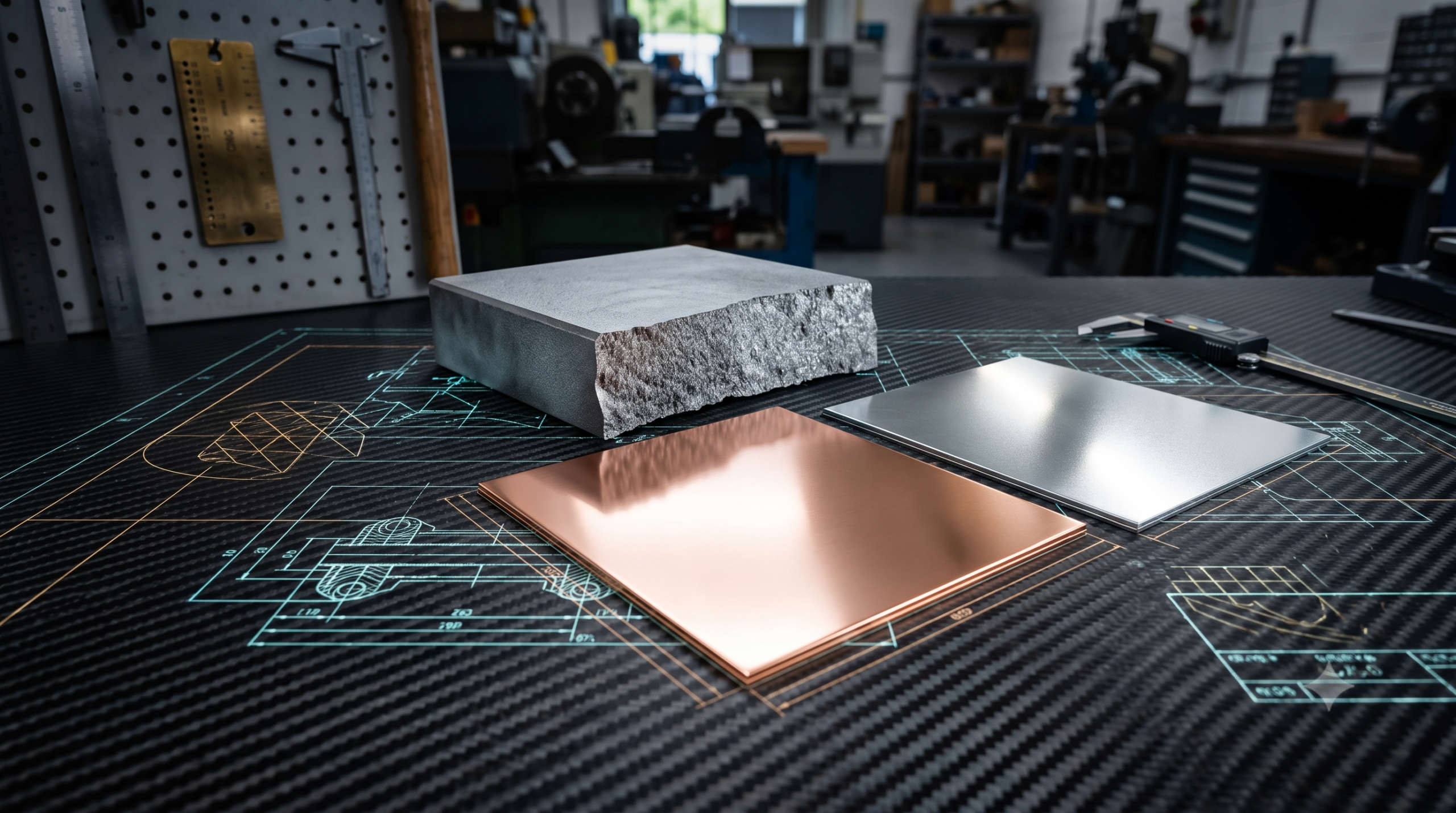
Choosing the stronger sheet metal requires balancing tensile yield strength, formability, and surface aesthetics. Selecting high-strength alloys prevents structural deformation under heavy industrial loads.
Which Sheet Metal Has Better Appearance? Guide to the Best Stronger Sheet Metal
When fabricators ask which sheet metal has better appearance than other metals, they are evaluating surface finish quality, corrosion resistance, and polish retention across structural designs.
Identifying the best sheet metal and engineering the best sheet metal parts demands a thorough understanding of alloy tensile limits and structural load capacities.
This trade theory module prepares technicians for NIMI and NCVT MIS exams. Key fabrication topics covered include:
- High-Strength Alloys: Selecting high strength sheet metal like stainless steel and titanium.
- Surface Aesthetics: Comparing brushed, polished, and galvanized finishes across structural sheets.
- Tensile Performance: Analyzing yield strength and load-bearing limits for stronger sheet metal assemblies.
📌 Quick Navigation Agenda
1. Five Core Sheet Metal Materials and Strength Grades Explained
Fabricators select the best sheet metal based on structural loading, corrosion resistance, and appearance criteria:
1.1 Stainless Steel Grades and Aesthetic Superiority
When considering which sheet metal has better appearance than other metals, austenitic stainless steel (Grade 304/316) provides a brilliant, rust-free polish that outperforms ordinary carbon steel.
1.2 Galvanized Iron and CRCA Carbon Steel Sheets
Cold Rolled Close Annealed (CRCA) and galvanized steel offer exceptional stiffness for manufacturing robust best sheet metal parts.
1.2.1 Forming Sheet Metal Components on Workshop Machinery
Forming precise cylindrical sleeves from high strength sheet metal requires robust workshop roller attachments. Check tooling gear in our best lathe accessories guide.
1.3 Aluminum Alloys for Lightweight Structural Applications
Aluminum alloy 6061-T6 provides an optimal strength-to-weight ratio for aerospace and automotive enclosures. Read our guide on joints or fastening methods.
1.4.1 Securing Sheet Metal Assemblies with Rivets and Bolts
Joining stronger sheet metal enclosures requires high-shear rivets and blind fasteners. Explore hardware in our best fasteners for industry post.
2. Post-Forming Heat Treatment & Stress Relieving
Bending and stamping high strength sheet metal introduces internal residual stresses that can cause springback and distortion.
Read our comprehensive heat treatment process guide and case hardening methods for fabricated metal parts.
3. Measuring Tensile Yield Strength and Hardness Values
Evaluating the stronger sheet metal requires destructive tensile testing and Rockwell hardness evaluations.
3.1 Interchangeability Limits in Pressed Metal Components
Standardized stamping dies ensure absolute dimensional interchangeability. Read our guide on interchangeability in manufacturing and explore measuring tools in our best precision measuring instruments guide.
4. Sheet Metal Shop Safety & Edges Deburring Rules
Handling razor-sharp high strength sheet metal edges causes severe laceration hazards. Always deburr sheared edges and wear protective leather gloves. Review safety protocols in our occupational health and safety rules. Consult official ISO Sheet Metal Safety Standards for compliance.
5. Advanced Metallurgical Insights & Grain Hardening
Advanced sheet metal fabrication relies on cold rolling strain hardening and crystalline grain elongation to maximize structural yield strength.
5.1 Cold Rolling Strain Hardening and Grain Dislocation
Passing sheet metal through cold reduction rollers increases dislocation density within the crystal lattice, making the metal harder and stronger sheet metal stock.
5.1.1 Electrochemical Anodizing and Oxide Passivation
Anodizing aluminum sheets thickens protective surface oxide films, enhancing corrosion resistance and aesthetic finish quality.
5.1.1.1 Microscopic Crystalline Grain Structure Analysis
Microscopic metallographic examination verifies uniform grain orientation across formed bends and stamped flanges.
Stronger Sheet Metal Selection Matrix (Real Data)
Pros and Cons of Stainless Steel vs Aluminum Sheets
Compare technical benefits and limits of stainless steel versus aluminum sheets:
Common Sheet Metal Fabrication Errors & Solutions
Avoid these widespread shop floor errors during stronger sheet metal fabrication:
1. Ignoring Bend Allowance: Neglecting bend deduction calculations causes formed sheet metal parts to exceed final dimensional tolerances. Solution: Apply standard K-factor bend allowance formulas prior to shearing.
Workshop Math: Sheet Metal Bend Allowance Formulas
Calculating sheet metal bend allowance is tested in ITI Workshop Calculation exams. Access practice problems in our workshop calculation hub.
🧮 Practical Sheet Metal Bend Allowance Calculation Example:
Material Thickness (T) = 2.0 mm
Bend Angle (A) = 90 Degrees
Neutral Axis Factor (K) = 0.33
Inside Radius (R) = 3.0 mm
Bend Allowance (BA) = (pi x A / 180) x (R + (K x T))
BA = (3.1416 x 90 / 180) x (3.0 + (0.33 x 2.0)) = 1.5708 x (3.0 + 0.66) = 1.5708 x 3.66 = 5.75 mm
Shop Floor Metal Forming Defect Diagnostics Table
International ISO 4997 Structural Steel Sheet Standards
Structural steel sheet materials comply with global ISO 4997 cold-reduced sheet specifications. Standards align with published research from the International Organization for Standardization (ISO).
Automotive Body Panel Stamping Overhaul
An automotive body panel manufacturing plant experienced springback and cracking defects when forming high-strength steel sheets. Optimizing die clearance angles and switching to interstitial-free stronger sheet metal eliminated micro-cracks and achieved 100% stamping precision.
Frequently Asked Questions (6 Technical Exam Qs)
1. Which sheet metal has a better appearance than other metals?
Austenitic stainless steel provides a brilliant, rust-free polish and superior appearance that outperforms ordinary carbon steel.
2. What is the main benefit of using stronger sheet metal?
Stronger sheet metal resists structural deformation and heavy impact loads while allowing reduced material thickness.
Have questions about which sheet metal has better appearance or calculating bend allowances? Share your queries in the comments below!