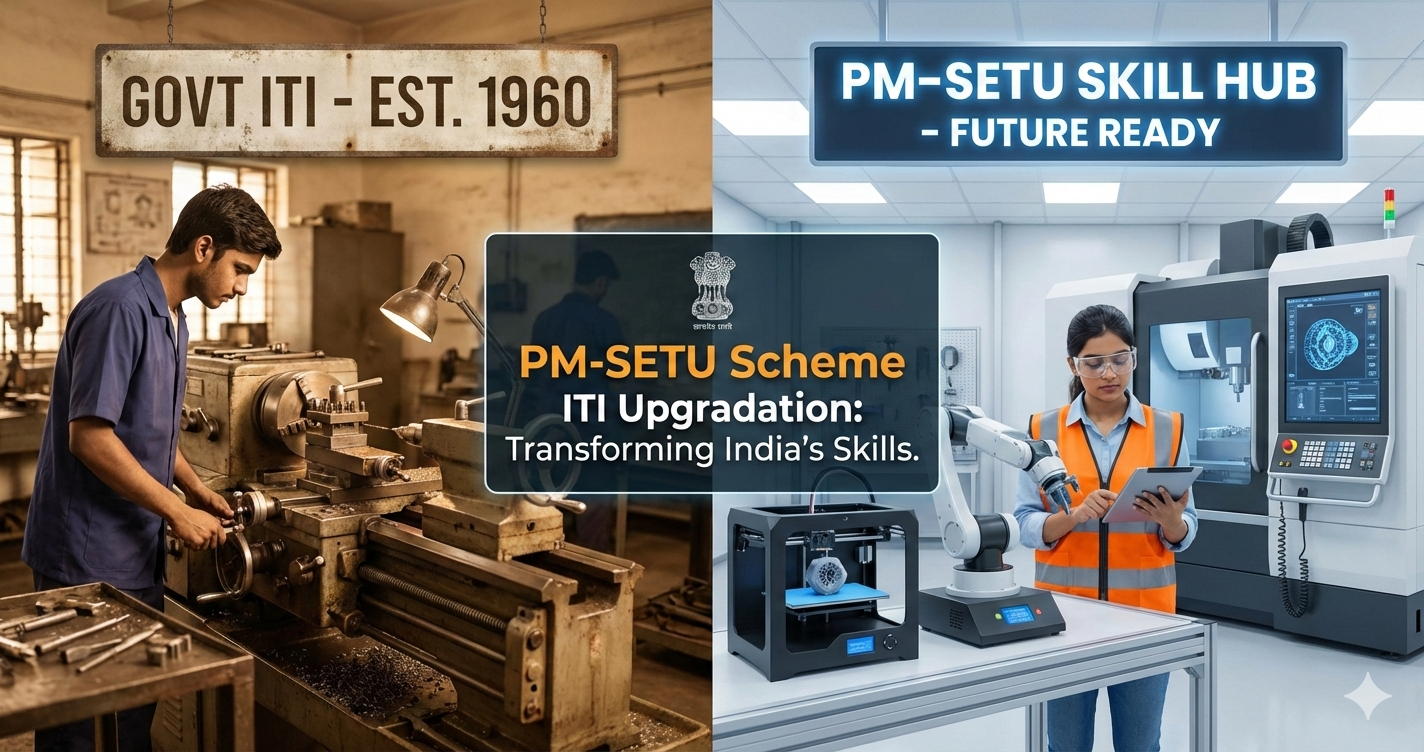
Introduction to PM SETU Scheme 2026
Technical education across India is undergoing a massive transformation today. Government Industrial Training Institutes form the backbone of our national skilled workforce. Having inspected multiple workshop layouts across regional industrial belts, I have seen firsthand how outdated machinery limits student learning. Traditional bench fitting and manual lathes no longer match current smart factory expectations.
To bridge this critical skill gap, the Central Government launched the PM SETU Scheme (Pradhan Mantri Skilling and Employability Transformation for Upgrading ITIs). This massive national mission overhauls traditional workshops with cutting-edge Industry 4.0 technology. For comprehensive trade theory resources and public recruitment alerts, visit our Info-ITI Portal.
📌 Quick Navigation Agenda
What is the PM SETU Scheme for ITI Upgradation?
The PM SETU Scheme is a flagship national initiative designed to modernize 1,000 Government ITIs across India with a total budget outlay of ₹60,000 Crore. Operating under a Hub and Spoke model, it converts 200 central institutes into modern technological hubs while linking 800 rural centers for shared access. By integrating advanced curricula in EV servicing, industrial mechatronics, and solar energy under Skill India Mission 2026, the scheme ensures candidates receive direct job placements in top manufacturing firms.
Ground Experience: Why Traditional Workshop Training Needs an Overhaul
During my interaction with senior trade instructors in industrial fitting shops, a recurring problem emerged. Students were spending months filing mild steel blocks manually. While basic manual precision is important, modern industrial employers demand familiarity with multi-axis CNC machines and automated PLC panels.
When fresh ITI candidates step onto corporate factory floors, they often face complex robotic welding setups. The NCVT ITI Modernization 2026 roadmap directly solves this mismatch by upgrading classroom tools to match modern factory standards.
Addressing the Equipment Deficit in Rural Institutes
Rural ITIs historically faced severe capital constraints. Purchasing high-cost diagnostic equipment for every small institute was financially impossible for state departments.
The Financial Burden of Capital Infrastructure
Setting up a single multi-axis milling unit can cost over ₹50 Lakhs. Multiplying this across thousands of centers drains public funds without guaranteeing full operational utility.
Balancing Capital Grants and Maintenance Costs
Machinery maintenance requires trained service engineers. Without structured industry contracts, expensive machinery often sits idle in regional workshops.
Strategic Solution via Corporate Partnerships
Public-private partnerships under PM SETU transfer machine maintenance and training oversight directly to leading industrial original equipment manufacturers (OEMs).
💡 Key Technical Insight: Equipment upgrades without active industry collaboration fail. PM SETU binds equipment grants directly with mandatory corporate apprenticeship drives.
Core Pillars and Budget Outlay Breakdown
Executing technical education reform at this scale requires a transparent financial layout. The overall budget of ₹60,000 Crore combines contributions from central ministries, state directorates, and corporate CSR allocations.
| Pillar Component | Target Coverage | Primary Objective |
|---|---|---|
| Hub ITIs Creation | 200 Anchor Institutes | Equipped with advanced labs, CNC centers, and robotic welding rigs. |
| Spoke ITIs Linkage | 800 Secondary Institutes | Connected to nearby Hubs for practical exposure and shared resources. |
| Industry Alignment | 100% Industry Partners | Anchor industrial firms manage trade curriculum and placement drives. |
| Instructor Training | 15,000+ Instructors | Mandatory re-skilling in Industry 4.0 applications and digital tools. |
This structured resource allocation prevents capital waste. For candidates reviewing foundational workshop rules before starting advanced machine work, check our detailed occupational health and safety guide.
How the Hub and Spoke Model Works in Practice
The central breakthrough of PM SETU is its cluster-based resource sharing model. Instead of spreading funds thinly, high-value machinery is centralized in designated anchor Hub ITIs.
The ITI Hub and Spoke Model functions through structured operational layers:
- Anchor Hub ITIs: Central district institutes receive high-end laboratories, simulation software, and specialized testing equipment.
- Linked Spoke ITIs: Nearby rural centers maintain core trade theory classes while sending trainees to linked Hubs for rotational practicals.
- Digital Allocation Portals: Trainee shifts, workshop schedules, and practical marks are tracked digitally across centers.
I observed this model during a pilot run where students from rural feeder institutes traveled weekly to a district hub. Their practical confidence improved significantly after working directly on modern digital simulators.
Integration of New Industry 4.0 Trades
Traditional trades like Fitter, Electrician, and Turner remain vital. However, modern automated plants require multi-skilled technicians who understand electronics, sensors, and microcontrollers.
Under the PM SETU Scheme, specialized trade modules are being integrated nationwide:
Key Modern Trades Introduced Under PM SETU
- Electric Vehicle Maintenance Technician: Battery diagnostic systems, EV powertrain repair, and charging station assembly.
- Industrial Mechatronics & Automation: PLC programming, pneumatic control loops, and sensor networks.
- Solar & Renewable Energy Technician: PV grid integration, inverter maintenance, and rooftop solar installations.
- Additive Manufacturing: CAD model slicing, industrial 3D printing, and resin material handling.
- IoT in Manufacturing: Smart factory sensor calibration and wireless telemetry configuration.
These modern modules align directly with national initiatives like the National Apprenticeship Promotion Scheme. Before selecting specialized electrical trades, candidates can review foundational concepts in our trade theory library.
Direct Benefits for ITI Students and Instructors
For candidates currently enrolled in technical courses, the upgrade delivers clear practical advantages across learning and job placement:
For Candidates
Hands-on training on modern industrial tools, direct industry exposure during dual training modules, and higher starting stipends in corporate apprenticeships.
For Instructors
Structured re-skilling at National Skill Training Institutes, exposure to modern factory techniques, and access to digital teaching toolkits.
Students can verify their institute’s upgrade status and access digital study materials directly through the official NCVT MIS Portal.
Implementation Phases and Operational Timeline
Upgrading 1,000 institutes across urban and rural districts requires a phased execution plan. State Skill Directorates manage local execution in coordination with central audit teams.
- Phase 1 (Assessment): Identification of 200 Hub ITIs based on land availability, industrial proximity, and baseline enrollment figures.
- Phase 2 (Procurement): Construction of specialized workshop bays and procurement of Industry 4.0 trades equipment.
- Phase 3 (Curriculum Alignment): Rolling out updated NCVT syllabus modules and training teaching staff at corporate centers.
- Phase 4 (Full Operational Launch): Enrolling the first batch of candidates under updated trade codes and launching placement drives.
Looking for Public Sector ITI Recruitment Updates?
Explore official job notifications, trade apprenticeship forms, and career pathways in our dedicated portal section.
Explore ITI Jobs & Career HubFrequently Asked Questions
What is the main objective of the PM SETU Scheme?
The primary goal of PM SETU is to upgrade 1,000 Government ITIs with modern Industry 4.0 equipment, aligning vocational training directly with current manufacturing requirements.
How does the Hub and Spoke model benefit small ITIs?
Small Spoke ITIs do not need multi-crore budgets for high-end machinery. Their trainees gain rotational access to advanced laboratories and testing rigs established at central Hub ITIs.
Will PM SETU introduce new trades for NCVT candidates?
Yes, the scheme introduces modern courses such as EV Repair, Industrial Automation, Mechatronics, Solar Technology, and 3D Printing across participating institutes.
Curious if your local Government ITI is selected under the Hub-and-Spoke upgrade list? Ask your questions in the comments below, and let’s clear up your doubts!