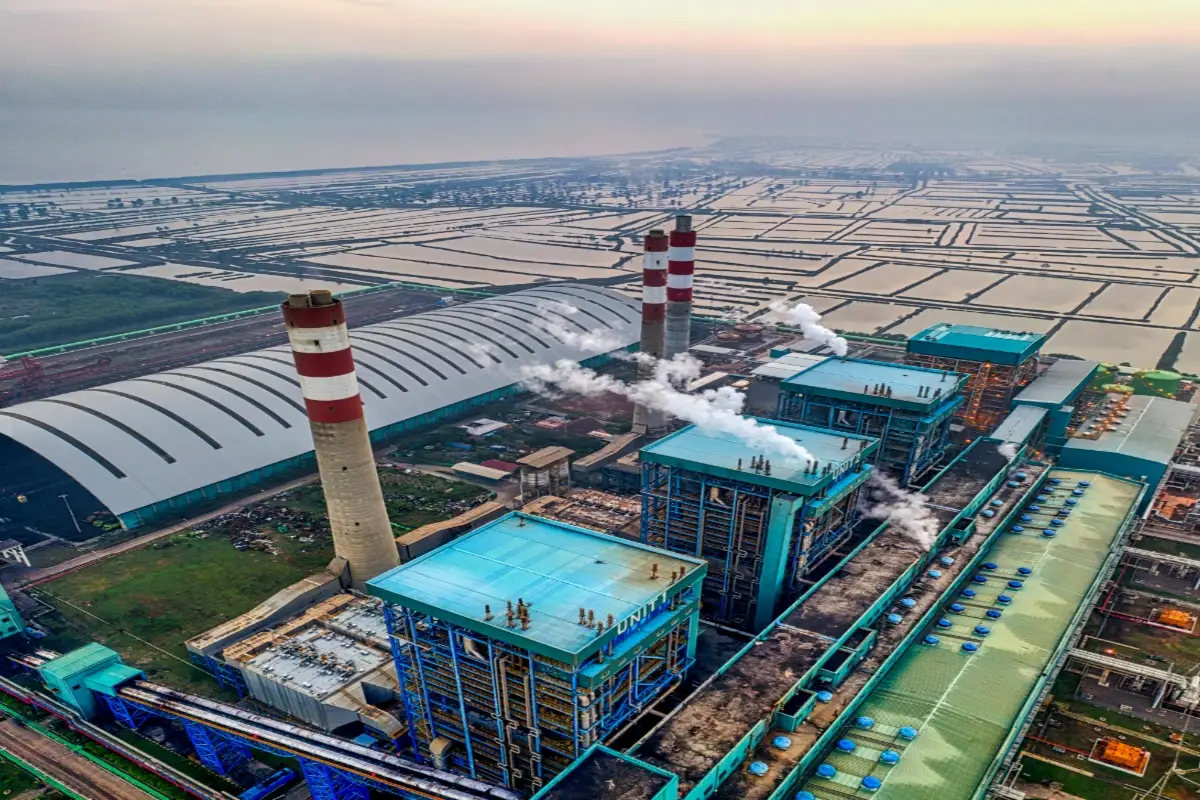
The joint venture between National Thermal Power Corporation (NTPC) and Bharat Heavy Electricals Limited (BHEL) to establish an 800 MW Advanced Ultra-Supercritical (AUSC) thermal power plant at Sipat in Bilaspur, Chhattisgarh represents a pivotal shift in India’s energy infrastructure. Developed through indigenous R&D involving BHEL, NTPC, and the Indira Gandhi Centre for Atomic Research (IGCAR), this technology drives plant thermal efficiency up to 46% while dramatically lowering carbon emissions per unit of electricity generated.
📌 Technical Snapshot: NTPC-BHEL 800 MW AUSC Project
- Location: Sipat Thermal Power Station (Stage III, Unit 6), Bilaspur, Chhattisgarh.
- Steam Parameters: 710°C Main Steam / 720°C Reheat Steam at 310 Bar pressure.
- Thermal Efficiency: 46% design efficiency (compared to 32% for subcritical units).
- Emission Reduction: Cuts specific coal consumption and CO2 emissions by 11% to 15%.
- Core Metallurgy: Deployment of Nickel-based Superalloys (Inconel 617, Haynes 230, Super 304H).
Thermodynamics: Sub-Critical vs. Supercritical vs. AUSC
Thermal power plant efficiency depends on the operating temperature and pressure of the main steam entering the turbine. Raising steam parameters allows the Rankine cycle to extract greater thermodynamic enthalpy per kilogram of steam burnt.
| Technology Classification | Main Steam Temperature | Main Steam Pressure | Average Thermal Efficiency | Coal Consumption per kWh |
|---|---|---|---|---|
| Sub-Critical | 538°C – 540°C | 170 – 180 Bar | 32% – 34% | ~0.65 kg/kWh |
| Supercritical (SC) | 565°C – 580°C | 242 Bar | 38% – 40% | ~0.54 kg/kWh |
| Ultra-Supercritical (USC) | 600°C – 620°C | 270 – 300 Bar | 41% – 42% | ~0.50 kg/kWh |
| Advanced Ultra-Supercritical (AUSC) | 710°C – 720°C | 310 Bar | 46% | ~0.42 kg/kWh |
Operating at 710°C–720°C enables the turbine to convert heat energy into electricity far more effectively. This reduces coal requirements by approximately 11% to 15% compared to supercritical units, lowering greenhouse gas emissions per megawatt-hour generated.
The Materials Breakthrough: Superalloys and Advanced Metallurgy
Standard power plant steels, such as P91, T92, or P92, lose mechanical strength and creep resistance above 620°C. Operating at 710°C steam temperatures required developing specialized nickel-based superalloys capable of surviving extreme thermal fatigue and oxidation.
The indigenous metallurgical breakthrough engineered by IGCAR, BHEL, and NTPC utilizes specific high-temperature alloys:
1. Inconel 617 / Haynes 230: High-nickel, solid-solution strengthened alloys used in superheater headers and main steam piping to resist creep rupture at 720°C.
2. Super 304H & TP347HFG: Fine-grained austenitic stainless steel tubing used in boiler coils to withstand fireside corrosion from high-ash Indian coal.
3. Forged Turbine Rotors: Specialized nickel-alloy rotor forgings designed to endure cyclic thermal stresses without micro-cracking during startup and load swings.
Manufacturing & Fabrication Standards: Hot-Wire GTAW Welding
Fabricating an AUSC boiler requires specialized workshop procedures. Standard manual metal arc welding cannot be used on nickel-base superalloys due to solidification cracking and strict heat-input limits.
BHEL’s Welding Research Institute (WRI) developed automated Hot-Wire Gas Tungsten Arc Welding (GTAW) protocols. Preheating the filler wire before entry into the weld pool ensures precise heat control, higher deposition rates, and defect-free joints across thick-walled superalloy pipes.
Quality inspection requires 100% Volumetric Non-Destructive Testing (NDT), including Phased Array Ultrasonic Testing (PAUT) and Time-of-Flight Diffraction (TOFD), ensuring total joint integrity under 310 Bar pressure.
Trainees preparing for high-precision workshop roles can review essential measurement practices in our guide on micrometer and vernier caliper calculations.
Industrial Skill Demand: Technical Scope for ITI & Diploma Trainees
Deploying advanced ultra-supercritical technology increases the demand for certified ITI pass-outs, diploma engineers, and skilled technicians across equipment manufacturing and plant maintenance.
🔧 Skill Upgrades Required for Power Sector Technicians
| Designated ITI / Diploma Trade | Conventional Duty | AUSC High-Tech Skill Requirement |
|---|---|---|
| Welder (GTAW / SMAW) | Carbon steel & basic alloy pipe jointing | Automatic Hot-Wire GTAW qualification for Inconel 617 & Super 304H |
| Fitter / Machinist | Standard pump valve overhaul | Precision alignment of high-pressure turbine casings & hydraulic controls |
| Instrument Mechanic | Analog transmitter calibration | Optical pyrometry, digital twin sensors & high-temp thermocouple loops |
Working around high-temperature steam lines mandates strict adherence to safety protocols. Review core safety procedures in our guide on occupational health and safety guidelines.
Sipat Plant Integration & Environmental Impact
The 800 MW AUSC unit is established as the Stage III expansion (Unit 6) of NTPC’s existing Sipat Thermal Power Station in Bilaspur, Chhattisgarh. Utilizing existing coal handling facilities fed by South Eastern Coalfields Limited (SECL) mines and water infrastructure from the Hasdeo River optimizes capital expenditure and project completion timelines.
Over its 35-year design life, operating an 800 MW AUSC unit prevents millions of tonnes of CO2 from entering the atmosphere compared to older sub-critical stations, providing a proven pathway toward cleaner coal power generation.
Technicians seeking employment opportunities across public sector power enterprises can explore active vacancy drives in our DRDO Technical Recruitment Guide and HAL Industrial Training Guide.
Frequently Asked Questions (FAQs)
What is the capacity of the NTPC-BHEL AUSC plant?
The commercial demonstration plant features a unit capacity of 800 MW, located at NTPC Sipat in Bilaspur, Chhattisgarh.
How does AUSC technology lower carbon emissions?
By achieving 46% thermal efficiency, the plant burns less coal per kilowatt-hour of electricity generated, resulting in an 11% to 15% reduction in specific CO2 emissions.
Which institutes developed the indigenous AUSC technology?
The technology was indigenously developed through a joint R&D initiative between BHEL, NTPC, and the Indira Gandhi Centre for Atomic Research (IGCAR).
To explore technical study resources, trade theory guides, and the latest PSU job updates, visit the Info-ITI Homepage.