
When I first started working with precision measurement tools in the engineering workshop, I noticed many trainees struggling with a very specific problem: calculating diagonal distances on sheet metal or finding AC electrical impedance. Almost every time, the math trace led back to one fundamental concept: square roots.
In Workshop Calculation & Science (WCS), square roots are not just abstract math problems printed in textbooks. They are daily practical tools used by fitters, electricians, turners, and machinists. Let’s strip away the unnecessary academic jargon and look at how square roots actually work, how to calculate them manually, and where you will use them on the shop floor.
Table of Contents
What Exactly Is a Square Root?
At its simplest, finding the square root of a number is the exact opposite of squaring a number.
If you multiply a number by itself, you get its square:
5 × 5 = 25
The square root asks the reverse question: “What number multiplied by itself gives 25?”
√25 = 5
The radical symbol (√) represents this operation. The number placed inside the radical is called the radicand.
Key Properties You Must Know for Exams & Workshop Tasks
To avoid basic calculation mistakes during NCVT CBT exams or trade tests, keep these four core rules in mind:
- Non-Negative Values: In standard engineering calculations, the square root of a positive real number is always treated as positive (known as the principal square root).
- Multiplication Property: You can split or combine square roots under multiplication:
√(a × b) = √a × √b
Example:√(36 × 4) = √36 × √4 = 6 × 2 = 12 - Division Property: Similarly, division inside a radical can be separated:
√(a / b) = √a / √b - Square of a Radical: Squaring a square root cancels out the radical sign completely:
(√x)² = x
How to Calculate Square Roots Manually (Step-by-Step)
While digital calculators are common, trade exams often test your ability to solve square roots manually. Here are the two most reliable methods every technical student should master.
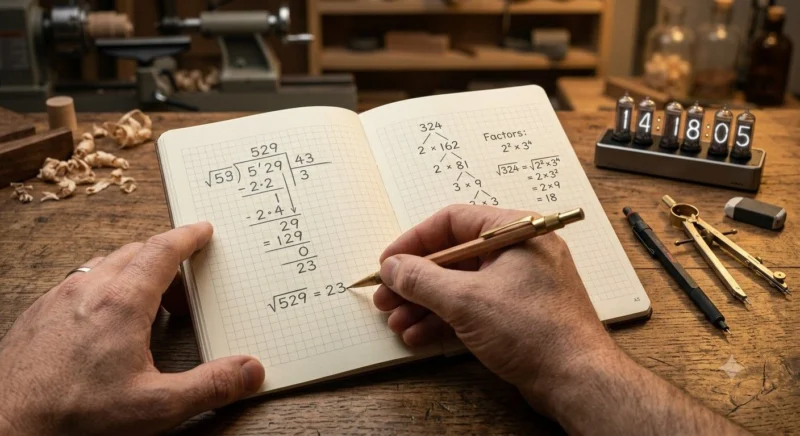
Method 1: Prime Factorization (Best for Perfect Squares)
This method works smoothly when dealing with whole numbers that form perfect squares.
Example: Find √324
- Break down 324 into prime factors:
324 = 2 × 2 × 3 × 3 × 3 × 3 - Group the identical prime factors into pairs:
(2 × 2) × (3 × 3) × (3 × 3) - Take one number from each pair and multiply them together:
√324 = 2 × 3 × 3 = 18
Method 2: Long Division Method (Best for Decimals & Non-Perfect Squares)
In real workshop jobs, measurements rarely come out as neat whole numbers. The long division method allows you to calculate roots for decimals like 2.25 or non-perfect squares like 2 or 5 accurately up to two or three decimal places.
Example: Find √529
- Group the digits into pairs starting from the right (unit digit): 5, 29.
- Find the largest single digit whose square is less than or equal to 5. That number is 2 (2 × 2 = 4).
- Subtract 4 from 5 (remainder = 1), and bring down the next pair (29) to make 129.
- Double your current quotient (2 × 2 = 4) to form the starting digit of your next divisor (4_).
- Find a digit to fill the blank such that (4_ × digit) ≤ 129. Here, 43 × 3 = 129.
- Subtract 129 from 129 (remainder = 0). Your final answer is 23.
Practical Industrial & Workshop Applications
Why do we teach square roots in technical training? Here are three real-world job scenarios where square root equations are mandatory:
1. Layout Marking & Sheet Metal Fabrication (Pythagoras Theorem)
When verifying whether a rectangular sheet or frame is perfectly square (90°), craftsmen measure the diagonal length using the Pythagorean formula:
c = √(a² + b²)
If a metal frame has a length of 4 meters and a width of 3 meters, the diagonal length must equal exactly:√(4² + 3²) = √(16 + 9) = √25 = 5 meters
2. Electrical Trade: AC Circuit Impedance

Electricians working on Alternating Current (AC) circuits calculate total opposition to current flow (Impedance, Z) using resistance (R) and inductive reactance (XL):
Z = √(R² + XL²)
Without square roots, sizing circuit breakers, transformers, and industrial wiring accurately is impossible.
3. Mechanical Engineering: Cutting Speed & Area Calculations
When calculating stress-strain tolerances or determining shaft diameters from cross-sectional areas, reverse-calculating the diameter requires taking the square root of the area value:
D = √[(4 × Area) / π]
Common Mistakes Students Make (And How to Fix Them)
- Confusing Squaring with Square Roots: Students often write √9 = 81 instead of 3. Always double-check your answer by multiplying it by itself (3 × 3 = 9).
- Ignoring Decimal Point Pairs: When performing long division on decimal numbers, always pair digits starting from the decimal point, moving left for whole numbers and moving right for decimal parts.
- Trying to Split Addition Under Radicals: Remember that
√(a² + b²) ≠ a + b. You must square the numbers first, add them, and then take the square root.
Square Roots in Workshop Calculation and Science (FAQs)
Q1: What is the square root of a negative number in workshop calculation?
In standard workshop calculation and engineering trade tests, we only deal with real numbers. The square root of a negative number leads to imaginary numbers (i), which are not used in practical shop floor measurement tasks.
Q2: Which method is best for NCVT CBT exams, Prime Factorization or Long Division?
Prime Factorization is fastest for small whole numbers (like 144, 256, 625). However, Long Division is essential for solving decimal numbers and practical values like √2, √3, or √5 in exam questions.
Q3: How do I calculate square roots without a calculator during trade practical tests?
Memorize perfect square roots from 1 to 25 (e.g., 12² = 144, 15² = 225, 25² = 625) and practice the long division method for non-perfect square decimals.
Conclusion
Square roots are foundational tools in Workshop Calculation & Science. Mastering prime factorization for quick mental math and long division for precise decimal calculations will give you a major advantage during technical trade tests, NCVT CBT exams, and daily shop floor operations. When you understand the logic behind the math, precision work becomes much simpler.
Need more practice material for your upcoming NCVT exams? Explore our dedicated Workshop Calculation & Science Practice Tests on Info ITI and boost your score today!