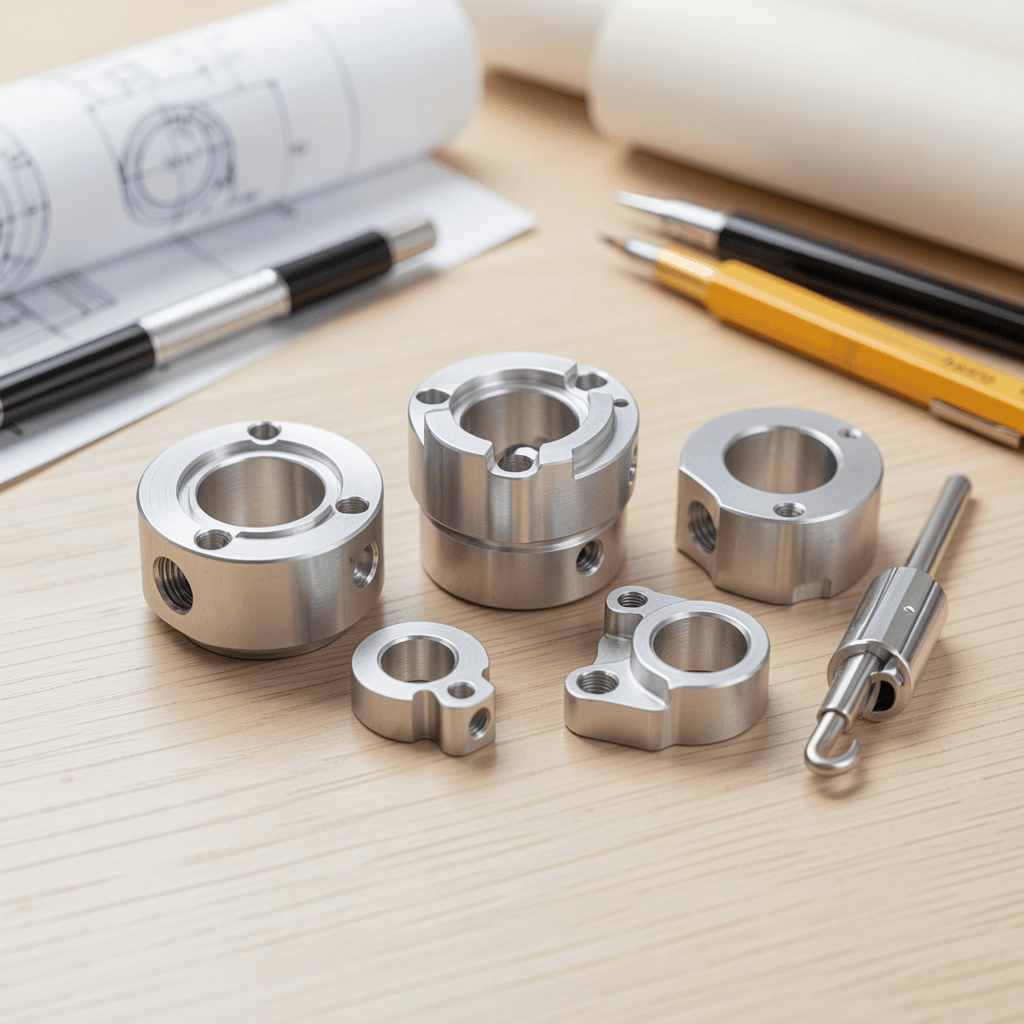
A precision defense supplier experienced structural weight penalties when using traditional steel mounting brackets, restricting payload capacities in drone airframes.
By redesigning structural brackets using CNC-machined 7075-T6 aluminum, component weight dropped by 64 percent while maintaining a yield strength above 500 MPa, expanding drone flight range by 22 percent.
Preparing for ITI Exams, Apprentice Tests & Industrial Recruitment?
Access NIMI-aligned trade theory notes, Workshop Calculation solutions, and official Railway, PSU, and ITI job notifications directly on our portal.
Explore ITI Jobs & Career PortalFrequently Asked Questions
Is aluminium a ferrous metal?
No, aluminum is strictly a non-ferrous metal because it contains zero iron in its elemental state and is completely non-magnetic.
Hindalium is an alloy of which metals?
Hindalium is an alloy composed primarily of Aluminum (Al), Copper (Cu), Magnesium (Mg), Manganese (Mn), and Silicon (Si).
What is the composition of Duralumin?
Duralumin consists of roughly 94% Aluminum, 4% Copper, 0.5% Magnesium, and 0.5% Manganese.
Have questions about heat-treating aluminum tempers or selecting alloys for your workshop project? Share your queries in the comments below!
Aluminum sheet and plate product specifications comply with global ASTM B209-21a standards. Extruded profile tolerances align with ISO 6361 requirements published by the International Organization for Standardization (ISO).
Aerospace Structural Bracket Transformation Case Study
A precision defense supplier experienced structural weight penalties when using traditional steel mounting brackets, restricting payload capacities in drone airframes.
By redesigning structural brackets using CNC-machined 7075-T6 aluminum, component weight dropped by 64 percent while maintaining a yield strength above 500 MPa, expanding drone flight range by 22 percent.
Preparing for ITI Exams, Apprentice Tests & Industrial Recruitment?
Access NIMI-aligned trade theory notes, Workshop Calculation solutions, and official Railway, PSU, and ITI job notifications directly on our portal.
Explore ITI Jobs & Career PortalFrequently Asked Questions
Is aluminium a ferrous metal?
No, aluminum is strictly a non-ferrous metal because it contains zero iron in its elemental state and is completely non-magnetic.
Hindalium is an alloy of which metals?
Hindalium is an alloy composed primarily of Aluminum (Al), Copper (Cu), Magnesium (Mg), Manganese (Mn), and Silicon (Si).
What is the composition of Duralumin?
Duralumin consists of roughly 94% Aluminum, 4% Copper, 0.5% Magnesium, and 0.5% Manganese.
Have questions about heat-treating aluminum tempers or selecting alloys for your workshop project? Share your queries in the comments below!
Diagnose aluminum machining faults systematically on the shop floor:
| Symptom | Root Cause | Corrective Action |
|---|---|---|
| Built-Up Edge (BUE) on Tool Tip | Low cutting speed and insufficient top rake angle | Increase RPM and use polished carbide inserts with mist coolant |
| Long Unbroken Stringy Chips | Lack of chip breaker groove on high-ductility alloy | Use inserts with aggressive chip-breaker geometries |
| Surface Corrosion White Powder | Moisture entrapment inside unventilated storage stacks | Store sheets vertically in dry, temperature-controlled bays |
International ASTM B209-21a & ISO 6361 Standards
Aluminum sheet and plate product specifications comply with global ASTM B209-21a standards. Extruded profile tolerances align with ISO 6361 requirements published by the International Organization for Standardization (ISO).
Aerospace Structural Bracket Transformation Case Study
A precision defense supplier experienced structural weight penalties when using traditional steel mounting brackets, restricting payload capacities in drone airframes.
By redesigning structural brackets using CNC-machined 7075-T6 aluminum, component weight dropped by 64 percent while maintaining a yield strength above 500 MPa, expanding drone flight range by 22 percent.
Preparing for ITI Exams, Apprentice Tests & Industrial Recruitment?
Access NIMI-aligned trade theory notes, Workshop Calculation solutions, and official Railway, PSU, and ITI job notifications directly on our portal.
Explore ITI Jobs & Career PortalFrequently Asked Questions
Is aluminium a ferrous metal?
No, aluminum is strictly a non-ferrous metal because it contains zero iron in its elemental state and is completely non-magnetic.
Hindalium is an alloy of which metals?
Hindalium is an alloy composed primarily of Aluminum (Al), Copper (Cu), Magnesium (Mg), Manganese (Mn), and Silicon (Si).
What is the composition of Duralumin?
Duralumin consists of roughly 94% Aluminum, 4% Copper, 0.5% Magnesium, and 0.5% Manganese.
Have questions about heat-treating aluminum tempers or selecting alloys for your workshop project? Share your queries in the comments below!
Calculating material weight is a core topic in ITI Workshop Calculation and Science exams. Access practice sets in our workshop calculation hub.
Mass = Volume x Density
🧮 Practical Weight Calculation Example:
Aluminum Plate Dimensions = 100 cm x 50 cm x 2 cm (Volume = 10,000 cm^3)
Aluminum Density = 2.70 g/cm^3
Mass = 10,000 cm^3 x 2.70 g/cm^3 = 27,000 grams = 27 Kilograms
Shop Floor Machining & Surface Defect Diagnostics
Diagnose aluminum machining faults systematically on the shop floor:
| Symptom | Root Cause | Corrective Action |
|---|---|---|
| Built-Up Edge (BUE) on Tool Tip | Low cutting speed and insufficient top rake angle | Increase RPM and use polished carbide inserts with mist coolant |
| Long Unbroken Stringy Chips | Lack of chip breaker groove on high-ductility alloy | Use inserts with aggressive chip-breaker geometries |
| Surface Corrosion White Powder | Moisture entrapment inside unventilated storage stacks | Store sheets vertically in dry, temperature-controlled bays |
International ASTM B209-21a & ISO 6361 Standards
Aluminum sheet and plate product specifications comply with global ASTM B209-21a standards. Extruded profile tolerances align with ISO 6361 requirements published by the International Organization for Standardization (ISO).
Aerospace Structural Bracket Transformation Case Study
A precision defense supplier experienced structural weight penalties when using traditional steel mounting brackets, restricting payload capacities in drone airframes.
By redesigning structural brackets using CNC-machined 7075-T6 aluminum, component weight dropped by 64 percent while maintaining a yield strength above 500 MPa, expanding drone flight range by 22 percent.
Preparing for ITI Exams, Apprentice Tests & Industrial Recruitment?
Access NIMI-aligned trade theory notes, Workshop Calculation solutions, and official Railway, PSU, and ITI job notifications directly on our portal.
Explore ITI Jobs & Career PortalFrequently Asked Questions
Is aluminium a ferrous metal?
No, aluminum is strictly a non-ferrous metal because it contains zero iron in its elemental state and is completely non-magnetic.
Hindalium is an alloy of which metals?
Hindalium is an alloy composed primarily of Aluminum (Al), Copper (Cu), Magnesium (Mg), Manganese (Mn), and Silicon (Si).
What is the composition of Duralumin?
Duralumin consists of roughly 94% Aluminum, 4% Copper, 0.5% Magnesium, and 0.5% Manganese.
Have questions about heat-treating aluminum tempers or selecting alloys for your workshop project? Share your queries in the comments below!
Calculating material weight is a core topic in ITI Workshop Calculation and Science exams. Access practice sets in our workshop calculation hub.
Mass = Volume x Density
🧮 Practical Weight Calculation Example:
Aluminum Plate Dimensions = 100 cm x 50 cm x 2 cm (Volume = 10,000 cm^3)
Aluminum Density = 2.70 g/cm^3
Mass = 10,000 cm^3 x 2.70 g/cm^3 = 27,000 grams = 27 Kilograms
Shop Floor Machining & Surface Defect Diagnostics
Diagnose aluminum machining faults systematically on the shop floor:
| Symptom | Root Cause | Corrective Action |
|---|---|---|
| Built-Up Edge (BUE) on Tool Tip | Low cutting speed and insufficient top rake angle | Increase RPM and use polished carbide inserts with mist coolant |
| Long Unbroken Stringy Chips | Lack of chip breaker groove on high-ductility alloy | Use inserts with aggressive chip-breaker geometries |
| Surface Corrosion White Powder | Moisture entrapment inside unventilated storage stacks | Store sheets vertically in dry, temperature-controlled bays |
International ASTM B209-21a & ISO 6361 Standards
Aluminum sheet and plate product specifications comply with global ASTM B209-21a standards. Extruded profile tolerances align with ISO 6361 requirements published by the International Organization for Standardization (ISO).
Aerospace Structural Bracket Transformation Case Study
A precision defense supplier experienced structural weight penalties when using traditional steel mounting brackets, restricting payload capacities in drone airframes.
By redesigning structural brackets using CNC-machined 7075-T6 aluminum, component weight dropped by 64 percent while maintaining a yield strength above 500 MPa, expanding drone flight range by 22 percent.
Preparing for ITI Exams, Apprentice Tests & Industrial Recruitment?
Access NIMI-aligned trade theory notes, Workshop Calculation solutions, and official Railway, PSU, and ITI job notifications directly on our portal.
Explore ITI Jobs & Career PortalFrequently Asked Questions
Is aluminium a ferrous metal?
No, aluminum is strictly a non-ferrous metal because it contains zero iron in its elemental state and is completely non-magnetic.
Hindalium is an alloy of which metals?
Hindalium is an alloy composed primarily of Aluminum (Al), Copper (Cu), Magnesium (Mg), Manganese (Mn), and Silicon (Si).
What is the composition of Duralumin?
Duralumin consists of roughly 94% Aluminum, 4% Copper, 0.5% Magnesium, and 0.5% Manganese.
Have questions about heat-treating aluminum tempers or selecting alloys for your workshop project? Share your queries in the comments below!
1. Machining Aluminum Dry Without Coolant: Dry turning causes chips to weld directly onto tool cutting edges, producing poor surface finishes. Solution: Apply soluble oil coolant or alcohol mist continuously.
2. Using High Clamping Force on Thin Tubes: Clamping thin aluminum tubing tightly inside lathe chuck jaws distorts roundness permanently. Solution: Use pie-shaped soft jaw caps or internal expansion arbors.
Workshop Math: Density & Component Weight Calculations
Calculating material weight is a core topic in ITI Workshop Calculation and Science exams. Access practice sets in our workshop calculation hub.
Mass = Volume x Density
🧮 Practical Weight Calculation Example:
Aluminum Plate Dimensions = 100 cm x 50 cm x 2 cm (Volume = 10,000 cm^3)
Aluminum Density = 2.70 g/cm^3
Mass = 10,000 cm^3 x 2.70 g/cm^3 = 27,000 grams = 27 Kilograms
Shop Floor Machining & Surface Defect Diagnostics
Diagnose aluminum machining faults systematically on the shop floor:
| Symptom | Root Cause | Corrective Action |
|---|---|---|
| Built-Up Edge (BUE) on Tool Tip | Low cutting speed and insufficient top rake angle | Increase RPM and use polished carbide inserts with mist coolant |
| Long Unbroken Stringy Chips | Lack of chip breaker groove on high-ductility alloy | Use inserts with aggressive chip-breaker geometries |
| Surface Corrosion White Powder | Moisture entrapment inside unventilated storage stacks | Store sheets vertically in dry, temperature-controlled bays |
International ASTM B209-21a & ISO 6361 Standards
Aluminum sheet and plate product specifications comply with global ASTM B209-21a standards. Extruded profile tolerances align with ISO 6361 requirements published by the International Organization for Standardization (ISO).
Aerospace Structural Bracket Transformation Case Study
A precision defense supplier experienced structural weight penalties when using traditional steel mounting brackets, restricting payload capacities in drone airframes.
By redesigning structural brackets using CNC-machined 7075-T6 aluminum, component weight dropped by 64 percent while maintaining a yield strength above 500 MPa, expanding drone flight range by 22 percent.
Preparing for ITI Exams, Apprentice Tests & Industrial Recruitment?
Access NIMI-aligned trade theory notes, Workshop Calculation solutions, and official Railway, PSU, and ITI job notifications directly on our portal.
Explore ITI Jobs & Career PortalFrequently Asked Questions
Is aluminium a ferrous metal?
No, aluminum is strictly a non-ferrous metal because it contains zero iron in its elemental state and is completely non-magnetic.
Hindalium is an alloy of which metals?
Hindalium is an alloy composed primarily of Aluminum (Al), Copper (Cu), Magnesium (Mg), Manganese (Mn), and Silicon (Si).
What is the composition of Duralumin?
Duralumin consists of roughly 94% Aluminum, 4% Copper, 0.5% Magnesium, and 0.5% Manganese.
Have questions about heat-treating aluminum tempers or selecting alloys for your workshop project? Share your queries in the comments below!
Avoid these widespread workshop turning mistakes when machining soft non-ferrous metals:
1. Machining Aluminum Dry Without Coolant: Dry turning causes chips to weld directly onto tool cutting edges, producing poor surface finishes. Solution: Apply soluble oil coolant or alcohol mist continuously.
2. Using High Clamping Force on Thin Tubes: Clamping thin aluminum tubing tightly inside lathe chuck jaws distorts roundness permanently. Solution: Use pie-shaped soft jaw caps or internal expansion arbors.
Workshop Math: Density & Component Weight Calculations
Calculating material weight is a core topic in ITI Workshop Calculation and Science exams. Access practice sets in our workshop calculation hub.
Mass = Volume x Density
🧮 Practical Weight Calculation Example:
Aluminum Plate Dimensions = 100 cm x 50 cm x 2 cm (Volume = 10,000 cm^3)
Aluminum Density = 2.70 g/cm^3
Mass = 10,000 cm^3 x 2.70 g/cm^3 = 27,000 grams = 27 Kilograms
Shop Floor Machining & Surface Defect Diagnostics
Diagnose aluminum machining faults systematically on the shop floor:
| Symptom | Root Cause | Corrective Action |
|---|---|---|
| Built-Up Edge (BUE) on Tool Tip | Low cutting speed and insufficient top rake angle | Increase RPM and use polished carbide inserts with mist coolant |
| Long Unbroken Stringy Chips | Lack of chip breaker groove on high-ductility alloy | Use inserts with aggressive chip-breaker geometries |
| Surface Corrosion White Powder | Moisture entrapment inside unventilated storage stacks | Store sheets vertically in dry, temperature-controlled bays |
International ASTM B209-21a & ISO 6361 Standards
Aluminum sheet and plate product specifications comply with global ASTM B209-21a standards. Extruded profile tolerances align with ISO 6361 requirements published by the International Organization for Standardization (ISO).
Aerospace Structural Bracket Transformation Case Study
A precision defense supplier experienced structural weight penalties when using traditional steel mounting brackets, restricting payload capacities in drone airframes.
By redesigning structural brackets using CNC-machined 7075-T6 aluminum, component weight dropped by 64 percent while maintaining a yield strength above 500 MPa, expanding drone flight range by 22 percent.
Preparing for ITI Exams, Apprentice Tests & Industrial Recruitment?
Access NIMI-aligned trade theory notes, Workshop Calculation solutions, and official Railway, PSU, and ITI job notifications directly on our portal.
Explore ITI Jobs & Career PortalFrequently Asked Questions
Is aluminium a ferrous metal?
No, aluminum is strictly a non-ferrous metal because it contains zero iron in its elemental state and is completely non-magnetic.
Hindalium is an alloy of which metals?
Hindalium is an alloy composed primarily of Aluminum (Al), Copper (Cu), Magnesium (Mg), Manganese (Mn), and Silicon (Si).
What is the composition of Duralumin?
Duralumin consists of roughly 94% Aluminum, 4% Copper, 0.5% Magnesium, and 0.5% Manganese.
Have questions about heat-treating aluminum tempers or selecting alloys for your workshop project? Share your queries in the comments below!
Avoid these widespread workshop turning mistakes when machining soft non-ferrous metals:
1. Machining Aluminum Dry Without Coolant: Dry turning causes chips to weld directly onto tool cutting edges, producing poor surface finishes. Solution: Apply soluble oil coolant or alcohol mist continuously.
2. Using High Clamping Force on Thin Tubes: Clamping thin aluminum tubing tightly inside lathe chuck jaws distorts roundness permanently. Solution: Use pie-shaped soft jaw caps or internal expansion arbors.
Workshop Math: Density & Component Weight Calculations
Calculating material weight is a core topic in ITI Workshop Calculation and Science exams. Access practice sets in our workshop calculation hub.
Mass = Volume x Density
🧮 Practical Weight Calculation Example:
Aluminum Plate Dimensions = 100 cm x 50 cm x 2 cm (Volume = 10,000 cm^3)
Aluminum Density = 2.70 g/cm^3
Mass = 10,000 cm^3 x 2.70 g/cm^3 = 27,000 grams = 27 Kilograms
Shop Floor Machining & Surface Defect Diagnostics
Diagnose aluminum machining faults systematically on the shop floor:
| Symptom | Root Cause | Corrective Action |
|---|---|---|
| Built-Up Edge (BUE) on Tool Tip | Low cutting speed and insufficient top rake angle | Increase RPM and use polished carbide inserts with mist coolant |
| Long Unbroken Stringy Chips | Lack of chip breaker groove on high-ductility alloy | Use inserts with aggressive chip-breaker geometries |
| Surface Corrosion White Powder | Moisture entrapment inside unventilated storage stacks | Store sheets vertically in dry, temperature-controlled bays |
International ASTM B209-21a & ISO 6361 Standards
Aluminum sheet and plate product specifications comply with global ASTM B209-21a standards. Extruded profile tolerances align with ISO 6361 requirements published by the International Organization for Standardization (ISO).
Aerospace Structural Bracket Transformation Case Study
A precision defense supplier experienced structural weight penalties when using traditional steel mounting brackets, restricting payload capacities in drone airframes.
By redesigning structural brackets using CNC-machined 7075-T6 aluminum, component weight dropped by 64 percent while maintaining a yield strength above 500 MPa, expanding drone flight range by 22 percent.
Preparing for ITI Exams, Apprentice Tests & Industrial Recruitment?
Access NIMI-aligned trade theory notes, Workshop Calculation solutions, and official Railway, PSU, and ITI job notifications directly on our portal.
Explore ITI Jobs & Career PortalFrequently Asked Questions
Is aluminium a ferrous metal?
No, aluminum is strictly a non-ferrous metal because it contains zero iron in its elemental state and is completely non-magnetic.
Hindalium is an alloy of which metals?
Hindalium is an alloy composed primarily of Aluminum (Al), Copper (Cu), Magnesium (Mg), Manganese (Mn), and Silicon (Si).
What is the composition of Duralumin?
Duralumin consists of roughly 94% Aluminum, 4% Copper, 0.5% Magnesium, and 0.5% Manganese.
Have questions about heat-treating aluminum tempers or selecting alloys for your workshop project? Share your queries in the comments below!
Evaluate key technical advantages and operational limits when selecting manufacturing processes:
| Category | Key Advantages | Key Limitations |
|---|---|---|
| Wrought Alloys (Rolling / Extrusion) | High mechanical fatigue strength and ductility. | Higher machinery tooling equipment costs. |
| Cast Alloys (Sand / Die Casting) | Forms complex internal cooling channels easily. | Prone to internal gas porosity defects. |
Common Machining Errors & Practical Solutions
Avoid these widespread workshop turning mistakes when machining soft non-ferrous metals:
1. Machining Aluminum Dry Without Coolant: Dry turning causes chips to weld directly onto tool cutting edges, producing poor surface finishes. Solution: Apply soluble oil coolant or alcohol mist continuously.
2. Using High Clamping Force on Thin Tubes: Clamping thin aluminum tubing tightly inside lathe chuck jaws distorts roundness permanently. Solution: Use pie-shaped soft jaw caps or internal expansion arbors.
Workshop Math: Density & Component Weight Calculations
Calculating material weight is a core topic in ITI Workshop Calculation and Science exams. Access practice sets in our workshop calculation hub.
Mass = Volume x Density
🧮 Practical Weight Calculation Example:
Aluminum Plate Dimensions = 100 cm x 50 cm x 2 cm (Volume = 10,000 cm^3)
Aluminum Density = 2.70 g/cm^3
Mass = 10,000 cm^3 x 2.70 g/cm^3 = 27,000 grams = 27 Kilograms
Shop Floor Machining & Surface Defect Diagnostics
Diagnose aluminum machining faults systematically on the shop floor:
| Symptom | Root Cause | Corrective Action |
|---|---|---|
| Built-Up Edge (BUE) on Tool Tip | Low cutting speed and insufficient top rake angle | Increase RPM and use polished carbide inserts with mist coolant |
| Long Unbroken Stringy Chips | Lack of chip breaker groove on high-ductility alloy | Use inserts with aggressive chip-breaker geometries |
| Surface Corrosion White Powder | Moisture entrapment inside unventilated storage stacks | Store sheets vertically in dry, temperature-controlled bays |
International ASTM B209-21a & ISO 6361 Standards
Aluminum sheet and plate product specifications comply with global ASTM B209-21a standards. Extruded profile tolerances align with ISO 6361 requirements published by the International Organization for Standardization (ISO).
Aerospace Structural Bracket Transformation Case Study
A precision defense supplier experienced structural weight penalties when using traditional steel mounting brackets, restricting payload capacities in drone airframes.
By redesigning structural brackets using CNC-machined 7075-T6 aluminum, component weight dropped by 64 percent while maintaining a yield strength above 500 MPa, expanding drone flight range by 22 percent.
Preparing for ITI Exams, Apprentice Tests & Industrial Recruitment?
Access NIMI-aligned trade theory notes, Workshop Calculation solutions, and official Railway, PSU, and ITI job notifications directly on our portal.
Explore ITI Jobs & Career PortalFrequently Asked Questions
Is aluminium a ferrous metal?
No, aluminum is strictly a non-ferrous metal because it contains zero iron in its elemental state and is completely non-magnetic.
Hindalium is an alloy of which metals?
Hindalium is an alloy composed primarily of Aluminum (Al), Copper (Cu), Magnesium (Mg), Manganese (Mn), and Silicon (Si).
What is the composition of Duralumin?
Duralumin consists of roughly 94% Aluminum, 4% Copper, 0.5% Magnesium, and 0.5% Manganese.
Have questions about heat-treating aluminum tempers or selecting alloys for your workshop project? Share your queries in the comments below!
Select the optimal alloy grade based on specific structural requirements:
| Industrial Requirement | Best Recommended Alloy | Temper Designation | Target Benefit |
|---|---|---|---|
| Saltwater Marine Boat Hulls | 5083 Aluminum-Magnesium | H116 / H321 | Exfoliation corrosion resistance |
| Aerospace High Stress Structures | 7075 Aluminum-Zinc | T6 / T651 | Ultra-high yield strength (>500 MPa) |
| Architectural Window Extrusions | 6063 Aluminum-Mg-Si | T5 / T6 | Smooth surface finish & anodizing |
Pros and Cons of Wrought vs. Cast Aluminum Alloys
Evaluate key technical advantages and operational limits when selecting manufacturing processes:
| Category | Key Advantages | Key Limitations |
|---|---|---|
| Wrought Alloys (Rolling / Extrusion) | High mechanical fatigue strength and ductility. | Higher machinery tooling equipment costs. |
| Cast Alloys (Sand / Die Casting) | Forms complex internal cooling channels easily. | Prone to internal gas porosity defects. |
Common Machining Errors & Practical Solutions
Avoid these widespread workshop turning mistakes when machining soft non-ferrous metals:
1. Machining Aluminum Dry Without Coolant: Dry turning causes chips to weld directly onto tool cutting edges, producing poor surface finishes. Solution: Apply soluble oil coolant or alcohol mist continuously.
2. Using High Clamping Force on Thin Tubes: Clamping thin aluminum tubing tightly inside lathe chuck jaws distorts roundness permanently. Solution: Use pie-shaped soft jaw caps or internal expansion arbors.
Workshop Math: Density & Component Weight Calculations
Calculating material weight is a core topic in ITI Workshop Calculation and Science exams. Access practice sets in our workshop calculation hub.
Mass = Volume x Density
🧮 Practical Weight Calculation Example:
Aluminum Plate Dimensions = 100 cm x 50 cm x 2 cm (Volume = 10,000 cm^3)
Aluminum Density = 2.70 g/cm^3
Mass = 10,000 cm^3 x 2.70 g/cm^3 = 27,000 grams = 27 Kilograms
Shop Floor Machining & Surface Defect Diagnostics
Diagnose aluminum machining faults systematically on the shop floor:
| Symptom | Root Cause | Corrective Action |
|---|---|---|
| Built-Up Edge (BUE) on Tool Tip | Low cutting speed and insufficient top rake angle | Increase RPM and use polished carbide inserts with mist coolant |
| Long Unbroken Stringy Chips | Lack of chip breaker groove on high-ductility alloy | Use inserts with aggressive chip-breaker geometries |
| Surface Corrosion White Powder | Moisture entrapment inside unventilated storage stacks | Store sheets vertically in dry, temperature-controlled bays |
International ASTM B209-21a & ISO 6361 Standards
Aluminum sheet and plate product specifications comply with global ASTM B209-21a standards. Extruded profile tolerances align with ISO 6361 requirements published by the International Organization for Standardization (ISO).
Aerospace Structural Bracket Transformation Case Study
A precision defense supplier experienced structural weight penalties when using traditional steel mounting brackets, restricting payload capacities in drone airframes.
By redesigning structural brackets using CNC-machined 7075-T6 aluminum, component weight dropped by 64 percent while maintaining a yield strength above 500 MPa, expanding drone flight range by 22 percent.
Preparing for ITI Exams, Apprentice Tests & Industrial Recruitment?
Access NIMI-aligned trade theory notes, Workshop Calculation solutions, and official Railway, PSU, and ITI job notifications directly on our portal.
Explore ITI Jobs & Career PortalFrequently Asked Questions
Is aluminium a ferrous metal?
No, aluminum is strictly a non-ferrous metal because it contains zero iron in its elemental state and is completely non-magnetic.
Hindalium is an alloy of which metals?
Hindalium is an alloy composed primarily of Aluminum (Al), Copper (Cu), Magnesium (Mg), Manganese (Mn), and Silicon (Si).
What is the composition of Duralumin?
Duralumin consists of roughly 94% Aluminum, 4% Copper, 0.5% Magnesium, and 0.5% Manganese.
Have questions about heat-treating aluminum tempers or selecting alloys for your workshop project? Share your queries in the comments below!
Fine aluminum dust generated during dry grinding or belt sanding represents an extreme explosive hazard. Airborne aluminum particles ignite rapidly when exposed to static sparks, creating high-pressure dust explosions.
Always operate wet-dust collection systems when grinding aluminum parts. Review core workshop safety guidelines in our occupational health and safety rules. Consult official OSHA Combustible Dust Guidelines for safety standards.
Material Selection Guide for Manufacturing Bottlenecks
Select the optimal alloy grade based on specific structural requirements:
| Industrial Requirement | Best Recommended Alloy | Temper Designation | Target Benefit |
|---|---|---|---|
| Saltwater Marine Boat Hulls | 5083 Aluminum-Magnesium | H116 / H321 | Exfoliation corrosion resistance |
| Aerospace High Stress Structures | 7075 Aluminum-Zinc | T6 / T651 | Ultra-high yield strength (>500 MPa) |
| Architectural Window Extrusions | 6063 Aluminum-Mg-Si | T5 / T6 | Smooth surface finish & anodizing |
Pros and Cons of Wrought vs. Cast Aluminum Alloys
Evaluate key technical advantages and operational limits when selecting manufacturing processes:
| Category | Key Advantages | Key Limitations |
|---|---|---|
| Wrought Alloys (Rolling / Extrusion) | High mechanical fatigue strength and ductility. | Higher machinery tooling equipment costs. |
| Cast Alloys (Sand / Die Casting) | Forms complex internal cooling channels easily. | Prone to internal gas porosity defects. |
Common Machining Errors & Practical Solutions
Avoid these widespread workshop turning mistakes when machining soft non-ferrous metals:
1. Machining Aluminum Dry Without Coolant: Dry turning causes chips to weld directly onto tool cutting edges, producing poor surface finishes. Solution: Apply soluble oil coolant or alcohol mist continuously.
2. Using High Clamping Force on Thin Tubes: Clamping thin aluminum tubing tightly inside lathe chuck jaws distorts roundness permanently. Solution: Use pie-shaped soft jaw caps or internal expansion arbors.
Workshop Math: Density & Component Weight Calculations
Calculating material weight is a core topic in ITI Workshop Calculation and Science exams. Access practice sets in our workshop calculation hub.
Mass = Volume x Density
🧮 Practical Weight Calculation Example:
Aluminum Plate Dimensions = 100 cm x 50 cm x 2 cm (Volume = 10,000 cm^3)
Aluminum Density = 2.70 g/cm^3
Mass = 10,000 cm^3 x 2.70 g/cm^3 = 27,000 grams = 27 Kilograms
Shop Floor Machining & Surface Defect Diagnostics
Diagnose aluminum machining faults systematically on the shop floor:
| Symptom | Root Cause | Corrective Action |
|---|---|---|
| Built-Up Edge (BUE) on Tool Tip | Low cutting speed and insufficient top rake angle | Increase RPM and use polished carbide inserts with mist coolant |
| Long Unbroken Stringy Chips | Lack of chip breaker groove on high-ductility alloy | Use inserts with aggressive chip-breaker geometries |
| Surface Corrosion White Powder | Moisture entrapment inside unventilated storage stacks | Store sheets vertically in dry, temperature-controlled bays |
International ASTM B209-21a & ISO 6361 Standards
Aluminum sheet and plate product specifications comply with global ASTM B209-21a standards. Extruded profile tolerances align with ISO 6361 requirements published by the International Organization for Standardization (ISO).
Aerospace Structural Bracket Transformation Case Study
A precision defense supplier experienced structural weight penalties when using traditional steel mounting brackets, restricting payload capacities in drone airframes.
By redesigning structural brackets using CNC-machined 7075-T6 aluminum, component weight dropped by 64 percent while maintaining a yield strength above 500 MPa, expanding drone flight range by 22 percent.
Preparing for ITI Exams, Apprentice Tests & Industrial Recruitment?
Access NIMI-aligned trade theory notes, Workshop Calculation solutions, and official Railway, PSU, and ITI job notifications directly on our portal.
Explore ITI Jobs & Career PortalFrequently Asked Questions
Is aluminium a ferrous metal?
No, aluminum is strictly a non-ferrous metal because it contains zero iron in its elemental state and is completely non-magnetic.
Hindalium is an alloy of which metals?
Hindalium is an alloy composed primarily of Aluminum (Al), Copper (Cu), Magnesium (Mg), Manganese (Mn), and Silicon (Si).
What is the composition of Duralumin?
Duralumin consists of roughly 94% Aluminum, 4% Copper, 0.5% Magnesium, and 0.5% Manganese.
Have questions about heat-treating aluminum tempers or selecting alloys for your workshop project? Share your queries in the comments below!
Fine aluminum dust generated during dry grinding or belt sanding represents an extreme explosive hazard. Airborne aluminum particles ignite rapidly when exposed to static sparks, creating high-pressure dust explosions.
Always operate wet-dust collection systems when grinding aluminum parts. Review core workshop safety guidelines in our occupational health and safety rules. Consult official OSHA Combustible Dust Guidelines for safety standards.
Material Selection Guide for Manufacturing Bottlenecks
Select the optimal alloy grade based on specific structural requirements:
| Industrial Requirement | Best Recommended Alloy | Temper Designation | Target Benefit |
|---|---|---|---|
| Saltwater Marine Boat Hulls | 5083 Aluminum-Magnesium | H116 / H321 | Exfoliation corrosion resistance |
| Aerospace High Stress Structures | 7075 Aluminum-Zinc | T6 / T651 | Ultra-high yield strength (>500 MPa) |
| Architectural Window Extrusions | 6063 Aluminum-Mg-Si | T5 / T6 | Smooth surface finish & anodizing |
Pros and Cons of Wrought vs. Cast Aluminum Alloys
Evaluate key technical advantages and operational limits when selecting manufacturing processes:
| Category | Key Advantages | Key Limitations |
|---|---|---|
| Wrought Alloys (Rolling / Extrusion) | High mechanical fatigue strength and ductility. | Higher machinery tooling equipment costs. |
| Cast Alloys (Sand / Die Casting) | Forms complex internal cooling channels easily. | Prone to internal gas porosity defects. |
Common Machining Errors & Practical Solutions
Avoid these widespread workshop turning mistakes when machining soft non-ferrous metals:
1. Machining Aluminum Dry Without Coolant: Dry turning causes chips to weld directly onto tool cutting edges, producing poor surface finishes. Solution: Apply soluble oil coolant or alcohol mist continuously.
2. Using High Clamping Force on Thin Tubes: Clamping thin aluminum tubing tightly inside lathe chuck jaws distorts roundness permanently. Solution: Use pie-shaped soft jaw caps or internal expansion arbors.
Workshop Math: Density & Component Weight Calculations
Calculating material weight is a core topic in ITI Workshop Calculation and Science exams. Access practice sets in our workshop calculation hub.
Mass = Volume x Density
🧮 Practical Weight Calculation Example:
Aluminum Plate Dimensions = 100 cm x 50 cm x 2 cm (Volume = 10,000 cm^3)
Aluminum Density = 2.70 g/cm^3
Mass = 10,000 cm^3 x 2.70 g/cm^3 = 27,000 grams = 27 Kilograms
Shop Floor Machining & Surface Defect Diagnostics
Diagnose aluminum machining faults systematically on the shop floor:
| Symptom | Root Cause | Corrective Action |
|---|---|---|
| Built-Up Edge (BUE) on Tool Tip | Low cutting speed and insufficient top rake angle | Increase RPM and use polished carbide inserts with mist coolant |
| Long Unbroken Stringy Chips | Lack of chip breaker groove on high-ductility alloy | Use inserts with aggressive chip-breaker geometries |
| Surface Corrosion White Powder | Moisture entrapment inside unventilated storage stacks | Store sheets vertically in dry, temperature-controlled bays |
International ASTM B209-21a & ISO 6361 Standards
Aluminum sheet and plate product specifications comply with global ASTM B209-21a standards. Extruded profile tolerances align with ISO 6361 requirements published by the International Organization for Standardization (ISO).
Aerospace Structural Bracket Transformation Case Study
A precision defense supplier experienced structural weight penalties when using traditional steel mounting brackets, restricting payload capacities in drone airframes.
By redesigning structural brackets using CNC-machined 7075-T6 aluminum, component weight dropped by 64 percent while maintaining a yield strength above 500 MPa, expanding drone flight range by 22 percent.
Preparing for ITI Exams, Apprentice Tests & Industrial Recruitment?
Access NIMI-aligned trade theory notes, Workshop Calculation solutions, and official Railway, PSU, and ITI job notifications directly on our portal.
Explore ITI Jobs & Career PortalFrequently Asked Questions
Is aluminium a ferrous metal?
No, aluminum is strictly a non-ferrous metal because it contains zero iron in its elemental state and is completely non-magnetic.
Hindalium is an alloy of which metals?
Hindalium is an alloy composed primarily of Aluminum (Al), Copper (Cu), Magnesium (Mg), Manganese (Mn), and Silicon (Si).
What is the composition of Duralumin?
Duralumin consists of roughly 94% Aluminum, 4% Copper, 0.5% Magnesium, and 0.5% Manganese.
Have questions about heat-treating aluminum tempers or selecting alloys for your workshop project? Share your queries in the comments below!
Aluminum has a high coefficient of thermal expansion (23 x 10^-6 / K, roughly twice that of steel). Machining bearing pockets inside aluminum gear housings requires precision fit tolerances. Learn how manufacturing limits affect thermal fits in our guide to interchangeability in manufacturing. Heavy cast-iron machine frames dampen dynamic cutting vibrations effectively; learn about frame construction in high standard lathe construction in india.
6. Shop Floor Safety & Aluminum Dust Explosion Risks
Fine aluminum dust generated during dry grinding or belt sanding represents an extreme explosive hazard. Airborne aluminum particles ignite rapidly when exposed to static sparks, creating high-pressure dust explosions.
Always operate wet-dust collection systems when grinding aluminum parts. Review core workshop safety guidelines in our occupational health and safety rules. Consult official OSHA Combustible Dust Guidelines for safety standards.
Material Selection Guide for Manufacturing Bottlenecks
Select the optimal alloy grade based on specific structural requirements:
| Industrial Requirement | Best Recommended Alloy | Temper Designation | Target Benefit |
|---|---|---|---|
| Saltwater Marine Boat Hulls | 5083 Aluminum-Magnesium | H116 / H321 | Exfoliation corrosion resistance |
| Aerospace High Stress Structures | 7075 Aluminum-Zinc | T6 / T651 | Ultra-high yield strength (>500 MPa) |
| Architectural Window Extrusions | 6063 Aluminum-Mg-Si | T5 / T6 | Smooth surface finish & anodizing |
Pros and Cons of Wrought vs. Cast Aluminum Alloys
Evaluate key technical advantages and operational limits when selecting manufacturing processes:
| Category | Key Advantages | Key Limitations |
|---|---|---|
| Wrought Alloys (Rolling / Extrusion) | High mechanical fatigue strength and ductility. | Higher machinery tooling equipment costs. |
| Cast Alloys (Sand / Die Casting) | Forms complex internal cooling channels easily. | Prone to internal gas porosity defects. |
Common Machining Errors & Practical Solutions
Avoid these widespread workshop turning mistakes when machining soft non-ferrous metals:
1. Machining Aluminum Dry Without Coolant: Dry turning causes chips to weld directly onto tool cutting edges, producing poor surface finishes. Solution: Apply soluble oil coolant or alcohol mist continuously.
2. Using High Clamping Force on Thin Tubes: Clamping thin aluminum tubing tightly inside lathe chuck jaws distorts roundness permanently. Solution: Use pie-shaped soft jaw caps or internal expansion arbors.
Workshop Math: Density & Component Weight Calculations
Calculating material weight is a core topic in ITI Workshop Calculation and Science exams. Access practice sets in our workshop calculation hub.
Mass = Volume x Density
🧮 Practical Weight Calculation Example:
Aluminum Plate Dimensions = 100 cm x 50 cm x 2 cm (Volume = 10,000 cm^3)
Aluminum Density = 2.70 g/cm^3
Mass = 10,000 cm^3 x 2.70 g/cm^3 = 27,000 grams = 27 Kilograms
Shop Floor Machining & Surface Defect Diagnostics
Diagnose aluminum machining faults systematically on the shop floor:
| Symptom | Root Cause | Corrective Action |
|---|---|---|
| Built-Up Edge (BUE) on Tool Tip | Low cutting speed and insufficient top rake angle | Increase RPM and use polished carbide inserts with mist coolant |
| Long Unbroken Stringy Chips | Lack of chip breaker groove on high-ductility alloy | Use inserts with aggressive chip-breaker geometries |
| Surface Corrosion White Powder | Moisture entrapment inside unventilated storage stacks | Store sheets vertically in dry, temperature-controlled bays |
International ASTM B209-21a & ISO 6361 Standards
Aluminum sheet and plate product specifications comply with global ASTM B209-21a standards. Extruded profile tolerances align with ISO 6361 requirements published by the International Organization for Standardization (ISO).
Aerospace Structural Bracket Transformation Case Study
A precision defense supplier experienced structural weight penalties when using traditional steel mounting brackets, restricting payload capacities in drone airframes.
By redesigning structural brackets using CNC-machined 7075-T6 aluminum, component weight dropped by 64 percent while maintaining a yield strength above 500 MPa, expanding drone flight range by 22 percent.
Preparing for ITI Exams, Apprentice Tests & Industrial Recruitment?
Access NIMI-aligned trade theory notes, Workshop Calculation solutions, and official Railway, PSU, and ITI job notifications directly on our portal.
Explore ITI Jobs & Career PortalFrequently Asked Questions
Is aluminium a ferrous metal?
No, aluminum is strictly a non-ferrous metal because it contains zero iron in its elemental state and is completely non-magnetic.
Hindalium is an alloy of which metals?
Hindalium is an alloy composed primarily of Aluminum (Al), Copper (Cu), Magnesium (Mg), Manganese (Mn), and Silicon (Si).
What is the composition of Duralumin?
Duralumin consists of roughly 94% Aluminum, 4% Copper, 0.5% Magnesium, and 0.5% Manganese.
Have questions about heat-treating aluminum tempers or selecting alloys for your workshop project? Share your queries in the comments below!
Electric Vehicle (EV) battery crash frames utilize hollow multi-void 6005A-T6 aluminum extrusions. These extruded channels absorb crash energy during impacts while maintaining lightweight structural protection around lithium battery cells.
5.3 Thermal Expansion & Bearing Pocket Fits
Aluminum has a high coefficient of thermal expansion (23 x 10^-6 / K, roughly twice that of steel). Machining bearing pockets inside aluminum gear housings requires precision fit tolerances. Learn how manufacturing limits affect thermal fits in our guide to interchangeability in manufacturing. Heavy cast-iron machine frames dampen dynamic cutting vibrations effectively; learn about frame construction in high standard lathe construction in india.
6. Shop Floor Safety & Aluminum Dust Explosion Risks
Fine aluminum dust generated during dry grinding or belt sanding represents an extreme explosive hazard. Airborne aluminum particles ignite rapidly when exposed to static sparks, creating high-pressure dust explosions.
Always operate wet-dust collection systems when grinding aluminum parts. Review core workshop safety guidelines in our occupational health and safety rules. Consult official OSHA Combustible Dust Guidelines for safety standards.
Material Selection Guide for Manufacturing Bottlenecks
Select the optimal alloy grade based on specific structural requirements:
| Industrial Requirement | Best Recommended Alloy | Temper Designation | Target Benefit |
|---|---|---|---|
| Saltwater Marine Boat Hulls | 5083 Aluminum-Magnesium | H116 / H321 | Exfoliation corrosion resistance |
| Aerospace High Stress Structures | 7075 Aluminum-Zinc | T6 / T651 | Ultra-high yield strength (>500 MPa) |
| Architectural Window Extrusions | 6063 Aluminum-Mg-Si | T5 / T6 | Smooth surface finish & anodizing |
Pros and Cons of Wrought vs. Cast Aluminum Alloys
Evaluate key technical advantages and operational limits when selecting manufacturing processes:
| Category | Key Advantages | Key Limitations |
|---|---|---|
| Wrought Alloys (Rolling / Extrusion) | High mechanical fatigue strength and ductility. | Higher machinery tooling equipment costs. |
| Cast Alloys (Sand / Die Casting) | Forms complex internal cooling channels easily. | Prone to internal gas porosity defects. |
Common Machining Errors & Practical Solutions
Avoid these widespread workshop turning mistakes when machining soft non-ferrous metals:
1. Machining Aluminum Dry Without Coolant: Dry turning causes chips to weld directly onto tool cutting edges, producing poor surface finishes. Solution: Apply soluble oil coolant or alcohol mist continuously.
2. Using High Clamping Force on Thin Tubes: Clamping thin aluminum tubing tightly inside lathe chuck jaws distorts roundness permanently. Solution: Use pie-shaped soft jaw caps or internal expansion arbors.
Workshop Math: Density & Component Weight Calculations
Calculating material weight is a core topic in ITI Workshop Calculation and Science exams. Access practice sets in our workshop calculation hub.
Mass = Volume x Density
🧮 Practical Weight Calculation Example:
Aluminum Plate Dimensions = 100 cm x 50 cm x 2 cm (Volume = 10,000 cm^3)
Aluminum Density = 2.70 g/cm^3
Mass = 10,000 cm^3 x 2.70 g/cm^3 = 27,000 grams = 27 Kilograms
Shop Floor Machining & Surface Defect Diagnostics
Diagnose aluminum machining faults systematically on the shop floor:
| Symptom | Root Cause | Corrective Action |
|---|---|---|
| Built-Up Edge (BUE) on Tool Tip | Low cutting speed and insufficient top rake angle | Increase RPM and use polished carbide inserts with mist coolant |
| Long Unbroken Stringy Chips | Lack of chip breaker groove on high-ductility alloy | Use inserts with aggressive chip-breaker geometries |
| Surface Corrosion White Powder | Moisture entrapment inside unventilated storage stacks | Store sheets vertically in dry, temperature-controlled bays |
International ASTM B209-21a & ISO 6361 Standards
Aluminum sheet and plate product specifications comply with global ASTM B209-21a standards. Extruded profile tolerances align with ISO 6361 requirements published by the International Organization for Standardization (ISO).
Aerospace Structural Bracket Transformation Case Study
A precision defense supplier experienced structural weight penalties when using traditional steel mounting brackets, restricting payload capacities in drone airframes.
By redesigning structural brackets using CNC-machined 7075-T6 aluminum, component weight dropped by 64 percent while maintaining a yield strength above 500 MPa, expanding drone flight range by 22 percent.
Preparing for ITI Exams, Apprentice Tests & Industrial Recruitment?
Access NIMI-aligned trade theory notes, Workshop Calculation solutions, and official Railway, PSU, and ITI job notifications directly on our portal.
Explore ITI Jobs & Career PortalFrequently Asked Questions
Is aluminium a ferrous metal?
No, aluminum is strictly a non-ferrous metal because it contains zero iron in its elemental state and is completely non-magnetic.
Hindalium is an alloy of which metals?
Hindalium is an alloy composed primarily of Aluminum (Al), Copper (Cu), Magnesium (Mg), Manganese (Mn), and Silicon (Si).
What is the composition of Duralumin?
Duralumin consists of roughly 94% Aluminum, 4% Copper, 0.5% Magnesium, and 0.5% Manganese.
Have questions about heat-treating aluminum tempers or selecting alloys for your workshop project? Share your queries in the comments below!
Scalmalloy is an advanced Al-Mg-Sc-Zr (Aluminum-Magnesium-Scandium-Zirconium) alloy developed specifically for Selective Laser Melting (SLM) 3D printing. The addition of Scandium forms nano-scale Al3Sc precipitates that prevent hot cracking during laser melting, yielding 3D-printed parts with yield strengths exceeding 520 MPa.
5.2 EV Battery Enclosure Extrusions (6005A-T6)
Electric Vehicle (EV) battery crash frames utilize hollow multi-void 6005A-T6 aluminum extrusions. These extruded channels absorb crash energy during impacts while maintaining lightweight structural protection around lithium battery cells.
5.3 Thermal Expansion & Bearing Pocket Fits
Aluminum has a high coefficient of thermal expansion (23 x 10^-6 / K, roughly twice that of steel). Machining bearing pockets inside aluminum gear housings requires precision fit tolerances. Learn how manufacturing limits affect thermal fits in our guide to interchangeability in manufacturing. Heavy cast-iron machine frames dampen dynamic cutting vibrations effectively; learn about frame construction in high standard lathe construction in india.
6. Shop Floor Safety & Aluminum Dust Explosion Risks
Fine aluminum dust generated during dry grinding or belt sanding represents an extreme explosive hazard. Airborne aluminum particles ignite rapidly when exposed to static sparks, creating high-pressure dust explosions.
Always operate wet-dust collection systems when grinding aluminum parts. Review core workshop safety guidelines in our occupational health and safety rules. Consult official OSHA Combustible Dust Guidelines for safety standards.
Material Selection Guide for Manufacturing Bottlenecks
Select the optimal alloy grade based on specific structural requirements:
| Industrial Requirement | Best Recommended Alloy | Temper Designation | Target Benefit |
|---|---|---|---|
| Saltwater Marine Boat Hulls | 5083 Aluminum-Magnesium | H116 / H321 | Exfoliation corrosion resistance |
| Aerospace High Stress Structures | 7075 Aluminum-Zinc | T6 / T651 | Ultra-high yield strength (>500 MPa) |
| Architectural Window Extrusions | 6063 Aluminum-Mg-Si | T5 / T6 | Smooth surface finish & anodizing |
Pros and Cons of Wrought vs. Cast Aluminum Alloys
Evaluate key technical advantages and operational limits when selecting manufacturing processes:
| Category | Key Advantages | Key Limitations |
|---|---|---|
| Wrought Alloys (Rolling / Extrusion) | High mechanical fatigue strength and ductility. | Higher machinery tooling equipment costs. |
| Cast Alloys (Sand / Die Casting) | Forms complex internal cooling channels easily. | Prone to internal gas porosity defects. |
Common Machining Errors & Practical Solutions
Avoid these widespread workshop turning mistakes when machining soft non-ferrous metals:
1. Machining Aluminum Dry Without Coolant: Dry turning causes chips to weld directly onto tool cutting edges, producing poor surface finishes. Solution: Apply soluble oil coolant or alcohol mist continuously.
2. Using High Clamping Force on Thin Tubes: Clamping thin aluminum tubing tightly inside lathe chuck jaws distorts roundness permanently. Solution: Use pie-shaped soft jaw caps or internal expansion arbors.
Workshop Math: Density & Component Weight Calculations
Calculating material weight is a core topic in ITI Workshop Calculation and Science exams. Access practice sets in our workshop calculation hub.
Mass = Volume x Density
🧮 Practical Weight Calculation Example:
Aluminum Plate Dimensions = 100 cm x 50 cm x 2 cm (Volume = 10,000 cm^3)
Aluminum Density = 2.70 g/cm^3
Mass = 10,000 cm^3 x 2.70 g/cm^3 = 27,000 grams = 27 Kilograms
Shop Floor Machining & Surface Defect Diagnostics
Diagnose aluminum machining faults systematically on the shop floor:
| Symptom | Root Cause | Corrective Action |
|---|---|---|
| Built-Up Edge (BUE) on Tool Tip | Low cutting speed and insufficient top rake angle | Increase RPM and use polished carbide inserts with mist coolant |
| Long Unbroken Stringy Chips | Lack of chip breaker groove on high-ductility alloy | Use inserts with aggressive chip-breaker geometries |
| Surface Corrosion White Powder | Moisture entrapment inside unventilated storage stacks | Store sheets vertically in dry, temperature-controlled bays |
International ASTM B209-21a & ISO 6361 Standards
Aluminum sheet and plate product specifications comply with global ASTM B209-21a standards. Extruded profile tolerances align with ISO 6361 requirements published by the International Organization for Standardization (ISO).
Aerospace Structural Bracket Transformation Case Study
A precision defense supplier experienced structural weight penalties when using traditional steel mounting brackets, restricting payload capacities in drone airframes.
By redesigning structural brackets using CNC-machined 7075-T6 aluminum, component weight dropped by 64 percent while maintaining a yield strength above 500 MPa, expanding drone flight range by 22 percent.
Preparing for ITI Exams, Apprentice Tests & Industrial Recruitment?
Access NIMI-aligned trade theory notes, Workshop Calculation solutions, and official Railway, PSU, and ITI job notifications directly on our portal.
Explore ITI Jobs & Career PortalFrequently Asked Questions
Is aluminium a ferrous metal?
No, aluminum is strictly a non-ferrous metal because it contains zero iron in its elemental state and is completely non-magnetic.
Hindalium is an alloy of which metals?
Hindalium is an alloy composed primarily of Aluminum (Al), Copper (Cu), Magnesium (Mg), Manganese (Mn), and Silicon (Si).
What is the composition of Duralumin?
Duralumin consists of roughly 94% Aluminum, 4% Copper, 0.5% Magnesium, and 0.5% Manganese.
Have questions about heat-treating aluminum tempers or selecting alloys for your workshop project? Share your queries in the comments below!
Industrial manufacturing has advanced beyond traditional casting with the introduction of 3D-printed metal alloys.
5.1 Scalmalloy (Al-Mg-Sc-Zr) in Laser Powder Bed Fusion
Scalmalloy is an advanced Al-Mg-Sc-Zr (Aluminum-Magnesium-Scandium-Zirconium) alloy developed specifically for Selective Laser Melting (SLM) 3D printing. The addition of Scandium forms nano-scale Al3Sc precipitates that prevent hot cracking during laser melting, yielding 3D-printed parts with yield strengths exceeding 520 MPa.
5.2 EV Battery Enclosure Extrusions (6005A-T6)
Electric Vehicle (EV) battery crash frames utilize hollow multi-void 6005A-T6 aluminum extrusions. These extruded channels absorb crash energy during impacts while maintaining lightweight structural protection around lithium battery cells.
5.3 Thermal Expansion & Bearing Pocket Fits
Aluminum has a high coefficient of thermal expansion (23 x 10^-6 / K, roughly twice that of steel). Machining bearing pockets inside aluminum gear housings requires precision fit tolerances. Learn how manufacturing limits affect thermal fits in our guide to interchangeability in manufacturing. Heavy cast-iron machine frames dampen dynamic cutting vibrations effectively; learn about frame construction in high standard lathe construction in india.
6. Shop Floor Safety & Aluminum Dust Explosion Risks
Fine aluminum dust generated during dry grinding or belt sanding represents an extreme explosive hazard. Airborne aluminum particles ignite rapidly when exposed to static sparks, creating high-pressure dust explosions.
Always operate wet-dust collection systems when grinding aluminum parts. Review core workshop safety guidelines in our occupational health and safety rules. Consult official OSHA Combustible Dust Guidelines for safety standards.
Material Selection Guide for Manufacturing Bottlenecks
Select the optimal alloy grade based on specific structural requirements:
| Industrial Requirement | Best Recommended Alloy | Temper Designation | Target Benefit |
|---|---|---|---|
| Saltwater Marine Boat Hulls | 5083 Aluminum-Magnesium | H116 / H321 | Exfoliation corrosion resistance |
| Aerospace High Stress Structures | 7075 Aluminum-Zinc | T6 / T651 | Ultra-high yield strength (>500 MPa) |
| Architectural Window Extrusions | 6063 Aluminum-Mg-Si | T5 / T6 | Smooth surface finish & anodizing |
Pros and Cons of Wrought vs. Cast Aluminum Alloys
Evaluate key technical advantages and operational limits when selecting manufacturing processes:
| Category | Key Advantages | Key Limitations |
|---|---|---|
| Wrought Alloys (Rolling / Extrusion) | High mechanical fatigue strength and ductility. | Higher machinery tooling equipment costs. |
| Cast Alloys (Sand / Die Casting) | Forms complex internal cooling channels easily. | Prone to internal gas porosity defects. |
Common Machining Errors & Practical Solutions
Avoid these widespread workshop turning mistakes when machining soft non-ferrous metals:
1. Machining Aluminum Dry Without Coolant: Dry turning causes chips to weld directly onto tool cutting edges, producing poor surface finishes. Solution: Apply soluble oil coolant or alcohol mist continuously.
2. Using High Clamping Force on Thin Tubes: Clamping thin aluminum tubing tightly inside lathe chuck jaws distorts roundness permanently. Solution: Use pie-shaped soft jaw caps or internal expansion arbors.
Workshop Math: Density & Component Weight Calculations
Calculating material weight is a core topic in ITI Workshop Calculation and Science exams. Access practice sets in our workshop calculation hub.
Mass = Volume x Density
🧮 Practical Weight Calculation Example:
Aluminum Plate Dimensions = 100 cm x 50 cm x 2 cm (Volume = 10,000 cm^3)
Aluminum Density = 2.70 g/cm^3
Mass = 10,000 cm^3 x 2.70 g/cm^3 = 27,000 grams = 27 Kilograms
Shop Floor Machining & Surface Defect Diagnostics
Diagnose aluminum machining faults systematically on the shop floor:
| Symptom | Root Cause | Corrective Action |
|---|---|---|
| Built-Up Edge (BUE) on Tool Tip | Low cutting speed and insufficient top rake angle | Increase RPM and use polished carbide inserts with mist coolant |
| Long Unbroken Stringy Chips | Lack of chip breaker groove on high-ductility alloy | Use inserts with aggressive chip-breaker geometries |
| Surface Corrosion White Powder | Moisture entrapment inside unventilated storage stacks | Store sheets vertically in dry, temperature-controlled bays |
International ASTM B209-21a & ISO 6361 Standards
Aluminum sheet and plate product specifications comply with global ASTM B209-21a standards. Extruded profile tolerances align with ISO 6361 requirements published by the International Organization for Standardization (ISO).
Aerospace Structural Bracket Transformation Case Study
A precision defense supplier experienced structural weight penalties when using traditional steel mounting brackets, restricting payload capacities in drone airframes.
By redesigning structural brackets using CNC-machined 7075-T6 aluminum, component weight dropped by 64 percent while maintaining a yield strength above 500 MPa, expanding drone flight range by 22 percent.
Preparing for ITI Exams, Apprentice Tests & Industrial Recruitment?
Access NIMI-aligned trade theory notes, Workshop Calculation solutions, and official Railway, PSU, and ITI job notifications directly on our portal.
Explore ITI Jobs & Career PortalFrequently Asked Questions
Is aluminium a ferrous metal?
No, aluminum is strictly a non-ferrous metal because it contains zero iron in its elemental state and is completely non-magnetic.
Hindalium is an alloy of which metals?
Hindalium is an alloy composed primarily of Aluminum (Al), Copper (Cu), Magnesium (Mg), Manganese (Mn), and Silicon (Si).
What is the composition of Duralumin?
Duralumin consists of roughly 94% Aluminum, 4% Copper, 0.5% Magnesium, and 0.5% Manganese.
Have questions about heat-treating aluminum tempers or selecting alloys for your workshop project? Share your queries in the comments below!
Joining aluminum sheet assemblies requires anodized rivets or stainless hardware to prevent galvanic corrosion cell formation. Review high-tensile hardware in our best fasteners for industry guide.
5. NEW: Scalmalloy & Additive Manufacturing Alloys
Industrial manufacturing has advanced beyond traditional casting with the introduction of 3D-printed metal alloys.
5.1 Scalmalloy (Al-Mg-Sc-Zr) in Laser Powder Bed Fusion
Scalmalloy is an advanced Al-Mg-Sc-Zr (Aluminum-Magnesium-Scandium-Zirconium) alloy developed specifically for Selective Laser Melting (SLM) 3D printing. The addition of Scandium forms nano-scale Al3Sc precipitates that prevent hot cracking during laser melting, yielding 3D-printed parts with yield strengths exceeding 520 MPa.
5.2 EV Battery Enclosure Extrusions (6005A-T6)
Electric Vehicle (EV) battery crash frames utilize hollow multi-void 6005A-T6 aluminum extrusions. These extruded channels absorb crash energy during impacts while maintaining lightweight structural protection around lithium battery cells.
5.3 Thermal Expansion & Bearing Pocket Fits
Aluminum has a high coefficient of thermal expansion (23 x 10^-6 / K, roughly twice that of steel). Machining bearing pockets inside aluminum gear housings requires precision fit tolerances. Learn how manufacturing limits affect thermal fits in our guide to interchangeability in manufacturing. Heavy cast-iron machine frames dampen dynamic cutting vibrations effectively; learn about frame construction in high standard lathe construction in india.
6. Shop Floor Safety & Aluminum Dust Explosion Risks
Fine aluminum dust generated during dry grinding or belt sanding represents an extreme explosive hazard. Airborne aluminum particles ignite rapidly when exposed to static sparks, creating high-pressure dust explosions.
Always operate wet-dust collection systems when grinding aluminum parts. Review core workshop safety guidelines in our occupational health and safety rules. Consult official OSHA Combustible Dust Guidelines for safety standards.
Material Selection Guide for Manufacturing Bottlenecks
Select the optimal alloy grade based on specific structural requirements:
| Industrial Requirement | Best Recommended Alloy | Temper Designation | Target Benefit |
|---|---|---|---|
| Saltwater Marine Boat Hulls | 5083 Aluminum-Magnesium | H116 / H321 | Exfoliation corrosion resistance |
| Aerospace High Stress Structures | 7075 Aluminum-Zinc | T6 / T651 | Ultra-high yield strength (>500 MPa) |
| Architectural Window Extrusions | 6063 Aluminum-Mg-Si | T5 / T6 | Smooth surface finish & anodizing |
Pros and Cons of Wrought vs. Cast Aluminum Alloys
Evaluate key technical advantages and operational limits when selecting manufacturing processes:
| Category | Key Advantages | Key Limitations |
|---|---|---|
| Wrought Alloys (Rolling / Extrusion) | High mechanical fatigue strength and ductility. | Higher machinery tooling equipment costs. |
| Cast Alloys (Sand / Die Casting) | Forms complex internal cooling channels easily. | Prone to internal gas porosity defects. |
Common Machining Errors & Practical Solutions
Avoid these widespread workshop turning mistakes when machining soft non-ferrous metals:
1. Machining Aluminum Dry Without Coolant: Dry turning causes chips to weld directly onto tool cutting edges, producing poor surface finishes. Solution: Apply soluble oil coolant or alcohol mist continuously.
2. Using High Clamping Force on Thin Tubes: Clamping thin aluminum tubing tightly inside lathe chuck jaws distorts roundness permanently. Solution: Use pie-shaped soft jaw caps or internal expansion arbors.
Workshop Math: Density & Component Weight Calculations
Calculating material weight is a core topic in ITI Workshop Calculation and Science exams. Access practice sets in our workshop calculation hub.
Mass = Volume x Density
🧮 Practical Weight Calculation Example:
Aluminum Plate Dimensions = 100 cm x 50 cm x 2 cm (Volume = 10,000 cm^3)
Aluminum Density = 2.70 g/cm^3
Mass = 10,000 cm^3 x 2.70 g/cm^3 = 27,000 grams = 27 Kilograms
Shop Floor Machining & Surface Defect Diagnostics
Diagnose aluminum machining faults systematically on the shop floor:
| Symptom | Root Cause | Corrective Action |
|---|---|---|
| Built-Up Edge (BUE) on Tool Tip | Low cutting speed and insufficient top rake angle | Increase RPM and use polished carbide inserts with mist coolant |
| Long Unbroken Stringy Chips | Lack of chip breaker groove on high-ductility alloy | Use inserts with aggressive chip-breaker geometries |
| Surface Corrosion White Powder | Moisture entrapment inside unventilated storage stacks | Store sheets vertically in dry, temperature-controlled bays |
International ASTM B209-21a & ISO 6361 Standards
Aluminum sheet and plate product specifications comply with global ASTM B209-21a standards. Extruded profile tolerances align with ISO 6361 requirements published by the International Organization for Standardization (ISO).
Aerospace Structural Bracket Transformation Case Study
A precision defense supplier experienced structural weight penalties when using traditional steel mounting brackets, restricting payload capacities in drone airframes.
By redesigning structural brackets using CNC-machined 7075-T6 aluminum, component weight dropped by 64 percent while maintaining a yield strength above 500 MPa, expanding drone flight range by 22 percent.
Preparing for ITI Exams, Apprentice Tests & Industrial Recruitment?
Access NIMI-aligned trade theory notes, Workshop Calculation solutions, and official Railway, PSU, and ITI job notifications directly on our portal.
Explore ITI Jobs & Career PortalFrequently Asked Questions
Is aluminium a ferrous metal?
No, aluminum is strictly a non-ferrous metal because it contains zero iron in its elemental state and is completely non-magnetic.
Hindalium is an alloy of which metals?
Hindalium is an alloy composed primarily of Aluminum (Al), Copper (Cu), Magnesium (Mg), Manganese (Mn), and Silicon (Si).
What is the composition of Duralumin?
Duralumin consists of roughly 94% Aluminum, 4% Copper, 0.5% Magnesium, and 0.5% Manganese.
Have questions about heat-treating aluminum tempers or selecting alloys for your workshop project? Share your queries in the comments below!
Machining soft aluminum requires sharp tool cutting edges with top rake angles between 30 and 40 degrees to prevent built-up edge (BUE) formation. To select polished carbide inserts optimized for non-ferrous metals, explore precision cutter geometries in our best lathe tools in workshops guide. Check soft aluminum chuck jaws and live centers in our best lathe accessories post.
4.2.1.1 Anodized Rivets & Structural Fasteners
Joining aluminum sheet assemblies requires anodized rivets or stainless hardware to prevent galvanic corrosion cell formation. Review high-tensile hardware in our best fasteners for industry guide.
5. NEW: Scalmalloy & Additive Manufacturing Alloys
Industrial manufacturing has advanced beyond traditional casting with the introduction of 3D-printed metal alloys.
5.1 Scalmalloy (Al-Mg-Sc-Zr) in Laser Powder Bed Fusion
Scalmalloy is an advanced Al-Mg-Sc-Zr (Aluminum-Magnesium-Scandium-Zirconium) alloy developed specifically for Selective Laser Melting (SLM) 3D printing. The addition of Scandium forms nano-scale Al3Sc precipitates that prevent hot cracking during laser melting, yielding 3D-printed parts with yield strengths exceeding 520 MPa.
5.2 EV Battery Enclosure Extrusions (6005A-T6)
Electric Vehicle (EV) battery crash frames utilize hollow multi-void 6005A-T6 aluminum extrusions. These extruded channels absorb crash energy during impacts while maintaining lightweight structural protection around lithium battery cells.
5.3 Thermal Expansion & Bearing Pocket Fits
Aluminum has a high coefficient of thermal expansion (23 x 10^-6 / K, roughly twice that of steel). Machining bearing pockets inside aluminum gear housings requires precision fit tolerances. Learn how manufacturing limits affect thermal fits in our guide to interchangeability in manufacturing. Heavy cast-iron machine frames dampen dynamic cutting vibrations effectively; learn about frame construction in high standard lathe construction in india.
6. Shop Floor Safety & Aluminum Dust Explosion Risks
Fine aluminum dust generated during dry grinding or belt sanding represents an extreme explosive hazard. Airborne aluminum particles ignite rapidly when exposed to static sparks, creating high-pressure dust explosions.
Always operate wet-dust collection systems when grinding aluminum parts. Review core workshop safety guidelines in our occupational health and safety rules. Consult official OSHA Combustible Dust Guidelines for safety standards.
Material Selection Guide for Manufacturing Bottlenecks
Select the optimal alloy grade based on specific structural requirements:
| Industrial Requirement | Best Recommended Alloy | Temper Designation | Target Benefit |
|---|---|---|---|
| Saltwater Marine Boat Hulls | 5083 Aluminum-Magnesium | H116 / H321 | Exfoliation corrosion resistance |
| Aerospace High Stress Structures | 7075 Aluminum-Zinc | T6 / T651 | Ultra-high yield strength (>500 MPa) |
| Architectural Window Extrusions | 6063 Aluminum-Mg-Si | T5 / T6 | Smooth surface finish & anodizing |
Pros and Cons of Wrought vs. Cast Aluminum Alloys
Evaluate key technical advantages and operational limits when selecting manufacturing processes:
| Category | Key Advantages | Key Limitations |
|---|---|---|
| Wrought Alloys (Rolling / Extrusion) | High mechanical fatigue strength and ductility. | Higher machinery tooling equipment costs. |
| Cast Alloys (Sand / Die Casting) | Forms complex internal cooling channels easily. | Prone to internal gas porosity defects. |
Common Machining Errors & Practical Solutions
Avoid these widespread workshop turning mistakes when machining soft non-ferrous metals:
1. Machining Aluminum Dry Without Coolant: Dry turning causes chips to weld directly onto tool cutting edges, producing poor surface finishes. Solution: Apply soluble oil coolant or alcohol mist continuously.
2. Using High Clamping Force on Thin Tubes: Clamping thin aluminum tubing tightly inside lathe chuck jaws distorts roundness permanently. Solution: Use pie-shaped soft jaw caps or internal expansion arbors.
Workshop Math: Density & Component Weight Calculations
Calculating material weight is a core topic in ITI Workshop Calculation and Science exams. Access practice sets in our workshop calculation hub.
Mass = Volume x Density
🧮 Practical Weight Calculation Example:
Aluminum Plate Dimensions = 100 cm x 50 cm x 2 cm (Volume = 10,000 cm^3)
Aluminum Density = 2.70 g/cm^3
Mass = 10,000 cm^3 x 2.70 g/cm^3 = 27,000 grams = 27 Kilograms
Shop Floor Machining & Surface Defect Diagnostics
Diagnose aluminum machining faults systematically on the shop floor:
| Symptom | Root Cause | Corrective Action |
|---|---|---|
| Built-Up Edge (BUE) on Tool Tip | Low cutting speed and insufficient top rake angle | Increase RPM and use polished carbide inserts with mist coolant |
| Long Unbroken Stringy Chips | Lack of chip breaker groove on high-ductility alloy | Use inserts with aggressive chip-breaker geometries |
| Surface Corrosion White Powder | Moisture entrapment inside unventilated storage stacks | Store sheets vertically in dry, temperature-controlled bays |
International ASTM B209-21a & ISO 6361 Standards
Aluminum sheet and plate product specifications comply with global ASTM B209-21a standards. Extruded profile tolerances align with ISO 6361 requirements published by the International Organization for Standardization (ISO).
Aerospace Structural Bracket Transformation Case Study
A precision defense supplier experienced structural weight penalties when using traditional steel mounting brackets, restricting payload capacities in drone airframes.
By redesigning structural brackets using CNC-machined 7075-T6 aluminum, component weight dropped by 64 percent while maintaining a yield strength above 500 MPa, expanding drone flight range by 22 percent.
Preparing for ITI Exams, Apprentice Tests & Industrial Recruitment?
Access NIMI-aligned trade theory notes, Workshop Calculation solutions, and official Railway, PSU, and ITI job notifications directly on our portal.
Explore ITI Jobs & Career PortalFrequently Asked Questions
Is aluminium a ferrous metal?
No, aluminum is strictly a non-ferrous metal because it contains zero iron in its elemental state and is completely non-magnetic.
Hindalium is an alloy of which metals?
Hindalium is an alloy composed primarily of Aluminum (Al), Copper (Cu), Magnesium (Mg), Manganese (Mn), and Silicon (Si).
What is the composition of Duralumin?
Duralumin consists of roughly 94% Aluminum, 4% Copper, 0.5% Magnesium, and 0.5% Manganese.
Have questions about heat-treating aluminum tempers or selecting alloys for your workshop project? Share your queries in the comments below!
Duralumin consists of approximately 94 percent Aluminum, 4 percent Copper, 0.5 percent Magnesium, and 0.5 percent Manganese. Discovered by Alfred Wilm, it undergoes natural age hardening. Solution heat treating at 500 degrees Celsius followed by room-temperature aging increases tensile strength from 200 MPa to over 420 MPa.
4.2.1 High-Speed Lathe Turning & Tool Geometry
Machining soft aluminum requires sharp tool cutting edges with top rake angles between 30 and 40 degrees to prevent built-up edge (BUE) formation. To select polished carbide inserts optimized for non-ferrous metals, explore precision cutter geometries in our best lathe tools in workshops guide. Check soft aluminum chuck jaws and live centers in our best lathe accessories post.
4.2.1.1 Anodized Rivets & Structural Fasteners
Joining aluminum sheet assemblies requires anodized rivets or stainless hardware to prevent galvanic corrosion cell formation. Review high-tensile hardware in our best fasteners for industry guide.
5. NEW: Scalmalloy & Additive Manufacturing Alloys
Industrial manufacturing has advanced beyond traditional casting with the introduction of 3D-printed metal alloys.
5.1 Scalmalloy (Al-Mg-Sc-Zr) in Laser Powder Bed Fusion
Scalmalloy is an advanced Al-Mg-Sc-Zr (Aluminum-Magnesium-Scandium-Zirconium) alloy developed specifically for Selective Laser Melting (SLM) 3D printing. The addition of Scandium forms nano-scale Al3Sc precipitates that prevent hot cracking during laser melting, yielding 3D-printed parts with yield strengths exceeding 520 MPa.
5.2 EV Battery Enclosure Extrusions (6005A-T6)
Electric Vehicle (EV) battery crash frames utilize hollow multi-void 6005A-T6 aluminum extrusions. These extruded channels absorb crash energy during impacts while maintaining lightweight structural protection around lithium battery cells.
5.3 Thermal Expansion & Bearing Pocket Fits
Aluminum has a high coefficient of thermal expansion (23 x 10^-6 / K, roughly twice that of steel). Machining bearing pockets inside aluminum gear housings requires precision fit tolerances. Learn how manufacturing limits affect thermal fits in our guide to interchangeability in manufacturing. Heavy cast-iron machine frames dampen dynamic cutting vibrations effectively; learn about frame construction in high standard lathe construction in india.
6. Shop Floor Safety & Aluminum Dust Explosion Risks
Fine aluminum dust generated during dry grinding or belt sanding represents an extreme explosive hazard. Airborne aluminum particles ignite rapidly when exposed to static sparks, creating high-pressure dust explosions.
Always operate wet-dust collection systems when grinding aluminum parts. Review core workshop safety guidelines in our occupational health and safety rules. Consult official OSHA Combustible Dust Guidelines for safety standards.
Material Selection Guide for Manufacturing Bottlenecks
Select the optimal alloy grade based on specific structural requirements:
| Industrial Requirement | Best Recommended Alloy | Temper Designation | Target Benefit |
|---|---|---|---|
| Saltwater Marine Boat Hulls | 5083 Aluminum-Magnesium | H116 / H321 | Exfoliation corrosion resistance |
| Aerospace High Stress Structures | 7075 Aluminum-Zinc | T6 / T651 | Ultra-high yield strength (>500 MPa) |
| Architectural Window Extrusions | 6063 Aluminum-Mg-Si | T5 / T6 | Smooth surface finish & anodizing |
Pros and Cons of Wrought vs. Cast Aluminum Alloys
Evaluate key technical advantages and operational limits when selecting manufacturing processes:
| Category | Key Advantages | Key Limitations |
|---|---|---|
| Wrought Alloys (Rolling / Extrusion) | High mechanical fatigue strength and ductility. | Higher machinery tooling equipment costs. |
| Cast Alloys (Sand / Die Casting) | Forms complex internal cooling channels easily. | Prone to internal gas porosity defects. |
Common Machining Errors & Practical Solutions
Avoid these widespread workshop turning mistakes when machining soft non-ferrous metals:
1. Machining Aluminum Dry Without Coolant: Dry turning causes chips to weld directly onto tool cutting edges, producing poor surface finishes. Solution: Apply soluble oil coolant or alcohol mist continuously.
2. Using High Clamping Force on Thin Tubes: Clamping thin aluminum tubing tightly inside lathe chuck jaws distorts roundness permanently. Solution: Use pie-shaped soft jaw caps or internal expansion arbors.
Workshop Math: Density & Component Weight Calculations
Calculating material weight is a core topic in ITI Workshop Calculation and Science exams. Access practice sets in our workshop calculation hub.
Mass = Volume x Density
🧮 Practical Weight Calculation Example:
Aluminum Plate Dimensions = 100 cm x 50 cm x 2 cm (Volume = 10,000 cm^3)
Aluminum Density = 2.70 g/cm^3
Mass = 10,000 cm^3 x 2.70 g/cm^3 = 27,000 grams = 27 Kilograms
Shop Floor Machining & Surface Defect Diagnostics
Diagnose aluminum machining faults systematically on the shop floor:
| Symptom | Root Cause | Corrective Action |
|---|---|---|
| Built-Up Edge (BUE) on Tool Tip | Low cutting speed and insufficient top rake angle | Increase RPM and use polished carbide inserts with mist coolant |
| Long Unbroken Stringy Chips | Lack of chip breaker groove on high-ductility alloy | Use inserts with aggressive chip-breaker geometries |
| Surface Corrosion White Powder | Moisture entrapment inside unventilated storage stacks | Store sheets vertically in dry, temperature-controlled bays |
International ASTM B209-21a & ISO 6361 Standards
Aluminum sheet and plate product specifications comply with global ASTM B209-21a standards. Extruded profile tolerances align with ISO 6361 requirements published by the International Organization for Standardization (ISO).
Aerospace Structural Bracket Transformation Case Study
A precision defense supplier experienced structural weight penalties when using traditional steel mounting brackets, restricting payload capacities in drone airframes.
By redesigning structural brackets using CNC-machined 7075-T6 aluminum, component weight dropped by 64 percent while maintaining a yield strength above 500 MPa, expanding drone flight range by 22 percent.
Preparing for ITI Exams, Apprentice Tests & Industrial Recruitment?
Access NIMI-aligned trade theory notes, Workshop Calculation solutions, and official Railway, PSU, and ITI job notifications directly on our portal.
Explore ITI Jobs & Career PortalFrequently Asked Questions
Is aluminium a ferrous metal?
No, aluminum is strictly a non-ferrous metal because it contains zero iron in its elemental state and is completely non-magnetic.
Hindalium is an alloy of which metals?
Hindalium is an alloy composed primarily of Aluminum (Al), Copper (Cu), Magnesium (Mg), Manganese (Mn), and Silicon (Si).
What is the composition of Duralumin?
Duralumin consists of roughly 94% Aluminum, 4% Copper, 0.5% Magnesium, and 0.5% Manganese.
Have questions about heat-treating aluminum tempers or selecting alloys for your workshop project? Share your queries in the comments below!
A critical search query often raised by candidates is: Hindalium is an alloy of which metals?
Hindalium is an alloy of Aluminum (Al), Copper (Cu), Magnesium (Mg), Manganese (Mn), and Silicon (Si). Manufactured primarily by Hindustan Aluminium Corporation Ltd. (HINDALCO), it offers a strong, low-cost alternative to stainless steel. It exhibits superior resistance to organic food acids, making it a primary material choice for commercial cookware, pressure cookers, and chemical containers.
4.2 Duralumin (Duralium): Aircraft Structural Ribs
Duralumin consists of approximately 94 percent Aluminum, 4 percent Copper, 0.5 percent Magnesium, and 0.5 percent Manganese. Discovered by Alfred Wilm, it undergoes natural age hardening. Solution heat treating at 500 degrees Celsius followed by room-temperature aging increases tensile strength from 200 MPa to over 420 MPa.
4.2.1 High-Speed Lathe Turning & Tool Geometry
Machining soft aluminum requires sharp tool cutting edges with top rake angles between 30 and 40 degrees to prevent built-up edge (BUE) formation. To select polished carbide inserts optimized for non-ferrous metals, explore precision cutter geometries in our best lathe tools in workshops guide. Check soft aluminum chuck jaws and live centers in our best lathe accessories post.
4.2.1.1 Anodized Rivets & Structural Fasteners
Joining aluminum sheet assemblies requires anodized rivets or stainless hardware to prevent galvanic corrosion cell formation. Review high-tensile hardware in our best fasteners for industry guide.
5. NEW: Scalmalloy & Additive Manufacturing Alloys
Industrial manufacturing has advanced beyond traditional casting with the introduction of 3D-printed metal alloys.
5.1 Scalmalloy (Al-Mg-Sc-Zr) in Laser Powder Bed Fusion
Scalmalloy is an advanced Al-Mg-Sc-Zr (Aluminum-Magnesium-Scandium-Zirconium) alloy developed specifically for Selective Laser Melting (SLM) 3D printing. The addition of Scandium forms nano-scale Al3Sc precipitates that prevent hot cracking during laser melting, yielding 3D-printed parts with yield strengths exceeding 520 MPa.
5.2 EV Battery Enclosure Extrusions (6005A-T6)
Electric Vehicle (EV) battery crash frames utilize hollow multi-void 6005A-T6 aluminum extrusions. These extruded channels absorb crash energy during impacts while maintaining lightweight structural protection around lithium battery cells.
5.3 Thermal Expansion & Bearing Pocket Fits
Aluminum has a high coefficient of thermal expansion (23 x 10^-6 / K, roughly twice that of steel). Machining bearing pockets inside aluminum gear housings requires precision fit tolerances. Learn how manufacturing limits affect thermal fits in our guide to interchangeability in manufacturing. Heavy cast-iron machine frames dampen dynamic cutting vibrations effectively; learn about frame construction in high standard lathe construction in india.
6. Shop Floor Safety & Aluminum Dust Explosion Risks
Fine aluminum dust generated during dry grinding or belt sanding represents an extreme explosive hazard. Airborne aluminum particles ignite rapidly when exposed to static sparks, creating high-pressure dust explosions.
Always operate wet-dust collection systems when grinding aluminum parts. Review core workshop safety guidelines in our occupational health and safety rules. Consult official OSHA Combustible Dust Guidelines for safety standards.
Material Selection Guide for Manufacturing Bottlenecks
Select the optimal alloy grade based on specific structural requirements:
| Industrial Requirement | Best Recommended Alloy | Temper Designation | Target Benefit |
|---|---|---|---|
| Saltwater Marine Boat Hulls | 5083 Aluminum-Magnesium | H116 / H321 | Exfoliation corrosion resistance |
| Aerospace High Stress Structures | 7075 Aluminum-Zinc | T6 / T651 | Ultra-high yield strength (>500 MPa) |
| Architectural Window Extrusions | 6063 Aluminum-Mg-Si | T5 / T6 | Smooth surface finish & anodizing |
Pros and Cons of Wrought vs. Cast Aluminum Alloys
Evaluate key technical advantages and operational limits when selecting manufacturing processes:
| Category | Key Advantages | Key Limitations |
|---|---|---|
| Wrought Alloys (Rolling / Extrusion) | High mechanical fatigue strength and ductility. | Higher machinery tooling equipment costs. |
| Cast Alloys (Sand / Die Casting) | Forms complex internal cooling channels easily. | Prone to internal gas porosity defects. |
Common Machining Errors & Practical Solutions
Avoid these widespread workshop turning mistakes when machining soft non-ferrous metals:
1. Machining Aluminum Dry Without Coolant: Dry turning causes chips to weld directly onto tool cutting edges, producing poor surface finishes. Solution: Apply soluble oil coolant or alcohol mist continuously.
2. Using High Clamping Force on Thin Tubes: Clamping thin aluminum tubing tightly inside lathe chuck jaws distorts roundness permanently. Solution: Use pie-shaped soft jaw caps or internal expansion arbors.
Workshop Math: Density & Component Weight Calculations
Calculating material weight is a core topic in ITI Workshop Calculation and Science exams. Access practice sets in our workshop calculation hub.
Mass = Volume x Density
🧮 Practical Weight Calculation Example:
Aluminum Plate Dimensions = 100 cm x 50 cm x 2 cm (Volume = 10,000 cm^3)
Aluminum Density = 2.70 g/cm^3
Mass = 10,000 cm^3 x 2.70 g/cm^3 = 27,000 grams = 27 Kilograms
Shop Floor Machining & Surface Defect Diagnostics
Diagnose aluminum machining faults systematically on the shop floor:
| Symptom | Root Cause | Corrective Action |
|---|---|---|
| Built-Up Edge (BUE) on Tool Tip | Low cutting speed and insufficient top rake angle | Increase RPM and use polished carbide inserts with mist coolant |
| Long Unbroken Stringy Chips | Lack of chip breaker groove on high-ductility alloy | Use inserts with aggressive chip-breaker geometries |
| Surface Corrosion White Powder | Moisture entrapment inside unventilated storage stacks | Store sheets vertically in dry, temperature-controlled bays |
International ASTM B209-21a & ISO 6361 Standards
Aluminum sheet and plate product specifications comply with global ASTM B209-21a standards. Extruded profile tolerances align with ISO 6361 requirements published by the International Organization for Standardization (ISO).
Aerospace Structural Bracket Transformation Case Study
A precision defense supplier experienced structural weight penalties when using traditional steel mounting brackets, restricting payload capacities in drone airframes.
By redesigning structural brackets using CNC-machined 7075-T6 aluminum, component weight dropped by 64 percent while maintaining a yield strength above 500 MPa, expanding drone flight range by 22 percent.
Preparing for ITI Exams, Apprentice Tests & Industrial Recruitment?
Access NIMI-aligned trade theory notes, Workshop Calculation solutions, and official Railway, PSU, and ITI job notifications directly on our portal.
Explore ITI Jobs & Career PortalFrequently Asked Questions
Is aluminium a ferrous metal?
No, aluminum is strictly a non-ferrous metal because it contains zero iron in its elemental state and is completely non-magnetic.
Hindalium is an alloy of which metals?
Hindalium is an alloy composed primarily of Aluminum (Al), Copper (Cu), Magnesium (Mg), Manganese (Mn), and Silicon (Si).
What is the composition of Duralumin?
Duralumin consists of roughly 94% Aluminum, 4% Copper, 0.5% Magnesium, and 0.5% Manganese.
Have questions about heat-treating aluminum tempers or selecting alloys for your workshop project? Share your queries in the comments below!
A critical search query often raised by candidates is: Hindalium is an alloy of which metals?
Hindalium is an alloy of Aluminum (Al), Copper (Cu), Magnesium (Mg), Manganese (Mn), and Silicon (Si). Manufactured primarily by Hindustan Aluminium Corporation Ltd. (HINDALCO), it offers a strong, low-cost alternative to stainless steel. It exhibits superior resistance to organic food acids, making it a primary material choice for commercial cookware, pressure cookers, and chemical containers.
4.2 Duralumin (Duralium): Aircraft Structural Ribs
Duralumin consists of approximately 94 percent Aluminum, 4 percent Copper, 0.5 percent Magnesium, and 0.5 percent Manganese. Discovered by Alfred Wilm, it undergoes natural age hardening. Solution heat treating at 500 degrees Celsius followed by room-temperature aging increases tensile strength from 200 MPa to over 420 MPa.
4.2.1 High-Speed Lathe Turning & Tool Geometry
Machining soft aluminum requires sharp tool cutting edges with top rake angles between 30 and 40 degrees to prevent built-up edge (BUE) formation. To select polished carbide inserts optimized for non-ferrous metals, explore precision cutter geometries in our best lathe tools in workshops guide. Check soft aluminum chuck jaws and live centers in our best lathe accessories post.
4.2.1.1 Anodized Rivets & Structural Fasteners
Joining aluminum sheet assemblies requires anodized rivets or stainless hardware to prevent galvanic corrosion cell formation. Review high-tensile hardware in our best fasteners for industry guide.
5. NEW: Scalmalloy & Additive Manufacturing Alloys
Industrial manufacturing has advanced beyond traditional casting with the introduction of 3D-printed metal alloys.
5.1 Scalmalloy (Al-Mg-Sc-Zr) in Laser Powder Bed Fusion
Scalmalloy is an advanced Al-Mg-Sc-Zr (Aluminum-Magnesium-Scandium-Zirconium) alloy developed specifically for Selective Laser Melting (SLM) 3D printing. The addition of Scandium forms nano-scale Al3Sc precipitates that prevent hot cracking during laser melting, yielding 3D-printed parts with yield strengths exceeding 520 MPa.
5.2 EV Battery Enclosure Extrusions (6005A-T6)
Electric Vehicle (EV) battery crash frames utilize hollow multi-void 6005A-T6 aluminum extrusions. These extruded channels absorb crash energy during impacts while maintaining lightweight structural protection around lithium battery cells.
5.3 Thermal Expansion & Bearing Pocket Fits
Aluminum has a high coefficient of thermal expansion (23 x 10^-6 / K, roughly twice that of steel). Machining bearing pockets inside aluminum gear housings requires precision fit tolerances. Learn how manufacturing limits affect thermal fits in our guide to interchangeability in manufacturing. Heavy cast-iron machine frames dampen dynamic cutting vibrations effectively; learn about frame construction in high standard lathe construction in india.
6. Shop Floor Safety & Aluminum Dust Explosion Risks
Fine aluminum dust generated during dry grinding or belt sanding represents an extreme explosive hazard. Airborne aluminum particles ignite rapidly when exposed to static sparks, creating high-pressure dust explosions.
Always operate wet-dust collection systems when grinding aluminum parts. Review core workshop safety guidelines in our occupational health and safety rules. Consult official OSHA Combustible Dust Guidelines for safety standards.
Material Selection Guide for Manufacturing Bottlenecks
Select the optimal alloy grade based on specific structural requirements:
| Industrial Requirement | Best Recommended Alloy | Temper Designation | Target Benefit |
|---|---|---|---|
| Saltwater Marine Boat Hulls | 5083 Aluminum-Magnesium | H116 / H321 | Exfoliation corrosion resistance |
| Aerospace High Stress Structures | 7075 Aluminum-Zinc | T6 / T651 | Ultra-high yield strength (>500 MPa) |
| Architectural Window Extrusions | 6063 Aluminum-Mg-Si | T5 / T6 | Smooth surface finish & anodizing |
Pros and Cons of Wrought vs. Cast Aluminum Alloys
Evaluate key technical advantages and operational limits when selecting manufacturing processes:
| Category | Key Advantages | Key Limitations |
|---|---|---|
| Wrought Alloys (Rolling / Extrusion) | High mechanical fatigue strength and ductility. | Higher machinery tooling equipment costs. |
| Cast Alloys (Sand / Die Casting) | Forms complex internal cooling channels easily. | Prone to internal gas porosity defects. |
Common Machining Errors & Practical Solutions
Avoid these widespread workshop turning mistakes when machining soft non-ferrous metals:
1. Machining Aluminum Dry Without Coolant: Dry turning causes chips to weld directly onto tool cutting edges, producing poor surface finishes. Solution: Apply soluble oil coolant or alcohol mist continuously.
2. Using High Clamping Force on Thin Tubes: Clamping thin aluminum tubing tightly inside lathe chuck jaws distorts roundness permanently. Solution: Use pie-shaped soft jaw caps or internal expansion arbors.
Workshop Math: Density & Component Weight Calculations
Calculating material weight is a core topic in ITI Workshop Calculation and Science exams. Access practice sets in our workshop calculation hub.
Mass = Volume x Density
🧮 Practical Weight Calculation Example:
Aluminum Plate Dimensions = 100 cm x 50 cm x 2 cm (Volume = 10,000 cm^3)
Aluminum Density = 2.70 g/cm^3
Mass = 10,000 cm^3 x 2.70 g/cm^3 = 27,000 grams = 27 Kilograms
Shop Floor Machining & Surface Defect Diagnostics
Diagnose aluminum machining faults systematically on the shop floor:
| Symptom | Root Cause | Corrective Action |
|---|---|---|
| Built-Up Edge (BUE) on Tool Tip | Low cutting speed and insufficient top rake angle | Increase RPM and use polished carbide inserts with mist coolant |
| Long Unbroken Stringy Chips | Lack of chip breaker groove on high-ductility alloy | Use inserts with aggressive chip-breaker geometries |
| Surface Corrosion White Powder | Moisture entrapment inside unventilated storage stacks | Store sheets vertically in dry, temperature-controlled bays |
International ASTM B209-21a & ISO 6361 Standards
Aluminum sheet and plate product specifications comply with global ASTM B209-21a standards. Extruded profile tolerances align with ISO 6361 requirements published by the International Organization for Standardization (ISO).
Aerospace Structural Bracket Transformation Case Study
A precision defense supplier experienced structural weight penalties when using traditional steel mounting brackets, restricting payload capacities in drone airframes.
By redesigning structural brackets using CNC-machined 7075-T6 aluminum, component weight dropped by 64 percent while maintaining a yield strength above 500 MPa, expanding drone flight range by 22 percent.
Preparing for ITI Exams, Apprentice Tests & Industrial Recruitment?
Access NIMI-aligned trade theory notes, Workshop Calculation solutions, and official Railway, PSU, and ITI job notifications directly on our portal.
Explore ITI Jobs & Career PortalFrequently Asked Questions
Is aluminium a ferrous metal?
No, aluminum is strictly a non-ferrous metal because it contains zero iron in its elemental state and is completely non-magnetic.
Hindalium is an alloy of which metals?
Hindalium is an alloy composed primarily of Aluminum (Al), Copper (Cu), Magnesium (Mg), Manganese (Mn), and Silicon (Si).
What is the composition of Duralumin?
Duralumin consists of roughly 94% Aluminum, 4% Copper, 0.5% Magnesium, and 0.5% Manganese.
Have questions about heat-treating aluminum tempers or selecting alloys for your workshop project? Share your queries in the comments below!
Specialized commercial formulations are frequently covered in competitive technical exams and workshop fitting projects.
4.1 Hindalium Alloy: Composition & Utensil Metallurgy
A critical search query often raised by candidates is: Hindalium is an alloy of which metals?
Hindalium is an alloy of Aluminum (Al), Copper (Cu), Magnesium (Mg), Manganese (Mn), and Silicon (Si). Manufactured primarily by Hindustan Aluminium Corporation Ltd. (HINDALCO), it offers a strong, low-cost alternative to stainless steel. It exhibits superior resistance to organic food acids, making it a primary material choice for commercial cookware, pressure cookers, and chemical containers.
4.2 Duralumin (Duralium): Aircraft Structural Ribs
Duralumin consists of approximately 94 percent Aluminum, 4 percent Copper, 0.5 percent Magnesium, and 0.5 percent Manganese. Discovered by Alfred Wilm, it undergoes natural age hardening. Solution heat treating at 500 degrees Celsius followed by room-temperature aging increases tensile strength from 200 MPa to over 420 MPa.
4.2.1 High-Speed Lathe Turning & Tool Geometry
Machining soft aluminum requires sharp tool cutting edges with top rake angles between 30 and 40 degrees to prevent built-up edge (BUE) formation. To select polished carbide inserts optimized for non-ferrous metals, explore precision cutter geometries in our best lathe tools in workshops guide. Check soft aluminum chuck jaws and live centers in our best lathe accessories post.
4.2.1.1 Anodized Rivets & Structural Fasteners
Joining aluminum sheet assemblies requires anodized rivets or stainless hardware to prevent galvanic corrosion cell formation. Review high-tensile hardware in our best fasteners for industry guide.
5. NEW: Scalmalloy & Additive Manufacturing Alloys
Industrial manufacturing has advanced beyond traditional casting with the introduction of 3D-printed metal alloys.
5.1 Scalmalloy (Al-Mg-Sc-Zr) in Laser Powder Bed Fusion
Scalmalloy is an advanced Al-Mg-Sc-Zr (Aluminum-Magnesium-Scandium-Zirconium) alloy developed specifically for Selective Laser Melting (SLM) 3D printing. The addition of Scandium forms nano-scale Al3Sc precipitates that prevent hot cracking during laser melting, yielding 3D-printed parts with yield strengths exceeding 520 MPa.
5.2 EV Battery Enclosure Extrusions (6005A-T6)
Electric Vehicle (EV) battery crash frames utilize hollow multi-void 6005A-T6 aluminum extrusions. These extruded channels absorb crash energy during impacts while maintaining lightweight structural protection around lithium battery cells.
5.3 Thermal Expansion & Bearing Pocket Fits
Aluminum has a high coefficient of thermal expansion (23 x 10^-6 / K, roughly twice that of steel). Machining bearing pockets inside aluminum gear housings requires precision fit tolerances. Learn how manufacturing limits affect thermal fits in our guide to interchangeability in manufacturing. Heavy cast-iron machine frames dampen dynamic cutting vibrations effectively; learn about frame construction in high standard lathe construction in india.
6. Shop Floor Safety & Aluminum Dust Explosion Risks
Fine aluminum dust generated during dry grinding or belt sanding represents an extreme explosive hazard. Airborne aluminum particles ignite rapidly when exposed to static sparks, creating high-pressure dust explosions.
Always operate wet-dust collection systems when grinding aluminum parts. Review core workshop safety guidelines in our occupational health and safety rules. Consult official OSHA Combustible Dust Guidelines for safety standards.
Material Selection Guide for Manufacturing Bottlenecks
Select the optimal alloy grade based on specific structural requirements:
| Industrial Requirement | Best Recommended Alloy | Temper Designation | Target Benefit |
|---|---|---|---|
| Saltwater Marine Boat Hulls | 5083 Aluminum-Magnesium | H116 / H321 | Exfoliation corrosion resistance |
| Aerospace High Stress Structures | 7075 Aluminum-Zinc | T6 / T651 | Ultra-high yield strength (>500 MPa) |
| Architectural Window Extrusions | 6063 Aluminum-Mg-Si | T5 / T6 | Smooth surface finish & anodizing |
Pros and Cons of Wrought vs. Cast Aluminum Alloys
Evaluate key technical advantages and operational limits when selecting manufacturing processes:
| Category | Key Advantages | Key Limitations |
|---|---|---|
| Wrought Alloys (Rolling / Extrusion) | High mechanical fatigue strength and ductility. | Higher machinery tooling equipment costs. |
| Cast Alloys (Sand / Die Casting) | Forms complex internal cooling channels easily. | Prone to internal gas porosity defects. |
Common Machining Errors & Practical Solutions
Avoid these widespread workshop turning mistakes when machining soft non-ferrous metals:
1. Machining Aluminum Dry Without Coolant: Dry turning causes chips to weld directly onto tool cutting edges, producing poor surface finishes. Solution: Apply soluble oil coolant or alcohol mist continuously.
2. Using High Clamping Force on Thin Tubes: Clamping thin aluminum tubing tightly inside lathe chuck jaws distorts roundness permanently. Solution: Use pie-shaped soft jaw caps or internal expansion arbors.
Workshop Math: Density & Component Weight Calculations
Calculating material weight is a core topic in ITI Workshop Calculation and Science exams. Access practice sets in our workshop calculation hub.
Mass = Volume x Density
🧮 Practical Weight Calculation Example:
Aluminum Plate Dimensions = 100 cm x 50 cm x 2 cm (Volume = 10,000 cm^3)
Aluminum Density = 2.70 g/cm^3
Mass = 10,000 cm^3 x 2.70 g/cm^3 = 27,000 grams = 27 Kilograms
Shop Floor Machining & Surface Defect Diagnostics
Diagnose aluminum machining faults systematically on the shop floor:
| Symptom | Root Cause | Corrective Action |
|---|---|---|
| Built-Up Edge (BUE) on Tool Tip | Low cutting speed and insufficient top rake angle | Increase RPM and use polished carbide inserts with mist coolant |
| Long Unbroken Stringy Chips | Lack of chip breaker groove on high-ductility alloy | Use inserts with aggressive chip-breaker geometries |
| Surface Corrosion White Powder | Moisture entrapment inside unventilated storage stacks | Store sheets vertically in dry, temperature-controlled bays |
International ASTM B209-21a & ISO 6361 Standards
Aluminum sheet and plate product specifications comply with global ASTM B209-21a standards. Extruded profile tolerances align with ISO 6361 requirements published by the International Organization for Standardization (ISO).
Aerospace Structural Bracket Transformation Case Study
A precision defense supplier experienced structural weight penalties when using traditional steel mounting brackets, restricting payload capacities in drone airframes.
By redesigning structural brackets using CNC-machined 7075-T6 aluminum, component weight dropped by 64 percent while maintaining a yield strength above 500 MPa, expanding drone flight range by 22 percent.
Preparing for ITI Exams, Apprentice Tests & Industrial Recruitment?
Access NIMI-aligned trade theory notes, Workshop Calculation solutions, and official Railway, PSU, and ITI job notifications directly on our portal.
Explore ITI Jobs & Career PortalFrequently Asked Questions
Is aluminium a ferrous metal?
No, aluminum is strictly a non-ferrous metal because it contains zero iron in its elemental state and is completely non-magnetic.
Hindalium is an alloy of which metals?
Hindalium is an alloy composed primarily of Aluminum (Al), Copper (Cu), Magnesium (Mg), Manganese (Mn), and Silicon (Si).
What is the composition of Duralumin?
Duralumin consists of roughly 94% Aluminum, 4% Copper, 0.5% Magnesium, and 0.5% Manganese.
Have questions about heat-treating aluminum tempers or selecting alloys for your workshop project? Share your queries in the comments below!
Non-Heat-Treatable Alloys (1xxx, 3xxx, 4xxx, 5xxx): Strengthened exclusively through cold working or strain hardening (temper designations H1 to H4).
Heat-Treatable Alloys (2xxx, 6xxx, 7xxx): Strengthened through precipitation hardening (solution heat treatment, quenching, and artificial aging, designated T4, T6, T7).
💡 Workshop Pro Tip: Never heat 6061-T6 aluminum parts with an oxy-acetylene torch to bend them on a vice. Heating above 200 degrees Celsius destroys the artificial T6 precipitation temper, reducing material strength by over 40 percent permanently.
4. Key Industrial Alloys: Duralumin, Hindalium & Magnalium
Specialized commercial formulations are frequently covered in competitive technical exams and workshop fitting projects.
4.1 Hindalium Alloy: Composition & Utensil Metallurgy
A critical search query often raised by candidates is: Hindalium is an alloy of which metals?
Hindalium is an alloy of Aluminum (Al), Copper (Cu), Magnesium (Mg), Manganese (Mn), and Silicon (Si). Manufactured primarily by Hindustan Aluminium Corporation Ltd. (HINDALCO), it offers a strong, low-cost alternative to stainless steel. It exhibits superior resistance to organic food acids, making it a primary material choice for commercial cookware, pressure cookers, and chemical containers.
4.2 Duralumin (Duralium): Aircraft Structural Ribs
Duralumin consists of approximately 94 percent Aluminum, 4 percent Copper, 0.5 percent Magnesium, and 0.5 percent Manganese. Discovered by Alfred Wilm, it undergoes natural age hardening. Solution heat treating at 500 degrees Celsius followed by room-temperature aging increases tensile strength from 200 MPa to over 420 MPa.
4.2.1 High-Speed Lathe Turning & Tool Geometry
Machining soft aluminum requires sharp tool cutting edges with top rake angles between 30 and 40 degrees to prevent built-up edge (BUE) formation. To select polished carbide inserts optimized for non-ferrous metals, explore precision cutter geometries in our best lathe tools in workshops guide. Check soft aluminum chuck jaws and live centers in our best lathe accessories post.
4.2.1.1 Anodized Rivets & Structural Fasteners
Joining aluminum sheet assemblies requires anodized rivets or stainless hardware to prevent galvanic corrosion cell formation. Review high-tensile hardware in our best fasteners for industry guide.
5. NEW: Scalmalloy & Additive Manufacturing Alloys
Industrial manufacturing has advanced beyond traditional casting with the introduction of 3D-printed metal alloys.
5.1 Scalmalloy (Al-Mg-Sc-Zr) in Laser Powder Bed Fusion
Scalmalloy is an advanced Al-Mg-Sc-Zr (Aluminum-Magnesium-Scandium-Zirconium) alloy developed specifically for Selective Laser Melting (SLM) 3D printing. The addition of Scandium forms nano-scale Al3Sc precipitates that prevent hot cracking during laser melting, yielding 3D-printed parts with yield strengths exceeding 520 MPa.
5.2 EV Battery Enclosure Extrusions (6005A-T6)
Electric Vehicle (EV) battery crash frames utilize hollow multi-void 6005A-T6 aluminum extrusions. These extruded channels absorb crash energy during impacts while maintaining lightweight structural protection around lithium battery cells.
5.3 Thermal Expansion & Bearing Pocket Fits
Aluminum has a high coefficient of thermal expansion (23 x 10^-6 / K, roughly twice that of steel). Machining bearing pockets inside aluminum gear housings requires precision fit tolerances. Learn how manufacturing limits affect thermal fits in our guide to interchangeability in manufacturing. Heavy cast-iron machine frames dampen dynamic cutting vibrations effectively; learn about frame construction in high standard lathe construction in india.
6. Shop Floor Safety & Aluminum Dust Explosion Risks
Fine aluminum dust generated during dry grinding or belt sanding represents an extreme explosive hazard. Airborne aluminum particles ignite rapidly when exposed to static sparks, creating high-pressure dust explosions.
Always operate wet-dust collection systems when grinding aluminum parts. Review core workshop safety guidelines in our occupational health and safety rules. Consult official OSHA Combustible Dust Guidelines for safety standards.
Material Selection Guide for Manufacturing Bottlenecks
Select the optimal alloy grade based on specific structural requirements:
| Industrial Requirement | Best Recommended Alloy | Temper Designation | Target Benefit |
|---|---|---|---|
| Saltwater Marine Boat Hulls | 5083 Aluminum-Magnesium | H116 / H321 | Exfoliation corrosion resistance |
| Aerospace High Stress Structures | 7075 Aluminum-Zinc | T6 / T651 | Ultra-high yield strength (>500 MPa) |
| Architectural Window Extrusions | 6063 Aluminum-Mg-Si | T5 / T6 | Smooth surface finish & anodizing |
Pros and Cons of Wrought vs. Cast Aluminum Alloys
Evaluate key technical advantages and operational limits when selecting manufacturing processes:
| Category | Key Advantages | Key Limitations |
|---|---|---|
| Wrought Alloys (Rolling / Extrusion) | High mechanical fatigue strength and ductility. | Higher machinery tooling equipment costs. |
| Cast Alloys (Sand / Die Casting) | Forms complex internal cooling channels easily. | Prone to internal gas porosity defects. |
Common Machining Errors & Practical Solutions
Avoid these widespread workshop turning mistakes when machining soft non-ferrous metals:
1. Machining Aluminum Dry Without Coolant: Dry turning causes chips to weld directly onto tool cutting edges, producing poor surface finishes. Solution: Apply soluble oil coolant or alcohol mist continuously.
2. Using High Clamping Force on Thin Tubes: Clamping thin aluminum tubing tightly inside lathe chuck jaws distorts roundness permanently. Solution: Use pie-shaped soft jaw caps or internal expansion arbors.
Workshop Math: Density & Component Weight Calculations
Calculating material weight is a core topic in ITI Workshop Calculation and Science exams. Access practice sets in our workshop calculation hub.
Mass = Volume x Density
🧮 Practical Weight Calculation Example:
Aluminum Plate Dimensions = 100 cm x 50 cm x 2 cm (Volume = 10,000 cm^3)
Aluminum Density = 2.70 g/cm^3
Mass = 10,000 cm^3 x 2.70 g/cm^3 = 27,000 grams = 27 Kilograms
Shop Floor Machining & Surface Defect Diagnostics
Diagnose aluminum machining faults systematically on the shop floor:
| Symptom | Root Cause | Corrective Action |
|---|---|---|
| Built-Up Edge (BUE) on Tool Tip | Low cutting speed and insufficient top rake angle | Increase RPM and use polished carbide inserts with mist coolant |
| Long Unbroken Stringy Chips | Lack of chip breaker groove on high-ductility alloy | Use inserts with aggressive chip-breaker geometries |
| Surface Corrosion White Powder | Moisture entrapment inside unventilated storage stacks | Store sheets vertically in dry, temperature-controlled bays |
International ASTM B209-21a & ISO 6361 Standards
Aluminum sheet and plate product specifications comply with global ASTM B209-21a standards. Extruded profile tolerances align with ISO 6361 requirements published by the International Organization for Standardization (ISO).
Aerospace Structural Bracket Transformation Case Study
A precision defense supplier experienced structural weight penalties when using traditional steel mounting brackets, restricting payload capacities in drone airframes.
By redesigning structural brackets using CNC-machined 7075-T6 aluminum, component weight dropped by 64 percent while maintaining a yield strength above 500 MPa, expanding drone flight range by 22 percent.
Preparing for ITI Exams, Apprentice Tests & Industrial Recruitment?
Access NIMI-aligned trade theory notes, Workshop Calculation solutions, and official Railway, PSU, and ITI job notifications directly on our portal.
Explore ITI Jobs & Career PortalFrequently Asked Questions
Is aluminium a ferrous metal?
No, aluminum is strictly a non-ferrous metal because it contains zero iron in its elemental state and is completely non-magnetic.
Hindalium is an alloy of which metals?
Hindalium is an alloy composed primarily of Aluminum (Al), Copper (Cu), Magnesium (Mg), Manganese (Mn), and Silicon (Si).
What is the composition of Duralumin?
Duralumin consists of roughly 94% Aluminum, 4% Copper, 0.5% Magnesium, and 0.5% Manganese.
Have questions about heat-treating aluminum tempers or selecting alloys for your workshop project? Share your queries in the comments below!
Non-Heat-Treatable Alloys (1xxx, 3xxx, 4xxx, 5xxx): Strengthened exclusively through cold working or strain hardening (temper designations H1 to H4).
Heat-Treatable Alloys (2xxx, 6xxx, 7xxx): Strengthened through precipitation hardening (solution heat treatment, quenching, and artificial aging, designated T4, T6, T7).
💡 Workshop Pro Tip: Never heat 6061-T6 aluminum parts with an oxy-acetylene torch to bend them on a vice. Heating above 200 degrees Celsius destroys the artificial T6 precipitation temper, reducing material strength by over 40 percent permanently.
4. Key Industrial Alloys: Duralumin, Hindalium & Magnalium
Specialized commercial formulations are frequently covered in competitive technical exams and workshop fitting projects.
4.1 Hindalium Alloy: Composition & Utensil Metallurgy
A critical search query often raised by candidates is: Hindalium is an alloy of which metals?
Hindalium is an alloy of Aluminum (Al), Copper (Cu), Magnesium (Mg), Manganese (Mn), and Silicon (Si). Manufactured primarily by Hindustan Aluminium Corporation Ltd. (HINDALCO), it offers a strong, low-cost alternative to stainless steel. It exhibits superior resistance to organic food acids, making it a primary material choice for commercial cookware, pressure cookers, and chemical containers.
4.2 Duralumin (Duralium): Aircraft Structural Ribs
Duralumin consists of approximately 94 percent Aluminum, 4 percent Copper, 0.5 percent Magnesium, and 0.5 percent Manganese. Discovered by Alfred Wilm, it undergoes natural age hardening. Solution heat treating at 500 degrees Celsius followed by room-temperature aging increases tensile strength from 200 MPa to over 420 MPa.
4.2.1 High-Speed Lathe Turning & Tool Geometry
Machining soft aluminum requires sharp tool cutting edges with top rake angles between 30 and 40 degrees to prevent built-up edge (BUE) formation. To select polished carbide inserts optimized for non-ferrous metals, explore precision cutter geometries in our best lathe tools in workshops guide. Check soft aluminum chuck jaws and live centers in our best lathe accessories post.
4.2.1.1 Anodized Rivets & Structural Fasteners
Joining aluminum sheet assemblies requires anodized rivets or stainless hardware to prevent galvanic corrosion cell formation. Review high-tensile hardware in our best fasteners for industry guide.
5. NEW: Scalmalloy & Additive Manufacturing Alloys
Industrial manufacturing has advanced beyond traditional casting with the introduction of 3D-printed metal alloys.
5.1 Scalmalloy (Al-Mg-Sc-Zr) in Laser Powder Bed Fusion
Scalmalloy is an advanced Al-Mg-Sc-Zr (Aluminum-Magnesium-Scandium-Zirconium) alloy developed specifically for Selective Laser Melting (SLM) 3D printing. The addition of Scandium forms nano-scale Al3Sc precipitates that prevent hot cracking during laser melting, yielding 3D-printed parts with yield strengths exceeding 520 MPa.
5.2 EV Battery Enclosure Extrusions (6005A-T6)
Electric Vehicle (EV) battery crash frames utilize hollow multi-void 6005A-T6 aluminum extrusions. These extruded channels absorb crash energy during impacts while maintaining lightweight structural protection around lithium battery cells.
5.3 Thermal Expansion & Bearing Pocket Fits
Aluminum has a high coefficient of thermal expansion (23 x 10^-6 / K, roughly twice that of steel). Machining bearing pockets inside aluminum gear housings requires precision fit tolerances. Learn how manufacturing limits affect thermal fits in our guide to interchangeability in manufacturing. Heavy cast-iron machine frames dampen dynamic cutting vibrations effectively; learn about frame construction in high standard lathe construction in india.
6. Shop Floor Safety & Aluminum Dust Explosion Risks
Fine aluminum dust generated during dry grinding or belt sanding represents an extreme explosive hazard. Airborne aluminum particles ignite rapidly when exposed to static sparks, creating high-pressure dust explosions.
Always operate wet-dust collection systems when grinding aluminum parts. Review core workshop safety guidelines in our occupational health and safety rules. Consult official OSHA Combustible Dust Guidelines for safety standards.
Material Selection Guide for Manufacturing Bottlenecks
Select the optimal alloy grade based on specific structural requirements:
| Industrial Requirement | Best Recommended Alloy | Temper Designation | Target Benefit |
|---|---|---|---|
| Saltwater Marine Boat Hulls | 5083 Aluminum-Magnesium | H116 / H321 | Exfoliation corrosion resistance |
| Aerospace High Stress Structures | 7075 Aluminum-Zinc | T6 / T651 | Ultra-high yield strength (>500 MPa) |
| Architectural Window Extrusions | 6063 Aluminum-Mg-Si | T5 / T6 | Smooth surface finish & anodizing |
Pros and Cons of Wrought vs. Cast Aluminum Alloys
Evaluate key technical advantages and operational limits when selecting manufacturing processes:
| Category | Key Advantages | Key Limitations |
|---|---|---|
| Wrought Alloys (Rolling / Extrusion) | High mechanical fatigue strength and ductility. | Higher machinery tooling equipment costs. |
| Cast Alloys (Sand / Die Casting) | Forms complex internal cooling channels easily. | Prone to internal gas porosity defects. |
Common Machining Errors & Practical Solutions
Avoid these widespread workshop turning mistakes when machining soft non-ferrous metals:
1. Machining Aluminum Dry Without Coolant: Dry turning causes chips to weld directly onto tool cutting edges, producing poor surface finishes. Solution: Apply soluble oil coolant or alcohol mist continuously.
2. Using High Clamping Force on Thin Tubes: Clamping thin aluminum tubing tightly inside lathe chuck jaws distorts roundness permanently. Solution: Use pie-shaped soft jaw caps or internal expansion arbors.
Workshop Math: Density & Component Weight Calculations
Calculating material weight is a core topic in ITI Workshop Calculation and Science exams. Access practice sets in our workshop calculation hub.
Mass = Volume x Density
🧮 Practical Weight Calculation Example:
Aluminum Plate Dimensions = 100 cm x 50 cm x 2 cm (Volume = 10,000 cm^3)
Aluminum Density = 2.70 g/cm^3
Mass = 10,000 cm^3 x 2.70 g/cm^3 = 27,000 grams = 27 Kilograms
Shop Floor Machining & Surface Defect Diagnostics
Diagnose aluminum machining faults systematically on the shop floor:
| Symptom | Root Cause | Corrective Action |
|---|---|---|
| Built-Up Edge (BUE) on Tool Tip | Low cutting speed and insufficient top rake angle | Increase RPM and use polished carbide inserts with mist coolant |
| Long Unbroken Stringy Chips | Lack of chip breaker groove on high-ductility alloy | Use inserts with aggressive chip-breaker geometries |
| Surface Corrosion White Powder | Moisture entrapment inside unventilated storage stacks | Store sheets vertically in dry, temperature-controlled bays |
International ASTM B209-21a & ISO 6361 Standards
Aluminum sheet and plate product specifications comply with global ASTM B209-21a standards. Extruded profile tolerances align with ISO 6361 requirements published by the International Organization for Standardization (ISO).
Aerospace Structural Bracket Transformation Case Study
A precision defense supplier experienced structural weight penalties when using traditional steel mounting brackets, restricting payload capacities in drone airframes.
By redesigning structural brackets using CNC-machined 7075-T6 aluminum, component weight dropped by 64 percent while maintaining a yield strength above 500 MPa, expanding drone flight range by 22 percent.
Preparing for ITI Exams, Apprentice Tests & Industrial Recruitment?
Access NIMI-aligned trade theory notes, Workshop Calculation solutions, and official Railway, PSU, and ITI job notifications directly on our portal.
Explore ITI Jobs & Career PortalFrequently Asked Questions
Is aluminium a ferrous metal?
No, aluminum is strictly a non-ferrous metal because it contains zero iron in its elemental state and is completely non-magnetic.
Hindalium is an alloy of which metals?
Hindalium is an alloy composed primarily of Aluminum (Al), Copper (Cu), Magnesium (Mg), Manganese (Mn), and Silicon (Si).
What is the composition of Duralumin?
Duralumin consists of roughly 94% Aluminum, 4% Copper, 0.5% Magnesium, and 0.5% Manganese.
Have questions about heat-treating aluminum tempers or selecting alloys for your workshop project? Share your queries in the comments below!
The Aluminum Association (AA) designates wrought aluminum and its alloys using a standardized 4-digit system indicating primary alloying additions:
| Alloy Series | Primary Element | Key Properties | Common Applications |
|---|---|---|---|
| 1xxx Series | Pure Aluminum (>99%) | Excellent corrosion resistance & conductivity | Busbars, chemical tanks, foil wrap |
| 2xxx Series | Copper (Cu) | High yield strength, age-hardenable | Aircraft skin panels & structural ribs |
| 3xxx Series | Manganese (Mn) | Good formability & moderate strength | Beverage cans, roofing sheet, cookware |
| 5xxx Series | Magnesium (Mg) | High saltwater corrosion resistance | Marine ship hulls & pressure vessels |
| 6xxx Series | Magnesium & Silicon | Versatile extrudability & good strength | Architectural frames & EV battery enclosures |
| 7xxx Series | Zinc (Zn) | Ultra-high tensile strength (>500 MPa) | Aerospace spars & military armor plate |
3.1 Heat-Treatable vs. Non-Heat-Treatable Alloys
Non-Heat-Treatable Alloys (1xxx, 3xxx, 4xxx, 5xxx): Strengthened exclusively through cold working or strain hardening (temper designations H1 to H4).
Heat-Treatable Alloys (2xxx, 6xxx, 7xxx): Strengthened through precipitation hardening (solution heat treatment, quenching, and artificial aging, designated T4, T6, T7).
💡 Workshop Pro Tip: Never heat 6061-T6 aluminum parts with an oxy-acetylene torch to bend them on a vice. Heating above 200 degrees Celsius destroys the artificial T6 precipitation temper, reducing material strength by over 40 percent permanently.
4. Key Industrial Alloys: Duralumin, Hindalium & Magnalium
Specialized commercial formulations are frequently covered in competitive technical exams and workshop fitting projects.
4.1 Hindalium Alloy: Composition & Utensil Metallurgy
A critical search query often raised by candidates is: Hindalium is an alloy of which metals?
Hindalium is an alloy of Aluminum (Al), Copper (Cu), Magnesium (Mg), Manganese (Mn), and Silicon (Si). Manufactured primarily by Hindustan Aluminium Corporation Ltd. (HINDALCO), it offers a strong, low-cost alternative to stainless steel. It exhibits superior resistance to organic food acids, making it a primary material choice for commercial cookware, pressure cookers, and chemical containers.
4.2 Duralumin (Duralium): Aircraft Structural Ribs
Duralumin consists of approximately 94 percent Aluminum, 4 percent Copper, 0.5 percent Magnesium, and 0.5 percent Manganese. Discovered by Alfred Wilm, it undergoes natural age hardening. Solution heat treating at 500 degrees Celsius followed by room-temperature aging increases tensile strength from 200 MPa to over 420 MPa.
4.2.1 High-Speed Lathe Turning & Tool Geometry
Machining soft aluminum requires sharp tool cutting edges with top rake angles between 30 and 40 degrees to prevent built-up edge (BUE) formation. To select polished carbide inserts optimized for non-ferrous metals, explore precision cutter geometries in our best lathe tools in workshops guide. Check soft aluminum chuck jaws and live centers in our best lathe accessories post.
4.2.1.1 Anodized Rivets & Structural Fasteners
Joining aluminum sheet assemblies requires anodized rivets or stainless hardware to prevent galvanic corrosion cell formation. Review high-tensile hardware in our best fasteners for industry guide.
5. NEW: Scalmalloy & Additive Manufacturing Alloys
Industrial manufacturing has advanced beyond traditional casting with the introduction of 3D-printed metal alloys.
5.1 Scalmalloy (Al-Mg-Sc-Zr) in Laser Powder Bed Fusion
Scalmalloy is an advanced Al-Mg-Sc-Zr (Aluminum-Magnesium-Scandium-Zirconium) alloy developed specifically for Selective Laser Melting (SLM) 3D printing. The addition of Scandium forms nano-scale Al3Sc precipitates that prevent hot cracking during laser melting, yielding 3D-printed parts with yield strengths exceeding 520 MPa.
5.2 EV Battery Enclosure Extrusions (6005A-T6)
Electric Vehicle (EV) battery crash frames utilize hollow multi-void 6005A-T6 aluminum extrusions. These extruded channels absorb crash energy during impacts while maintaining lightweight structural protection around lithium battery cells.
5.3 Thermal Expansion & Bearing Pocket Fits
Aluminum has a high coefficient of thermal expansion (23 x 10^-6 / K, roughly twice that of steel). Machining bearing pockets inside aluminum gear housings requires precision fit tolerances. Learn how manufacturing limits affect thermal fits in our guide to interchangeability in manufacturing. Heavy cast-iron machine frames dampen dynamic cutting vibrations effectively; learn about frame construction in high standard lathe construction in india.
6. Shop Floor Safety & Aluminum Dust Explosion Risks
Fine aluminum dust generated during dry grinding or belt sanding represents an extreme explosive hazard. Airborne aluminum particles ignite rapidly when exposed to static sparks, creating high-pressure dust explosions.
Always operate wet-dust collection systems when grinding aluminum parts. Review core workshop safety guidelines in our occupational health and safety rules. Consult official OSHA Combustible Dust Guidelines for safety standards.
Material Selection Guide for Manufacturing Bottlenecks
Select the optimal alloy grade based on specific structural requirements:
| Industrial Requirement | Best Recommended Alloy | Temper Designation | Target Benefit |
|---|---|---|---|
| Saltwater Marine Boat Hulls | 5083 Aluminum-Magnesium | H116 / H321 | Exfoliation corrosion resistance |
| Aerospace High Stress Structures | 7075 Aluminum-Zinc | T6 / T651 | Ultra-high yield strength (>500 MPa) |
| Architectural Window Extrusions | 6063 Aluminum-Mg-Si | T5 / T6 | Smooth surface finish & anodizing |
Pros and Cons of Wrought vs. Cast Aluminum Alloys
Evaluate key technical advantages and operational limits when selecting manufacturing processes:
| Category | Key Advantages | Key Limitations |
|---|---|---|
| Wrought Alloys (Rolling / Extrusion) | High mechanical fatigue strength and ductility. | Higher machinery tooling equipment costs. |
| Cast Alloys (Sand / Die Casting) | Forms complex internal cooling channels easily. | Prone to internal gas porosity defects. |
Common Machining Errors & Practical Solutions
Avoid these widespread workshop turning mistakes when machining soft non-ferrous metals:
1. Machining Aluminum Dry Without Coolant: Dry turning causes chips to weld directly onto tool cutting edges, producing poor surface finishes. Solution: Apply soluble oil coolant or alcohol mist continuously.
2. Using High Clamping Force on Thin Tubes: Clamping thin aluminum tubing tightly inside lathe chuck jaws distorts roundness permanently. Solution: Use pie-shaped soft jaw caps or internal expansion arbors.
Workshop Math: Density & Component Weight Calculations
Calculating material weight is a core topic in ITI Workshop Calculation and Science exams. Access practice sets in our workshop calculation hub.
Mass = Volume x Density
🧮 Practical Weight Calculation Example:
Aluminum Plate Dimensions = 100 cm x 50 cm x 2 cm (Volume = 10,000 cm^3)
Aluminum Density = 2.70 g/cm^3
Mass = 10,000 cm^3 x 2.70 g/cm^3 = 27,000 grams = 27 Kilograms
Shop Floor Machining & Surface Defect Diagnostics
Diagnose aluminum machining faults systematically on the shop floor:
| Symptom | Root Cause | Corrective Action |
|---|---|---|
| Built-Up Edge (BUE) on Tool Tip | Low cutting speed and insufficient top rake angle | Increase RPM and use polished carbide inserts with mist coolant |
| Long Unbroken Stringy Chips | Lack of chip breaker groove on high-ductility alloy | Use inserts with aggressive chip-breaker geometries |
| Surface Corrosion White Powder | Moisture entrapment inside unventilated storage stacks | Store sheets vertically in dry, temperature-controlled bays |
International ASTM B209-21a & ISO 6361 Standards
Aluminum sheet and plate product specifications comply with global ASTM B209-21a standards. Extruded profile tolerances align with ISO 6361 requirements published by the International Organization for Standardization (ISO).
Aerospace Structural Bracket Transformation Case Study
A precision defense supplier experienced structural weight penalties when using traditional steel mounting brackets, restricting payload capacities in drone airframes.
By redesigning structural brackets using CNC-machined 7075-T6 aluminum, component weight dropped by 64 percent while maintaining a yield strength above 500 MPa, expanding drone flight range by 22 percent.
Preparing for ITI Exams, Apprentice Tests & Industrial Recruitment?
Access NIMI-aligned trade theory notes, Workshop Calculation solutions, and official Railway, PSU, and ITI job notifications directly on our portal.
Explore ITI Jobs & Career PortalFrequently Asked Questions
Is aluminium a ferrous metal?
No, aluminum is strictly a non-ferrous metal because it contains zero iron in its elemental state and is completely non-magnetic.
Hindalium is an alloy of which metals?
Hindalium is an alloy composed primarily of Aluminum (Al), Copper (Cu), Magnesium (Mg), Manganese (Mn), and Silicon (Si).
What is the composition of Duralumin?
Duralumin consists of roughly 94% Aluminum, 4% Copper, 0.5% Magnesium, and 0.5% Manganese.
Have questions about heat-treating aluminum tempers or selecting alloys for your workshop project? Share your queries in the comments below!
Commercial unalloyed aluminum offers distinct mechanical characteristics that make it an ideal base metal for high-performance structural formulations:
- Low Density: Approximately 2.70 g/cm^3 (roughly one-third the weight of carbon steel at 7.85 g/cm^3).
- Melting Point: 660.3 degrees Celsius (requires precise temperature monitoring during casting).
- Electrical Conductivity: 61 percent IACS (International Annealed Copper Standard), making it the primary choice for overhead power cables.
- Self-Passivating Corrosion Resistance: Forms a microscopic, non-porous Aluminum Oxide (Al2O3) surface layer that halts further atmospheric corrosion.
- Face-Centered Cubic (FCC) Lattice: Maintains high ductility even at cryogenic sub-zero temperatures without brittle transition.
3. Wrought Alloy Series (1xxx to 8xxx AA Classification)
The Aluminum Association (AA) designates wrought aluminum and its alloys using a standardized 4-digit system indicating primary alloying additions:
| Alloy Series | Primary Element | Key Properties | Common Applications |
|---|---|---|---|
| 1xxx Series | Pure Aluminum (>99%) | Excellent corrosion resistance & conductivity | Busbars, chemical tanks, foil wrap |
| 2xxx Series | Copper (Cu) | High yield strength, age-hardenable | Aircraft skin panels & structural ribs |
| 3xxx Series | Manganese (Mn) | Good formability & moderate strength | Beverage cans, roofing sheet, cookware |
| 5xxx Series | Magnesium (Mg) | High saltwater corrosion resistance | Marine ship hulls & pressure vessels |
| 6xxx Series | Magnesium & Silicon | Versatile extrudability & good strength | Architectural frames & EV battery enclosures |
| 7xxx Series | Zinc (Zn) | Ultra-high tensile strength (>500 MPa) | Aerospace spars & military armor plate |
3.1 Heat-Treatable vs. Non-Heat-Treatable Alloys
Non-Heat-Treatable Alloys (1xxx, 3xxx, 4xxx, 5xxx): Strengthened exclusively through cold working or strain hardening (temper designations H1 to H4).
Heat-Treatable Alloys (2xxx, 6xxx, 7xxx): Strengthened through precipitation hardening (solution heat treatment, quenching, and artificial aging, designated T4, T6, T7).
💡 Workshop Pro Tip: Never heat 6061-T6 aluminum parts with an oxy-acetylene torch to bend them on a vice. Heating above 200 degrees Celsius destroys the artificial T6 precipitation temper, reducing material strength by over 40 percent permanently.
4. Key Industrial Alloys: Duralumin, Hindalium & Magnalium
Specialized commercial formulations are frequently covered in competitive technical exams and workshop fitting projects.
4.1 Hindalium Alloy: Composition & Utensil Metallurgy
A critical search query often raised by candidates is: Hindalium is an alloy of which metals?
Hindalium is an alloy of Aluminum (Al), Copper (Cu), Magnesium (Mg), Manganese (Mn), and Silicon (Si). Manufactured primarily by Hindustan Aluminium Corporation Ltd. (HINDALCO), it offers a strong, low-cost alternative to stainless steel. It exhibits superior resistance to organic food acids, making it a primary material choice for commercial cookware, pressure cookers, and chemical containers.
4.2 Duralumin (Duralium): Aircraft Structural Ribs
Duralumin consists of approximately 94 percent Aluminum, 4 percent Copper, 0.5 percent Magnesium, and 0.5 percent Manganese. Discovered by Alfred Wilm, it undergoes natural age hardening. Solution heat treating at 500 degrees Celsius followed by room-temperature aging increases tensile strength from 200 MPa to over 420 MPa.
4.2.1 High-Speed Lathe Turning & Tool Geometry
Machining soft aluminum requires sharp tool cutting edges with top rake angles between 30 and 40 degrees to prevent built-up edge (BUE) formation. To select polished carbide inserts optimized for non-ferrous metals, explore precision cutter geometries in our best lathe tools in workshops guide. Check soft aluminum chuck jaws and live centers in our best lathe accessories post.
4.2.1.1 Anodized Rivets & Structural Fasteners
Joining aluminum sheet assemblies requires anodized rivets or stainless hardware to prevent galvanic corrosion cell formation. Review high-tensile hardware in our best fasteners for industry guide.
5. NEW: Scalmalloy & Additive Manufacturing Alloys
Industrial manufacturing has advanced beyond traditional casting with the introduction of 3D-printed metal alloys.
5.1 Scalmalloy (Al-Mg-Sc-Zr) in Laser Powder Bed Fusion
Scalmalloy is an advanced Al-Mg-Sc-Zr (Aluminum-Magnesium-Scandium-Zirconium) alloy developed specifically for Selective Laser Melting (SLM) 3D printing. The addition of Scandium forms nano-scale Al3Sc precipitates that prevent hot cracking during laser melting, yielding 3D-printed parts with yield strengths exceeding 520 MPa.
5.2 EV Battery Enclosure Extrusions (6005A-T6)
Electric Vehicle (EV) battery crash frames utilize hollow multi-void 6005A-T6 aluminum extrusions. These extruded channels absorb crash energy during impacts while maintaining lightweight structural protection around lithium battery cells.
5.3 Thermal Expansion & Bearing Pocket Fits
Aluminum has a high coefficient of thermal expansion (23 x 10^-6 / K, roughly twice that of steel). Machining bearing pockets inside aluminum gear housings requires precision fit tolerances. Learn how manufacturing limits affect thermal fits in our guide to interchangeability in manufacturing. Heavy cast-iron machine frames dampen dynamic cutting vibrations effectively; learn about frame construction in high standard lathe construction in india.
6. Shop Floor Safety & Aluminum Dust Explosion Risks
Fine aluminum dust generated during dry grinding or belt sanding represents an extreme explosive hazard. Airborne aluminum particles ignite rapidly when exposed to static sparks, creating high-pressure dust explosions.
Always operate wet-dust collection systems when grinding aluminum parts. Review core workshop safety guidelines in our occupational health and safety rules. Consult official OSHA Combustible Dust Guidelines for safety standards.
Material Selection Guide for Manufacturing Bottlenecks
Select the optimal alloy grade based on specific structural requirements:
| Industrial Requirement | Best Recommended Alloy | Temper Designation | Target Benefit |
|---|---|---|---|
| Saltwater Marine Boat Hulls | 5083 Aluminum-Magnesium | H116 / H321 | Exfoliation corrosion resistance |
| Aerospace High Stress Structures | 7075 Aluminum-Zinc | T6 / T651 | Ultra-high yield strength (>500 MPa) |
| Architectural Window Extrusions | 6063 Aluminum-Mg-Si | T5 / T6 | Smooth surface finish & anodizing |
Pros and Cons of Wrought vs. Cast Aluminum Alloys
Evaluate key technical advantages and operational limits when selecting manufacturing processes:
| Category | Key Advantages | Key Limitations |
|---|---|---|
| Wrought Alloys (Rolling / Extrusion) | High mechanical fatigue strength and ductility. | Higher machinery tooling equipment costs. |
| Cast Alloys (Sand / Die Casting) | Forms complex internal cooling channels easily. | Prone to internal gas porosity defects. |
Common Machining Errors & Practical Solutions
Avoid these widespread workshop turning mistakes when machining soft non-ferrous metals:
1. Machining Aluminum Dry Without Coolant: Dry turning causes chips to weld directly onto tool cutting edges, producing poor surface finishes. Solution: Apply soluble oil coolant or alcohol mist continuously.
2. Using High Clamping Force on Thin Tubes: Clamping thin aluminum tubing tightly inside lathe chuck jaws distorts roundness permanently. Solution: Use pie-shaped soft jaw caps or internal expansion arbors.
Workshop Math: Density & Component Weight Calculations
Calculating material weight is a core topic in ITI Workshop Calculation and Science exams. Access practice sets in our workshop calculation hub.
Mass = Volume x Density
🧮 Practical Weight Calculation Example:
Aluminum Plate Dimensions = 100 cm x 50 cm x 2 cm (Volume = 10,000 cm^3)
Aluminum Density = 2.70 g/cm^3
Mass = 10,000 cm^3 x 2.70 g/cm^3 = 27,000 grams = 27 Kilograms
Shop Floor Machining & Surface Defect Diagnostics
Diagnose aluminum machining faults systematically on the shop floor:
| Symptom | Root Cause | Corrective Action |
|---|---|---|
| Built-Up Edge (BUE) on Tool Tip | Low cutting speed and insufficient top rake angle | Increase RPM and use polished carbide inserts with mist coolant |
| Long Unbroken Stringy Chips | Lack of chip breaker groove on high-ductility alloy | Use inserts with aggressive chip-breaker geometries |
| Surface Corrosion White Powder | Moisture entrapment inside unventilated storage stacks | Store sheets vertically in dry, temperature-controlled bays |
International ASTM B209-21a & ISO 6361 Standards
Aluminum sheet and plate product specifications comply with global ASTM B209-21a standards. Extruded profile tolerances align with ISO 6361 requirements published by the International Organization for Standardization (ISO).
Aerospace Structural Bracket Transformation Case Study
A precision defense supplier experienced structural weight penalties when using traditional steel mounting brackets, restricting payload capacities in drone airframes.
By redesigning structural brackets using CNC-machined 7075-T6 aluminum, component weight dropped by 64 percent while maintaining a yield strength above 500 MPa, expanding drone flight range by 22 percent.
Preparing for ITI Exams, Apprentice Tests & Industrial Recruitment?
Access NIMI-aligned trade theory notes, Workshop Calculation solutions, and official Railway, PSU, and ITI job notifications directly on our portal.
Explore ITI Jobs & Career PortalFrequently Asked Questions
Is aluminium a ferrous metal?
No, aluminum is strictly a non-ferrous metal because it contains zero iron in its elemental state and is completely non-magnetic.
Hindalium is an alloy of which metals?
Hindalium is an alloy composed primarily of Aluminum (Al), Copper (Cu), Magnesium (Mg), Manganese (Mn), and Silicon (Si).
What is the composition of Duralumin?
Duralumin consists of roughly 94% Aluminum, 4% Copper, 0.5% Magnesium, and 0.5% Manganese.
Have questions about heat-treating aluminum tempers or selecting alloys for your workshop project? Share your queries in the comments below!
A frequent question in technical interviews and competitive trade exams asks: Is aluminium a ferrous metal?
No, aluminum is strictly a NON-FERROUS metal. Ferrous metals contain iron (Fe) as their main constituent element and exhibit strong magnetic properties (such as cast iron and carbon steel). Aluminum contains zero iron in its elemental state, is completely non-magnetic, and does not form reddish iron-oxide rust when exposed to moisture.
2. Physical & Mechanical Properties of Pure Aluminum
Commercial unalloyed aluminum offers distinct mechanical characteristics that make it an ideal base metal for high-performance structural formulations:
- Low Density: Approximately 2.70 g/cm^3 (roughly one-third the weight of carbon steel at 7.85 g/cm^3).
- Melting Point: 660.3 degrees Celsius (requires precise temperature monitoring during casting).
- Electrical Conductivity: 61 percent IACS (International Annealed Copper Standard), making it the primary choice for overhead power cables.
- Self-Passivating Corrosion Resistance: Forms a microscopic, non-porous Aluminum Oxide (Al2O3) surface layer that halts further atmospheric corrosion.
- Face-Centered Cubic (FCC) Lattice: Maintains high ductility even at cryogenic sub-zero temperatures without brittle transition.
3. Wrought Alloy Series (1xxx to 8xxx AA Classification)
The Aluminum Association (AA) designates wrought aluminum and its alloys using a standardized 4-digit system indicating primary alloying additions:
| Alloy Series | Primary Element | Key Properties | Common Applications |
|---|---|---|---|
| 1xxx Series | Pure Aluminum (>99%) | Excellent corrosion resistance & conductivity | Busbars, chemical tanks, foil wrap |
| 2xxx Series | Copper (Cu) | High yield strength, age-hardenable | Aircraft skin panels & structural ribs |
| 3xxx Series | Manganese (Mn) | Good formability & moderate strength | Beverage cans, roofing sheet, cookware |
| 5xxx Series | Magnesium (Mg) | High saltwater corrosion resistance | Marine ship hulls & pressure vessels |
| 6xxx Series | Magnesium & Silicon | Versatile extrudability & good strength | Architectural frames & EV battery enclosures |
| 7xxx Series | Zinc (Zn) | Ultra-high tensile strength (>500 MPa) | Aerospace spars & military armor plate |
3.1 Heat-Treatable vs. Non-Heat-Treatable Alloys
Non-Heat-Treatable Alloys (1xxx, 3xxx, 4xxx, 5xxx): Strengthened exclusively through cold working or strain hardening (temper designations H1 to H4).
Heat-Treatable Alloys (2xxx, 6xxx, 7xxx): Strengthened through precipitation hardening (solution heat treatment, quenching, and artificial aging, designated T4, T6, T7).
💡 Workshop Pro Tip: Never heat 6061-T6 aluminum parts with an oxy-acetylene torch to bend them on a vice. Heating above 200 degrees Celsius destroys the artificial T6 precipitation temper, reducing material strength by over 40 percent permanently.
4. Key Industrial Alloys: Duralumin, Hindalium & Magnalium
Specialized commercial formulations are frequently covered in competitive technical exams and workshop fitting projects.
4.1 Hindalium Alloy: Composition & Utensil Metallurgy
A critical search query often raised by candidates is: Hindalium is an alloy of which metals?
Hindalium is an alloy of Aluminum (Al), Copper (Cu), Magnesium (Mg), Manganese (Mn), and Silicon (Si). Manufactured primarily by Hindustan Aluminium Corporation Ltd. (HINDALCO), it offers a strong, low-cost alternative to stainless steel. It exhibits superior resistance to organic food acids, making it a primary material choice for commercial cookware, pressure cookers, and chemical containers.
4.2 Duralumin (Duralium): Aircraft Structural Ribs
Duralumin consists of approximately 94 percent Aluminum, 4 percent Copper, 0.5 percent Magnesium, and 0.5 percent Manganese. Discovered by Alfred Wilm, it undergoes natural age hardening. Solution heat treating at 500 degrees Celsius followed by room-temperature aging increases tensile strength from 200 MPa to over 420 MPa.
4.2.1 High-Speed Lathe Turning & Tool Geometry
Machining soft aluminum requires sharp tool cutting edges with top rake angles between 30 and 40 degrees to prevent built-up edge (BUE) formation. To select polished carbide inserts optimized for non-ferrous metals, explore precision cutter geometries in our best lathe tools in workshops guide. Check soft aluminum chuck jaws and live centers in our best lathe accessories post.
4.2.1.1 Anodized Rivets & Structural Fasteners
Joining aluminum sheet assemblies requires anodized rivets or stainless hardware to prevent galvanic corrosion cell formation. Review high-tensile hardware in our best fasteners for industry guide.
5. NEW: Scalmalloy & Additive Manufacturing Alloys
Industrial manufacturing has advanced beyond traditional casting with the introduction of 3D-printed metal alloys.
5.1 Scalmalloy (Al-Mg-Sc-Zr) in Laser Powder Bed Fusion
Scalmalloy is an advanced Al-Mg-Sc-Zr (Aluminum-Magnesium-Scandium-Zirconium) alloy developed specifically for Selective Laser Melting (SLM) 3D printing. The addition of Scandium forms nano-scale Al3Sc precipitates that prevent hot cracking during laser melting, yielding 3D-printed parts with yield strengths exceeding 520 MPa.
5.2 EV Battery Enclosure Extrusions (6005A-T6)
Electric Vehicle (EV) battery crash frames utilize hollow multi-void 6005A-T6 aluminum extrusions. These extruded channels absorb crash energy during impacts while maintaining lightweight structural protection around lithium battery cells.
5.3 Thermal Expansion & Bearing Pocket Fits
Aluminum has a high coefficient of thermal expansion (23 x 10^-6 / K, roughly twice that of steel). Machining bearing pockets inside aluminum gear housings requires precision fit tolerances. Learn how manufacturing limits affect thermal fits in our guide to interchangeability in manufacturing. Heavy cast-iron machine frames dampen dynamic cutting vibrations effectively; learn about frame construction in high standard lathe construction in india.
6. Shop Floor Safety & Aluminum Dust Explosion Risks
Fine aluminum dust generated during dry grinding or belt sanding represents an extreme explosive hazard. Airborne aluminum particles ignite rapidly when exposed to static sparks, creating high-pressure dust explosions.
Always operate wet-dust collection systems when grinding aluminum parts. Review core workshop safety guidelines in our occupational health and safety rules. Consult official OSHA Combustible Dust Guidelines for safety standards.
Material Selection Guide for Manufacturing Bottlenecks
Select the optimal alloy grade based on specific structural requirements:
| Industrial Requirement | Best Recommended Alloy | Temper Designation | Target Benefit |
|---|---|---|---|
| Saltwater Marine Boat Hulls | 5083 Aluminum-Magnesium | H116 / H321 | Exfoliation corrosion resistance |
| Aerospace High Stress Structures | 7075 Aluminum-Zinc | T6 / T651 | Ultra-high yield strength (>500 MPa) |
| Architectural Window Extrusions | 6063 Aluminum-Mg-Si | T5 / T6 | Smooth surface finish & anodizing |
Pros and Cons of Wrought vs. Cast Aluminum Alloys
Evaluate key technical advantages and operational limits when selecting manufacturing processes:
| Category | Key Advantages | Key Limitations |
|---|---|---|
| Wrought Alloys (Rolling / Extrusion) | High mechanical fatigue strength and ductility. | Higher machinery tooling equipment costs. |
| Cast Alloys (Sand / Die Casting) | Forms complex internal cooling channels easily. | Prone to internal gas porosity defects. |
Common Machining Errors & Practical Solutions
Avoid these widespread workshop turning mistakes when machining soft non-ferrous metals:
1. Machining Aluminum Dry Without Coolant: Dry turning causes chips to weld directly onto tool cutting edges, producing poor surface finishes. Solution: Apply soluble oil coolant or alcohol mist continuously.
2. Using High Clamping Force on Thin Tubes: Clamping thin aluminum tubing tightly inside lathe chuck jaws distorts roundness permanently. Solution: Use pie-shaped soft jaw caps or internal expansion arbors.
Workshop Math: Density & Component Weight Calculations
Calculating material weight is a core topic in ITI Workshop Calculation and Science exams. Access practice sets in our workshop calculation hub.
Mass = Volume x Density
🧮 Practical Weight Calculation Example:
Aluminum Plate Dimensions = 100 cm x 50 cm x 2 cm (Volume = 10,000 cm^3)
Aluminum Density = 2.70 g/cm^3
Mass = 10,000 cm^3 x 2.70 g/cm^3 = 27,000 grams = 27 Kilograms
Shop Floor Machining & Surface Defect Diagnostics
Diagnose aluminum machining faults systematically on the shop floor:
| Symptom | Root Cause | Corrective Action |
|---|---|---|
| Built-Up Edge (BUE) on Tool Tip | Low cutting speed and insufficient top rake angle | Increase RPM and use polished carbide inserts with mist coolant |
| Long Unbroken Stringy Chips | Lack of chip breaker groove on high-ductility alloy | Use inserts with aggressive chip-breaker geometries |
| Surface Corrosion White Powder | Moisture entrapment inside unventilated storage stacks | Store sheets vertically in dry, temperature-controlled bays |
International ASTM B209-21a & ISO 6361 Standards
Aluminum sheet and plate product specifications comply with global ASTM B209-21a standards. Extruded profile tolerances align with ISO 6361 requirements published by the International Organization for Standardization (ISO).
Aerospace Structural Bracket Transformation Case Study
A precision defense supplier experienced structural weight penalties when using traditional steel mounting brackets, restricting payload capacities in drone airframes.
By redesigning structural brackets using CNC-machined 7075-T6 aluminum, component weight dropped by 64 percent while maintaining a yield strength above 500 MPa, expanding drone flight range by 22 percent.
Preparing for ITI Exams, Apprentice Tests & Industrial Recruitment?
Access NIMI-aligned trade theory notes, Workshop Calculation solutions, and official Railway, PSU, and ITI job notifications directly on our portal.
Explore ITI Jobs & Career PortalFrequently Asked Questions
Is aluminium a ferrous metal?
No, aluminum is strictly a non-ferrous metal because it contains zero iron in its elemental state and is completely non-magnetic.
Hindalium is an alloy of which metals?
Hindalium is an alloy composed primarily of Aluminum (Al), Copper (Cu), Magnesium (Mg), Manganese (Mn), and Silicon (Si).
What is the composition of Duralumin?
Duralumin consists of roughly 94% Aluminum, 4% Copper, 0.5% Magnesium, and 0.5% Manganese.
Have questions about heat-treating aluminum tempers or selecting alloys for your workshop project? Share your queries in the comments below!
A frequent question in technical interviews and competitive trade exams asks: Is aluminium a ferrous metal?
No, aluminum is strictly a NON-FERROUS metal. Ferrous metals contain iron (Fe) as their main constituent element and exhibit strong magnetic properties (such as cast iron and carbon steel). Aluminum contains zero iron in its elemental state, is completely non-magnetic, and does not form reddish iron-oxide rust when exposed to moisture.
2. Physical & Mechanical Properties of Pure Aluminum
Commercial unalloyed aluminum offers distinct mechanical characteristics that make it an ideal base metal for high-performance structural formulations:
- Low Density: Approximately 2.70 g/cm^3 (roughly one-third the weight of carbon steel at 7.85 g/cm^3).
- Melting Point: 660.3 degrees Celsius (requires precise temperature monitoring during casting).
- Electrical Conductivity: 61 percent IACS (International Annealed Copper Standard), making it the primary choice for overhead power cables.
- Self-Passivating Corrosion Resistance: Forms a microscopic, non-porous Aluminum Oxide (Al2O3) surface layer that halts further atmospheric corrosion.
- Face-Centered Cubic (FCC) Lattice: Maintains high ductility even at cryogenic sub-zero temperatures without brittle transition.
3. Wrought Alloy Series (1xxx to 8xxx AA Classification)
The Aluminum Association (AA) designates wrought aluminum and its alloys using a standardized 4-digit system indicating primary alloying additions:
| Alloy Series | Primary Element | Key Properties | Common Applications |
|---|---|---|---|
| 1xxx Series | Pure Aluminum (>99%) | Excellent corrosion resistance & conductivity | Busbars, chemical tanks, foil wrap |
| 2xxx Series | Copper (Cu) | High yield strength, age-hardenable | Aircraft skin panels & structural ribs |
| 3xxx Series | Manganese (Mn) | Good formability & moderate strength | Beverage cans, roofing sheet, cookware |
| 5xxx Series | Magnesium (Mg) | High saltwater corrosion resistance | Marine ship hulls & pressure vessels |
| 6xxx Series | Magnesium & Silicon | Versatile extrudability & good strength | Architectural frames & EV battery enclosures |
| 7xxx Series | Zinc (Zn) | Ultra-high tensile strength (>500 MPa) | Aerospace spars & military armor plate |
3.1 Heat-Treatable vs. Non-Heat-Treatable Alloys
Non-Heat-Treatable Alloys (1xxx, 3xxx, 4xxx, 5xxx): Strengthened exclusively through cold working or strain hardening (temper designations H1 to H4).
Heat-Treatable Alloys (2xxx, 6xxx, 7xxx): Strengthened through precipitation hardening (solution heat treatment, quenching, and artificial aging, designated T4, T6, T7).
💡 Workshop Pro Tip: Never heat 6061-T6 aluminum parts with an oxy-acetylene torch to bend them on a vice. Heating above 200 degrees Celsius destroys the artificial T6 precipitation temper, reducing material strength by over 40 percent permanently.
4. Key Industrial Alloys: Duralumin, Hindalium & Magnalium
Specialized commercial formulations are frequently covered in competitive technical exams and workshop fitting projects.
4.1 Hindalium Alloy: Composition & Utensil Metallurgy
A critical search query often raised by candidates is: Hindalium is an alloy of which metals?
Hindalium is an alloy of Aluminum (Al), Copper (Cu), Magnesium (Mg), Manganese (Mn), and Silicon (Si). Manufactured primarily by Hindustan Aluminium Corporation Ltd. (HINDALCO), it offers a strong, low-cost alternative to stainless steel. It exhibits superior resistance to organic food acids, making it a primary material choice for commercial cookware, pressure cookers, and chemical containers.
4.2 Duralumin (Duralium): Aircraft Structural Ribs
Duralumin consists of approximately 94 percent Aluminum, 4 percent Copper, 0.5 percent Magnesium, and 0.5 percent Manganese. Discovered by Alfred Wilm, it undergoes natural age hardening. Solution heat treating at 500 degrees Celsius followed by room-temperature aging increases tensile strength from 200 MPa to over 420 MPa.
4.2.1 High-Speed Lathe Turning & Tool Geometry
Machining soft aluminum requires sharp tool cutting edges with top rake angles between 30 and 40 degrees to prevent built-up edge (BUE) formation. To select polished carbide inserts optimized for non-ferrous metals, explore precision cutter geometries in our best lathe tools in workshops guide. Check soft aluminum chuck jaws and live centers in our best lathe accessories post.
4.2.1.1 Anodized Rivets & Structural Fasteners
Joining aluminum sheet assemblies requires anodized rivets or stainless hardware to prevent galvanic corrosion cell formation. Review high-tensile hardware in our best fasteners for industry guide.
5. NEW: Scalmalloy & Additive Manufacturing Alloys
Industrial manufacturing has advanced beyond traditional casting with the introduction of 3D-printed metal alloys.
5.1 Scalmalloy (Al-Mg-Sc-Zr) in Laser Powder Bed Fusion
Scalmalloy is an advanced Al-Mg-Sc-Zr (Aluminum-Magnesium-Scandium-Zirconium) alloy developed specifically for Selective Laser Melting (SLM) 3D printing. The addition of Scandium forms nano-scale Al3Sc precipitates that prevent hot cracking during laser melting, yielding 3D-printed parts with yield strengths exceeding 520 MPa.
5.2 EV Battery Enclosure Extrusions (6005A-T6)
Electric Vehicle (EV) battery crash frames utilize hollow multi-void 6005A-T6 aluminum extrusions. These extruded channels absorb crash energy during impacts while maintaining lightweight structural protection around lithium battery cells.
5.3 Thermal Expansion & Bearing Pocket Fits
Aluminum has a high coefficient of thermal expansion (23 x 10^-6 / K, roughly twice that of steel). Machining bearing pockets inside aluminum gear housings requires precision fit tolerances. Learn how manufacturing limits affect thermal fits in our guide to interchangeability in manufacturing. Heavy cast-iron machine frames dampen dynamic cutting vibrations effectively; learn about frame construction in high standard lathe construction in india.
6. Shop Floor Safety & Aluminum Dust Explosion Risks
Fine aluminum dust generated during dry grinding or belt sanding represents an extreme explosive hazard. Airborne aluminum particles ignite rapidly when exposed to static sparks, creating high-pressure dust explosions.
Always operate wet-dust collection systems when grinding aluminum parts. Review core workshop safety guidelines in our occupational health and safety rules. Consult official OSHA Combustible Dust Guidelines for safety standards.
Material Selection Guide for Manufacturing Bottlenecks
Select the optimal alloy grade based on specific structural requirements:
| Industrial Requirement | Best Recommended Alloy | Temper Designation | Target Benefit |
|---|---|---|---|
| Saltwater Marine Boat Hulls | 5083 Aluminum-Magnesium | H116 / H321 | Exfoliation corrosion resistance |
| Aerospace High Stress Structures | 7075 Aluminum-Zinc | T6 / T651 | Ultra-high yield strength (>500 MPa) |
| Architectural Window Extrusions | 6063 Aluminum-Mg-Si | T5 / T6 | Smooth surface finish & anodizing |
Pros and Cons of Wrought vs. Cast Aluminum Alloys
Evaluate key technical advantages and operational limits when selecting manufacturing processes:
| Category | Key Advantages | Key Limitations |
|---|---|---|
| Wrought Alloys (Rolling / Extrusion) | High mechanical fatigue strength and ductility. | Higher machinery tooling equipment costs. |
| Cast Alloys (Sand / Die Casting) | Forms complex internal cooling channels easily. | Prone to internal gas porosity defects. |
Common Machining Errors & Practical Solutions
Avoid these widespread workshop turning mistakes when machining soft non-ferrous metals:
1. Machining Aluminum Dry Without Coolant: Dry turning causes chips to weld directly onto tool cutting edges, producing poor surface finishes. Solution: Apply soluble oil coolant or alcohol mist continuously.
2. Using High Clamping Force on Thin Tubes: Clamping thin aluminum tubing tightly inside lathe chuck jaws distorts roundness permanently. Solution: Use pie-shaped soft jaw caps or internal expansion arbors.
Workshop Math: Density & Component Weight Calculations
Calculating material weight is a core topic in ITI Workshop Calculation and Science exams. Access practice sets in our workshop calculation hub.
Mass = Volume x Density
🧮 Practical Weight Calculation Example:
Aluminum Plate Dimensions = 100 cm x 50 cm x 2 cm (Volume = 10,000 cm^3)
Aluminum Density = 2.70 g/cm^3
Mass = 10,000 cm^3 x 2.70 g/cm^3 = 27,000 grams = 27 Kilograms
Shop Floor Machining & Surface Defect Diagnostics
Diagnose aluminum machining faults systematically on the shop floor:
| Symptom | Root Cause | Corrective Action |
|---|---|---|
| Built-Up Edge (BUE) on Tool Tip | Low cutting speed and insufficient top rake angle | Increase RPM and use polished carbide inserts with mist coolant |
| Long Unbroken Stringy Chips | Lack of chip breaker groove on high-ductility alloy | Use inserts with aggressive chip-breaker geometries |
| Surface Corrosion White Powder | Moisture entrapment inside unventilated storage stacks | Store sheets vertically in dry, temperature-controlled bays |
International ASTM B209-21a & ISO 6361 Standards
Aluminum sheet and plate product specifications comply with global ASTM B209-21a standards. Extruded profile tolerances align with ISO 6361 requirements published by the International Organization for Standardization (ISO).
Aerospace Structural Bracket Transformation Case Study
A precision defense supplier experienced structural weight penalties when using traditional steel mounting brackets, restricting payload capacities in drone airframes.
By redesigning structural brackets using CNC-machined 7075-T6 aluminum, component weight dropped by 64 percent while maintaining a yield strength above 500 MPa, expanding drone flight range by 22 percent.
Preparing for ITI Exams, Apprentice Tests & Industrial Recruitment?
Access NIMI-aligned trade theory notes, Workshop Calculation solutions, and official Railway, PSU, and ITI job notifications directly on our portal.
Explore ITI Jobs & Career PortalFrequently Asked Questions
Is aluminium a ferrous metal?
No, aluminum is strictly a non-ferrous metal because it contains zero iron in its elemental state and is completely non-magnetic.
Hindalium is an alloy of which metals?
Hindalium is an alloy composed primarily of Aluminum (Al), Copper (Cu), Magnesium (Mg), Manganese (Mn), and Silicon (Si).
What is the composition of Duralumin?
Duralumin consists of roughly 94% Aluminum, 4% Copper, 0.5% Magnesium, and 0.5% Manganese.
Have questions about heat-treating aluminum tempers or selecting alloys for your workshop project? Share your queries in the comments below!
Modern manufacturing relies heavily on lightweight metals to boost fuel efficiency, structural agility, and corrosion resistance. Understanding the physical and chemical behavior of aluminum and its alloys is fundamental across aerospace engineering, automotive fabrication, and precision machine fitting.
If you are an ITI Fitter, Turner, Machinist, or industrial technician, mastering alloy designations, heat treatment tempers, and machining parameters bridges classroom trade theory with real-world shop floor practice.
Explore foundational metallurgical concepts in our trade theory resource library. For technical exam updates and career guidance, visit the main Info-ITI Technical Hub.
📌 Quick Navigation Agenda
1. Is Aluminium a Ferrous Metal? (Core Technical Answer)
A frequent question in technical interviews and competitive trade exams asks: Is aluminium a ferrous metal?
No, aluminum is strictly a NON-FERROUS metal. Ferrous metals contain iron (Fe) as their main constituent element and exhibit strong magnetic properties (such as cast iron and carbon steel). Aluminum contains zero iron in its elemental state, is completely non-magnetic, and does not form reddish iron-oxide rust when exposed to moisture.
2. Physical & Mechanical Properties of Pure Aluminum
Commercial unalloyed aluminum offers distinct mechanical characteristics that make it an ideal base metal for high-performance structural formulations:
- Low Density: Approximately 2.70 g/cm^3 (roughly one-third the weight of carbon steel at 7.85 g/cm^3).
- Melting Point: 660.3 degrees Celsius (requires precise temperature monitoring during casting).
- Electrical Conductivity: 61 percent IACS (International Annealed Copper Standard), making it the primary choice for overhead power cables.
- Self-Passivating Corrosion Resistance: Forms a microscopic, non-porous Aluminum Oxide (Al2O3) surface layer that halts further atmospheric corrosion.
- Face-Centered Cubic (FCC) Lattice: Maintains high ductility even at cryogenic sub-zero temperatures without brittle transition.
3. Wrought Alloy Series (1xxx to 8xxx AA Classification)
The Aluminum Association (AA) designates wrought aluminum and its alloys using a standardized 4-digit system indicating primary alloying additions:
| Alloy Series | Primary Element | Key Properties | Common Applications |
|---|---|---|---|
| 1xxx Series | Pure Aluminum (>99%) | Excellent corrosion resistance & conductivity | Busbars, chemical tanks, foil wrap |
| 2xxx Series | Copper (Cu) | High yield strength, age-hardenable | Aircraft skin panels & structural ribs |
| 3xxx Series | Manganese (Mn) | Good formability & moderate strength | Beverage cans, roofing sheet, cookware |
| 5xxx Series | Magnesium (Mg) | High saltwater corrosion resistance | Marine ship hulls & pressure vessels |
| 6xxx Series | Magnesium & Silicon | Versatile extrudability & good strength | Architectural frames & EV battery enclosures |
| 7xxx Series | Zinc (Zn) | Ultra-high tensile strength (>500 MPa) | Aerospace spars & military armor plate |
3.1 Heat-Treatable vs. Non-Heat-Treatable Alloys
Non-Heat-Treatable Alloys (1xxx, 3xxx, 4xxx, 5xxx): Strengthened exclusively through cold working or strain hardening (temper designations H1 to H4).
Heat-Treatable Alloys (2xxx, 6xxx, 7xxx): Strengthened through precipitation hardening (solution heat treatment, quenching, and artificial aging, designated T4, T6, T7).
💡 Workshop Pro Tip: Never heat 6061-T6 aluminum parts with an oxy-acetylene torch to bend them on a vice. Heating above 200 degrees Celsius destroys the artificial T6 precipitation temper, reducing material strength by over 40 percent permanently.
4. Key Industrial Alloys: Duralumin, Hindalium & Magnalium
Specialized commercial formulations are frequently covered in competitive technical exams and workshop fitting projects.
4.1 Hindalium Alloy: Composition & Utensil Metallurgy
A critical search query often raised by candidates is: Hindalium is an alloy of which metals?
Hindalium is an alloy of Aluminum (Al), Copper (Cu), Magnesium (Mg), Manganese (Mn), and Silicon (Si). Manufactured primarily by Hindustan Aluminium Corporation Ltd. (HINDALCO), it offers a strong, low-cost alternative to stainless steel. It exhibits superior resistance to organic food acids, making it a primary material choice for commercial cookware, pressure cookers, and chemical containers.
4.2 Duralumin (Duralium): Aircraft Structural Ribs
Duralumin consists of approximately 94 percent Aluminum, 4 percent Copper, 0.5 percent Magnesium, and 0.5 percent Manganese. Discovered by Alfred Wilm, it undergoes natural age hardening. Solution heat treating at 500 degrees Celsius followed by room-temperature aging increases tensile strength from 200 MPa to over 420 MPa.
4.2.1 High-Speed Lathe Turning & Tool Geometry
Machining soft aluminum requires sharp tool cutting edges with top rake angles between 30 and 40 degrees to prevent built-up edge (BUE) formation. To select polished carbide inserts optimized for non-ferrous metals, explore precision cutter geometries in our best lathe tools in workshops guide. Check soft aluminum chuck jaws and live centers in our best lathe accessories post.
4.2.1.1 Anodized Rivets & Structural Fasteners
Joining aluminum sheet assemblies requires anodized rivets or stainless hardware to prevent galvanic corrosion cell formation. Review high-tensile hardware in our best fasteners for industry guide.
5. NEW: Scalmalloy & Additive Manufacturing Alloys
Industrial manufacturing has advanced beyond traditional casting with the introduction of 3D-printed metal alloys.
5.1 Scalmalloy (Al-Mg-Sc-Zr) in Laser Powder Bed Fusion
Scalmalloy is an advanced Al-Mg-Sc-Zr (Aluminum-Magnesium-Scandium-Zirconium) alloy developed specifically for Selective Laser Melting (SLM) 3D printing. The addition of Scandium forms nano-scale Al3Sc precipitates that prevent hot cracking during laser melting, yielding 3D-printed parts with yield strengths exceeding 520 MPa.
5.2 EV Battery Enclosure Extrusions (6005A-T6)
Electric Vehicle (EV) battery crash frames utilize hollow multi-void 6005A-T6 aluminum extrusions. These extruded channels absorb crash energy during impacts while maintaining lightweight structural protection around lithium battery cells.
5.3 Thermal Expansion & Bearing Pocket Fits
Aluminum has a high coefficient of thermal expansion (23 x 10^-6 / K, roughly twice that of steel). Machining bearing pockets inside aluminum gear housings requires precision fit tolerances. Learn how manufacturing limits affect thermal fits in our guide to interchangeability in manufacturing. Heavy cast-iron machine frames dampen dynamic cutting vibrations effectively; learn about frame construction in high standard lathe construction in india.
6. Shop Floor Safety & Aluminum Dust Explosion Risks
Fine aluminum dust generated during dry grinding or belt sanding represents an extreme explosive hazard. Airborne aluminum particles ignite rapidly when exposed to static sparks, creating high-pressure dust explosions.
Always operate wet-dust collection systems when grinding aluminum parts. Review core workshop safety guidelines in our occupational health and safety rules. Consult official OSHA Combustible Dust Guidelines for safety standards.
Material Selection Guide for Manufacturing Bottlenecks
Select the optimal alloy grade based on specific structural requirements:
| Industrial Requirement | Best Recommended Alloy | Temper Designation | Target Benefit |
|---|---|---|---|
| Saltwater Marine Boat Hulls | 5083 Aluminum-Magnesium | H116 / H321 | Exfoliation corrosion resistance |
| Aerospace High Stress Structures | 7075 Aluminum-Zinc | T6 / T651 | Ultra-high yield strength (>500 MPa) |
| Architectural Window Extrusions | 6063 Aluminum-Mg-Si | T5 / T6 | Smooth surface finish & anodizing |
Pros and Cons of Wrought vs. Cast Aluminum Alloys
Evaluate key technical advantages and operational limits when selecting manufacturing processes:
| Category | Key Advantages | Key Limitations |
|---|---|---|
| Wrought Alloys (Rolling / Extrusion) | High mechanical fatigue strength and ductility. | Higher machinery tooling equipment costs. |
| Cast Alloys (Sand / Die Casting) | Forms complex internal cooling channels easily. | Prone to internal gas porosity defects. |
Common Machining Errors & Practical Solutions
Avoid these widespread workshop turning mistakes when machining soft non-ferrous metals:
1. Machining Aluminum Dry Without Coolant: Dry turning causes chips to weld directly onto tool cutting edges, producing poor surface finishes. Solution: Apply soluble oil coolant or alcohol mist continuously.
2. Using High Clamping Force on Thin Tubes: Clamping thin aluminum tubing tightly inside lathe chuck jaws distorts roundness permanently. Solution: Use pie-shaped soft jaw caps or internal expansion arbors.
Workshop Math: Density & Component Weight Calculations
Calculating material weight is a core topic in ITI Workshop Calculation and Science exams. Access practice sets in our workshop calculation hub.
Mass = Volume x Density
🧮 Practical Weight Calculation Example:
Aluminum Plate Dimensions = 100 cm x 50 cm x 2 cm (Volume = 10,000 cm^3)
Aluminum Density = 2.70 g/cm^3
Mass = 10,000 cm^3 x 2.70 g/cm^3 = 27,000 grams = 27 Kilograms
Shop Floor Machining & Surface Defect Diagnostics
Diagnose aluminum machining faults systematically on the shop floor:
| Symptom | Root Cause | Corrective Action |
|---|---|---|
| Built-Up Edge (BUE) on Tool Tip | Low cutting speed and insufficient top rake angle | Increase RPM and use polished carbide inserts with mist coolant |
| Long Unbroken Stringy Chips | Lack of chip breaker groove on high-ductility alloy | Use inserts with aggressive chip-breaker geometries |
| Surface Corrosion White Powder | Moisture entrapment inside unventilated storage stacks | Store sheets vertically in dry, temperature-controlled bays |
International ASTM B209-21a & ISO 6361 Standards
Aluminum sheet and plate product specifications comply with global ASTM B209-21a standards. Extruded profile tolerances align with ISO 6361 requirements published by the International Organization for Standardization (ISO).
Aerospace Structural Bracket Transformation Case Study
A precision defense supplier experienced structural weight penalties when using traditional steel mounting brackets, restricting payload capacities in drone airframes.
By redesigning structural brackets using CNC-machined 7075-T6 aluminum, component weight dropped by 64 percent while maintaining a yield strength above 500 MPa, expanding drone flight range by 22 percent.
Preparing for ITI Exams, Apprentice Tests & Industrial Recruitment?
Access NIMI-aligned trade theory notes, Workshop Calculation solutions, and official Railway, PSU, and ITI job notifications directly on our portal.
Explore ITI Jobs & Career PortalFrequently Asked Questions
Is aluminium a ferrous metal?
No, aluminum is strictly a non-ferrous metal because it contains zero iron in its elemental state and is completely non-magnetic.
Hindalium is an alloy of which metals?
Hindalium is an alloy composed primarily of Aluminum (Al), Copper (Cu), Magnesium (Mg), Manganese (Mn), and Silicon (Si).
What is the composition of Duralumin?
Duralumin consists of roughly 94% Aluminum, 4% Copper, 0.5% Magnesium, and 0.5% Manganese.
Have questions about heat-treating aluminum tempers or selecting alloys for your workshop project? Share your queries in the comments below!
Modern manufacturing relies heavily on lightweight metals to boost fuel efficiency, structural agility, and corrosion resistance. Understanding the physical and chemical behavior of aluminum and its alloys is fundamental across aerospace engineering, automotive fabrication, and precision machine fitting.
If you are an ITI Fitter, Turner, Machinist, or industrial technician, mastering alloy designations, heat treatment tempers, and machining parameters bridges classroom trade theory with real-world shop floor practice.
Explore foundational metallurgical concepts in our trade theory resource library. For technical exam updates and career guidance, visit the main Info-ITI Technical Hub.
📌 Quick Navigation Agenda
1. Is Aluminium a Ferrous Metal? (Core Technical Answer)
A frequent question in technical interviews and competitive trade exams asks: Is aluminium a ferrous metal?
No, aluminum is strictly a NON-FERROUS metal. Ferrous metals contain iron (Fe) as their main constituent element and exhibit strong magnetic properties (such as cast iron and carbon steel). Aluminum contains zero iron in its elemental state, is completely non-magnetic, and does not form reddish iron-oxide rust when exposed to moisture.
2. Physical & Mechanical Properties of Pure Aluminum
Commercial unalloyed aluminum offers distinct mechanical characteristics that make it an ideal base metal for high-performance structural formulations:
- Low Density: Approximately 2.70 g/cm^3 (roughly one-third the weight of carbon steel at 7.85 g/cm^3).
- Melting Point: 660.3 degrees Celsius (requires precise temperature monitoring during casting).
- Electrical Conductivity: 61 percent IACS (International Annealed Copper Standard), making it the primary choice for overhead power cables.
- Self-Passivating Corrosion Resistance: Forms a microscopic, non-porous Aluminum Oxide (Al2O3) surface layer that halts further atmospheric corrosion.
- Face-Centered Cubic (FCC) Lattice: Maintains high ductility even at cryogenic sub-zero temperatures without brittle transition.
3. Wrought Alloy Series (1xxx to 8xxx AA Classification)
The Aluminum Association (AA) designates wrought aluminum and its alloys using a standardized 4-digit system indicating primary alloying additions:
| Alloy Series | Primary Element | Key Properties | Common Applications |
|---|---|---|---|
| 1xxx Series | Pure Aluminum (>99%) | Excellent corrosion resistance & conductivity | Busbars, chemical tanks, foil wrap |
| 2xxx Series | Copper (Cu) | High yield strength, age-hardenable | Aircraft skin panels & structural ribs |
| 3xxx Series | Manganese (Mn) | Good formability & moderate strength | Beverage cans, roofing sheet, cookware |
| 5xxx Series | Magnesium (Mg) | High saltwater corrosion resistance | Marine ship hulls & pressure vessels |
| 6xxx Series | Magnesium & Silicon | Versatile extrudability & good strength | Architectural frames & EV battery enclosures |
| 7xxx Series | Zinc (Zn) | Ultra-high tensile strength (>500 MPa) | Aerospace spars & military armor plate |
3.1 Heat-Treatable vs. Non-Heat-Treatable Alloys
Non-Heat-Treatable Alloys (1xxx, 3xxx, 4xxx, 5xxx): Strengthened exclusively through cold working or strain hardening (temper designations H1 to H4).
Heat-Treatable Alloys (2xxx, 6xxx, 7xxx): Strengthened through precipitation hardening (solution heat treatment, quenching, and artificial aging, designated T4, T6, T7).
💡 Workshop Pro Tip: Never heat 6061-T6 aluminum parts with an oxy-acetylene torch to bend them on a vice. Heating above 200 degrees Celsius destroys the artificial T6 precipitation temper, reducing material strength by over 40 percent permanently.
4. Key Industrial Alloys: Duralumin, Hindalium & Magnalium
Specialized commercial formulations are frequently covered in competitive technical exams and workshop fitting projects.
4.1 Hindalium Alloy: Composition & Utensil Metallurgy
A critical search query often raised by candidates is: Hindalium is an alloy of which metals?
Hindalium is an alloy of Aluminum (Al), Copper (Cu), Magnesium (Mg), Manganese (Mn), and Silicon (Si). Manufactured primarily by Hindustan Aluminium Corporation Ltd. (HINDALCO), it offers a strong, low-cost alternative to stainless steel. It exhibits superior resistance to organic food acids, making it a primary material choice for commercial cookware, pressure cookers, and chemical containers.
4.2 Duralumin (Duralium): Aircraft Structural Ribs
Duralumin consists of approximately 94 percent Aluminum, 4 percent Copper, 0.5 percent Magnesium, and 0.5 percent Manganese. Discovered by Alfred Wilm, it undergoes natural age hardening. Solution heat treating at 500 degrees Celsius followed by room-temperature aging increases tensile strength from 200 MPa to over 420 MPa.
4.2.1 High-Speed Lathe Turning & Tool Geometry
Machining soft aluminum requires sharp tool cutting edges with top rake angles between 30 and 40 degrees to prevent built-up edge (BUE) formation. To select polished carbide inserts optimized for non-ferrous metals, explore precision cutter geometries in our best lathe tools in workshops guide. Check soft aluminum chuck jaws and live centers in our best lathe accessories post.
4.2.1.1 Anodized Rivets & Structural Fasteners
Joining aluminum sheet assemblies requires anodized rivets or stainless hardware to prevent galvanic corrosion cell formation. Review high-tensile hardware in our best fasteners for industry guide.
5. NEW: Scalmalloy & Additive Manufacturing Alloys
Industrial manufacturing has advanced beyond traditional casting with the introduction of 3D-printed metal alloys.
5.1 Scalmalloy (Al-Mg-Sc-Zr) in Laser Powder Bed Fusion
Scalmalloy is an advanced Al-Mg-Sc-Zr (Aluminum-Magnesium-Scandium-Zirconium) alloy developed specifically for Selective Laser Melting (SLM) 3D printing. The addition of Scandium forms nano-scale Al3Sc precipitates that prevent hot cracking during laser melting, yielding 3D-printed parts with yield strengths exceeding 520 MPa.
5.2 EV Battery Enclosure Extrusions (6005A-T6)
Electric Vehicle (EV) battery crash frames utilize hollow multi-void 6005A-T6 aluminum extrusions. These extruded channels absorb crash energy during impacts while maintaining lightweight structural protection around lithium battery cells.
5.3 Thermal Expansion & Bearing Pocket Fits
Aluminum has a high coefficient of thermal expansion (23 x 10^-6 / K, roughly twice that of steel). Machining bearing pockets inside aluminum gear housings requires precision fit tolerances. Learn how manufacturing limits affect thermal fits in our guide to interchangeability in manufacturing. Heavy cast-iron machine frames dampen dynamic cutting vibrations effectively; learn about frame construction in high standard lathe construction in india.
6. Shop Floor Safety & Aluminum Dust Explosion Risks
Fine aluminum dust generated during dry grinding or belt sanding represents an extreme explosive hazard. Airborne aluminum particles ignite rapidly when exposed to static sparks, creating high-pressure dust explosions.
Always operate wet-dust collection systems when grinding aluminum parts. Review core workshop safety guidelines in our occupational health and safety rules. Consult official OSHA Combustible Dust Guidelines for safety standards.
Material Selection Guide for Manufacturing Bottlenecks
Select the optimal alloy grade based on specific structural requirements:
| Industrial Requirement | Best Recommended Alloy | Temper Designation | Target Benefit |
|---|---|---|---|
| Saltwater Marine Boat Hulls | 5083 Aluminum-Magnesium | H116 / H321 | Exfoliation corrosion resistance |
| Aerospace High Stress Structures | 7075 Aluminum-Zinc | T6 / T651 | Ultra-high yield strength (>500 MPa) |
| Architectural Window Extrusions | 6063 Aluminum-Mg-Si | T5 / T6 | Smooth surface finish & anodizing |
Pros and Cons of Wrought vs. Cast Aluminum Alloys
Evaluate key technical advantages and operational limits when selecting manufacturing processes:
| Category | Key Advantages | Key Limitations |
|---|---|---|
| Wrought Alloys (Rolling / Extrusion) | High mechanical fatigue strength and ductility. | Higher machinery tooling equipment costs. |
| Cast Alloys (Sand / Die Casting) | Forms complex internal cooling channels easily. | Prone to internal gas porosity defects. |
Common Machining Errors & Practical Solutions
Avoid these widespread workshop turning mistakes when machining soft non-ferrous metals:
1. Machining Aluminum Dry Without Coolant: Dry turning causes chips to weld directly onto tool cutting edges, producing poor surface finishes. Solution: Apply soluble oil coolant or alcohol mist continuously.
2. Using High Clamping Force on Thin Tubes: Clamping thin aluminum tubing tightly inside lathe chuck jaws distorts roundness permanently. Solution: Use pie-shaped soft jaw caps or internal expansion arbors.
Workshop Math: Density & Component Weight Calculations
Calculating material weight is a core topic in ITI Workshop Calculation and Science exams. Access practice sets in our workshop calculation hub.
Mass = Volume x Density
🧮 Practical Weight Calculation Example:
Aluminum Plate Dimensions = 100 cm x 50 cm x 2 cm (Volume = 10,000 cm^3)
Aluminum Density = 2.70 g/cm^3
Mass = 10,000 cm^3 x 2.70 g/cm^3 = 27,000 grams = 27 Kilograms
Shop Floor Machining & Surface Defect Diagnostics
Diagnose aluminum machining faults systematically on the shop floor:
| Symptom | Root Cause | Corrective Action |
|---|---|---|
| Built-Up Edge (BUE) on Tool Tip | Low cutting speed and insufficient top rake angle | Increase RPM and use polished carbide inserts with mist coolant |
| Long Unbroken Stringy Chips | Lack of chip breaker groove on high-ductility alloy | Use inserts with aggressive chip-breaker geometries |
| Surface Corrosion White Powder | Moisture entrapment inside unventilated storage stacks | Store sheets vertically in dry, temperature-controlled bays |
International ASTM B209-21a & ISO 6361 Standards
Aluminum sheet and plate product specifications comply with global ASTM B209-21a standards. Extruded profile tolerances align with ISO 6361 requirements published by the International Organization for Standardization (ISO).
Aerospace Structural Bracket Transformation Case Study
A precision defense supplier experienced structural weight penalties when using traditional steel mounting brackets, restricting payload capacities in drone airframes.
By redesigning structural brackets using CNC-machined 7075-T6 aluminum, component weight dropped by 64 percent while maintaining a yield strength above 500 MPa, expanding drone flight range by 22 percent.
Preparing for ITI Exams, Apprentice Tests & Industrial Recruitment?
Access NIMI-aligned trade theory notes, Workshop Calculation solutions, and official Railway, PSU, and ITI job notifications directly on our portal.
Explore ITI Jobs & Career PortalFrequently Asked Questions
Is aluminium a ferrous metal?
No, aluminum is strictly a non-ferrous metal because it contains zero iron in its elemental state and is completely non-magnetic.
Hindalium is an alloy of which metals?
Hindalium is an alloy composed primarily of Aluminum (Al), Copper (Cu), Magnesium (Mg), Manganese (Mn), and Silicon (Si).
What is the composition of Duralumin?
Duralumin consists of roughly 94% Aluminum, 4% Copper, 0.5% Magnesium, and 0.5% Manganese.
Have questions about heat-treating aluminum tempers or selecting alloys for your workshop project? Share your queries in the comments below!
⚡ Core Takeaway: Pure aluminum and its alloys offer exceptional strength-to-weight ratios, high corrosion resistance, and superior thermal conductivity. Understanding the 1xxx to 8xxx classification, Duralumin, Hindalium, and additive Scalmalloy ensures peak aerospace, automotive, and workshop fitting precision.
Introduction to Aluminum and Its Industrial Alloys
Modern manufacturing relies heavily on lightweight metals to boost fuel efficiency, structural agility, and corrosion resistance. Understanding the physical and chemical behavior of aluminum and its alloys is fundamental across aerospace engineering, automotive fabrication, and precision machine fitting.
If you are an ITI Fitter, Turner, Machinist, or industrial technician, mastering alloy designations, heat treatment tempers, and machining parameters bridges classroom trade theory with real-world shop floor practice.
Explore foundational metallurgical concepts in our trade theory resource library. For technical exam updates and career guidance, visit the main Info-ITI Technical Hub.
📌 Quick Navigation Agenda
1. Is Aluminium a Ferrous Metal? (Core Technical Answer)
A frequent question in technical interviews and competitive trade exams asks: Is aluminium a ferrous metal?
No, aluminum is strictly a NON-FERROUS metal. Ferrous metals contain iron (Fe) as their main constituent element and exhibit strong magnetic properties (such as cast iron and carbon steel). Aluminum contains zero iron in its elemental state, is completely non-magnetic, and does not form reddish iron-oxide rust when exposed to moisture.
2. Physical & Mechanical Properties of Pure Aluminum
Commercial unalloyed aluminum offers distinct mechanical characteristics that make it an ideal base metal for high-performance structural formulations:
- Low Density: Approximately 2.70 g/cm^3 (roughly one-third the weight of carbon steel at 7.85 g/cm^3).
- Melting Point: 660.3 degrees Celsius (requires precise temperature monitoring during casting).
- Electrical Conductivity: 61 percent IACS (International Annealed Copper Standard), making it the primary choice for overhead power cables.
- Self-Passivating Corrosion Resistance: Forms a microscopic, non-porous Aluminum Oxide (Al2O3) surface layer that halts further atmospheric corrosion.
- Face-Centered Cubic (FCC) Lattice: Maintains high ductility even at cryogenic sub-zero temperatures without brittle transition.
3. Wrought Alloy Series (1xxx to 8xxx AA Classification)
The Aluminum Association (AA) designates wrought aluminum and its alloys using a standardized 4-digit system indicating primary alloying additions:
| Alloy Series | Primary Element | Key Properties | Common Applications |
|---|---|---|---|
| 1xxx Series | Pure Aluminum (>99%) | Excellent corrosion resistance & conductivity | Busbars, chemical tanks, foil wrap |
| 2xxx Series | Copper (Cu) | High yield strength, age-hardenable | Aircraft skin panels & structural ribs |
| 3xxx Series | Manganese (Mn) | Good formability & moderate strength | Beverage cans, roofing sheet, cookware |
| 5xxx Series | Magnesium (Mg) | High saltwater corrosion resistance | Marine ship hulls & pressure vessels |
| 6xxx Series | Magnesium & Silicon | Versatile extrudability & good strength | Architectural frames & EV battery enclosures |
| 7xxx Series | Zinc (Zn) | Ultra-high tensile strength (>500 MPa) | Aerospace spars & military armor plate |
3.1 Heat-Treatable vs. Non-Heat-Treatable Alloys
Non-Heat-Treatable Alloys (1xxx, 3xxx, 4xxx, 5xxx): Strengthened exclusively through cold working or strain hardening (temper designations H1 to H4).
Heat-Treatable Alloys (2xxx, 6xxx, 7xxx): Strengthened through precipitation hardening (solution heat treatment, quenching, and artificial aging, designated T4, T6, T7).
💡 Workshop Pro Tip: Never heat 6061-T6 aluminum parts with an oxy-acetylene torch to bend them on a vice. Heating above 200 degrees Celsius destroys the artificial T6 precipitation temper, reducing material strength by over 40 percent permanently.
4. Key Industrial Alloys: Duralumin, Hindalium & Magnalium
Specialized commercial formulations are frequently covered in competitive technical exams and workshop fitting projects.
4.1 Hindalium Alloy: Composition & Utensil Metallurgy
A critical search query often raised by candidates is: Hindalium is an alloy of which metals?
Hindalium is an alloy of Aluminum (Al), Copper (Cu), Magnesium (Mg), Manganese (Mn), and Silicon (Si). Manufactured primarily by Hindustan Aluminium Corporation Ltd. (HINDALCO), it offers a strong, low-cost alternative to stainless steel. It exhibits superior resistance to organic food acids, making it a primary material choice for commercial cookware, pressure cookers, and chemical containers.
4.2 Duralumin (Duralium): Aircraft Structural Ribs
Duralumin consists of approximately 94 percent Aluminum, 4 percent Copper, 0.5 percent Magnesium, and 0.5 percent Manganese. Discovered by Alfred Wilm, it undergoes natural age hardening. Solution heat treating at 500 degrees Celsius followed by room-temperature aging increases tensile strength from 200 MPa to over 420 MPa.
4.2.1 High-Speed Lathe Turning & Tool Geometry
Machining soft aluminum requires sharp tool cutting edges with top rake angles between 30 and 40 degrees to prevent built-up edge (BUE) formation. To select polished carbide inserts optimized for non-ferrous metals, explore precision cutter geometries in our best lathe tools in workshops guide. Check soft aluminum chuck jaws and live centers in our best lathe accessories post.
4.2.1.1 Anodized Rivets & Structural Fasteners
Joining aluminum sheet assemblies requires anodized rivets or stainless hardware to prevent galvanic corrosion cell formation. Review high-tensile hardware in our best fasteners for industry guide.
5. NEW: Scalmalloy & Additive Manufacturing Alloys
Industrial manufacturing has advanced beyond traditional casting with the introduction of 3D-printed metal alloys.
5.1 Scalmalloy (Al-Mg-Sc-Zr) in Laser Powder Bed Fusion
Scalmalloy is an advanced Al-Mg-Sc-Zr (Aluminum-Magnesium-Scandium-Zirconium) alloy developed specifically for Selective Laser Melting (SLM) 3D printing. The addition of Scandium forms nano-scale Al3Sc precipitates that prevent hot cracking during laser melting, yielding 3D-printed parts with yield strengths exceeding 520 MPa.
5.2 EV Battery Enclosure Extrusions (6005A-T6)
Electric Vehicle (EV) battery crash frames utilize hollow multi-void 6005A-T6 aluminum extrusions. These extruded channels absorb crash energy during impacts while maintaining lightweight structural protection around lithium battery cells.
5.3 Thermal Expansion & Bearing Pocket Fits
Aluminum has a high coefficient of thermal expansion (23 x 10^-6 / K, roughly twice that of steel). Machining bearing pockets inside aluminum gear housings requires precision fit tolerances. Learn how manufacturing limits affect thermal fits in our guide to interchangeability in manufacturing. Heavy cast-iron machine frames dampen dynamic cutting vibrations effectively; learn about frame construction in high standard lathe construction in india.
6. Shop Floor Safety & Aluminum Dust Explosion Risks
Fine aluminum dust generated during dry grinding or belt sanding represents an extreme explosive hazard. Airborne aluminum particles ignite rapidly when exposed to static sparks, creating high-pressure dust explosions.
Always operate wet-dust collection systems when grinding aluminum parts. Review core workshop safety guidelines in our occupational health and safety rules. Consult official OSHA Combustible Dust Guidelines for safety standards.
Material Selection Guide for Manufacturing Bottlenecks
Select the optimal alloy grade based on specific structural requirements:
| Industrial Requirement | Best Recommended Alloy | Temper Designation | Target Benefit |
|---|---|---|---|
| Saltwater Marine Boat Hulls | 5083 Aluminum-Magnesium | H116 / H321 | Exfoliation corrosion resistance |
| Aerospace High Stress Structures | 7075 Aluminum-Zinc | T6 / T651 | Ultra-high yield strength (>500 MPa) |
| Architectural Window Extrusions | 6063 Aluminum-Mg-Si | T5 / T6 | Smooth surface finish & anodizing |
Pros and Cons of Wrought vs. Cast Aluminum Alloys
Evaluate key technical advantages and operational limits when selecting manufacturing processes:
| Category | Key Advantages | Key Limitations |
|---|---|---|
| Wrought Alloys (Rolling / Extrusion) | High mechanical fatigue strength and ductility. | Higher machinery tooling equipment costs. |
| Cast Alloys (Sand / Die Casting) | Forms complex internal cooling channels easily. | Prone to internal gas porosity defects. |
Common Machining Errors & Practical Solutions
Avoid these widespread workshop turning mistakes when machining soft non-ferrous metals:
1. Machining Aluminum Dry Without Coolant: Dry turning causes chips to weld directly onto tool cutting edges, producing poor surface finishes. Solution: Apply soluble oil coolant or alcohol mist continuously.
2. Using High Clamping Force on Thin Tubes: Clamping thin aluminum tubing tightly inside lathe chuck jaws distorts roundness permanently. Solution: Use pie-shaped soft jaw caps or internal expansion arbors.
Workshop Math: Density & Component Weight Calculations
Calculating material weight is a core topic in ITI Workshop Calculation and Science exams. Access practice sets in our workshop calculation hub.
Mass = Volume x Density
🧮 Practical Weight Calculation Example:
Aluminum Plate Dimensions = 100 cm x 50 cm x 2 cm (Volume = 10,000 cm^3)
Aluminum Density = 2.70 g/cm^3
Mass = 10,000 cm^3 x 2.70 g/cm^3 = 27,000 grams = 27 Kilograms
Shop Floor Machining & Surface Defect Diagnostics
Diagnose aluminum machining faults systematically on the shop floor:
| Symptom | Root Cause | Corrective Action |
|---|---|---|
| Built-Up Edge (BUE) on Tool Tip | Low cutting speed and insufficient top rake angle | Increase RPM and use polished carbide inserts with mist coolant |
| Long Unbroken Stringy Chips | Lack of chip breaker groove on high-ductility alloy | Use inserts with aggressive chip-breaker geometries |
| Surface Corrosion White Powder | Moisture entrapment inside unventilated storage stacks | Store sheets vertically in dry, temperature-controlled bays |
International ASTM B209-21a & ISO 6361 Standards
Aluminum sheet and plate product specifications comply with global ASTM B209-21a standards. Extruded profile tolerances align with ISO 6361 requirements published by the International Organization for Standardization (ISO).
Aerospace Structural Bracket Transformation Case Study
A precision defense supplier experienced structural weight penalties when using traditional steel mounting brackets, restricting payload capacities in drone airframes.
By redesigning structural brackets using CNC-machined 7075-T6 aluminum, component weight dropped by 64 percent while maintaining a yield strength above 500 MPa, expanding drone flight range by 22 percent.
Preparing for ITI Exams, Apprentice Tests & Industrial Recruitment?
Access NIMI-aligned trade theory notes, Workshop Calculation solutions, and official Railway, PSU, and ITI job notifications directly on our portal.
Explore ITI Jobs & Career PortalFrequently Asked Questions
Is aluminium a ferrous metal?
No, aluminum is strictly a non-ferrous metal because it contains zero iron in its elemental state and is completely non-magnetic.
Hindalium is an alloy of which metals?
Hindalium is an alloy composed primarily of Aluminum (Al), Copper (Cu), Magnesium (Mg), Manganese (Mn), and Silicon (Si).
What is the composition of Duralumin?
Duralumin consists of roughly 94% Aluminum, 4% Copper, 0.5% Magnesium, and 0.5% Manganese.
Have questions about heat-treating aluminum tempers or selecting alloys for your workshop project? Share your queries in the comments below!