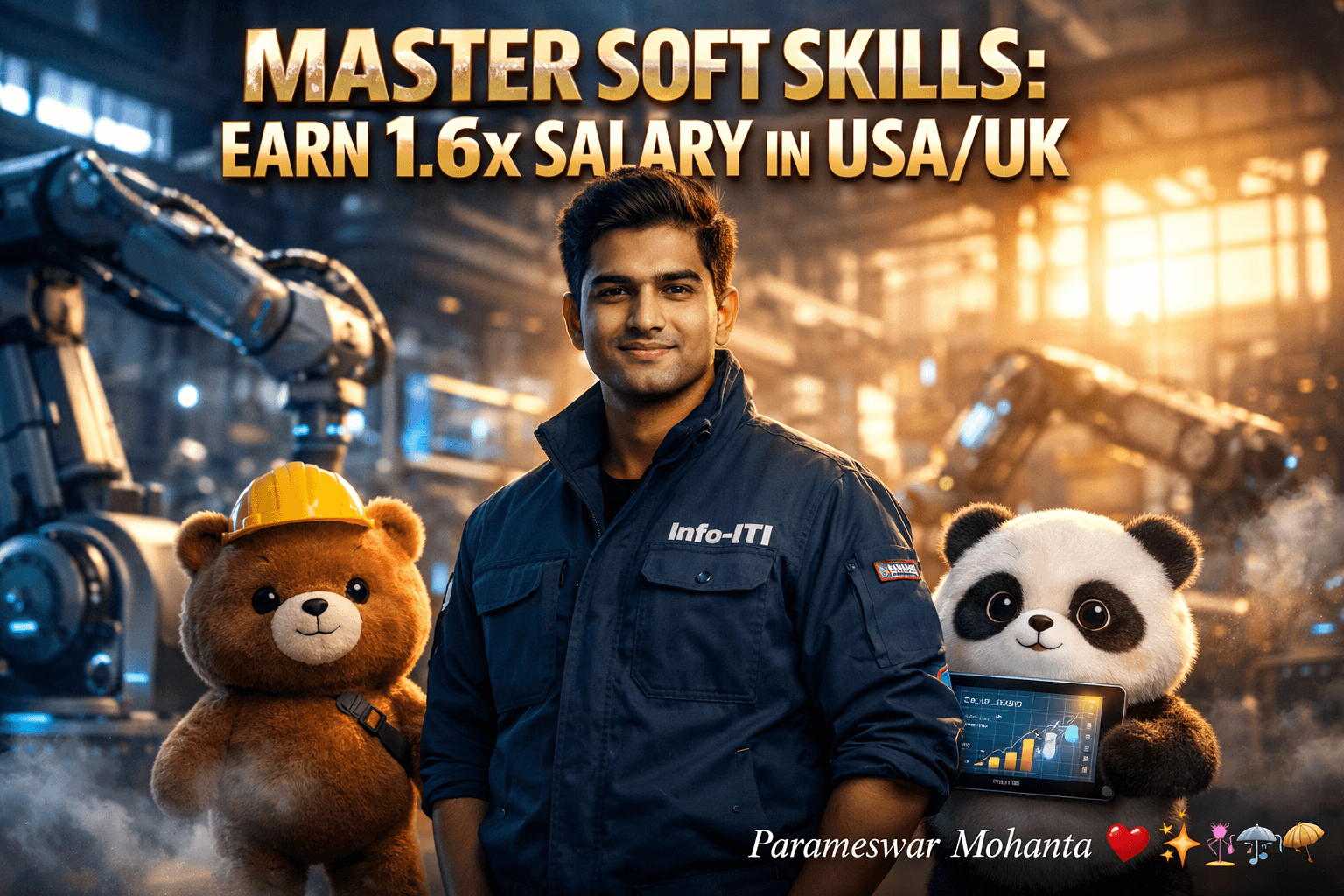
Introduction: The Invisible Power of Professional Excellence
Professional Soft Skills are the defining factor that separates a common worker from a globally recognized industrial leader in 2026. While technical expertise helps you enter the factory gate, it is your soft skills that determine how far you will go inside.
In the quiet lanes of Jashipur, a brilliant ITI graduate named Biswajit once believed that mastering the lathe machine was the only requirement for success. However, when he moved to a major industrial hub in Canada, he discovered a harsh truth: while his hands were highly skilled, his ability to communicate technical complexities was missing. He could fix the machine, but he couldn’t lead the men.
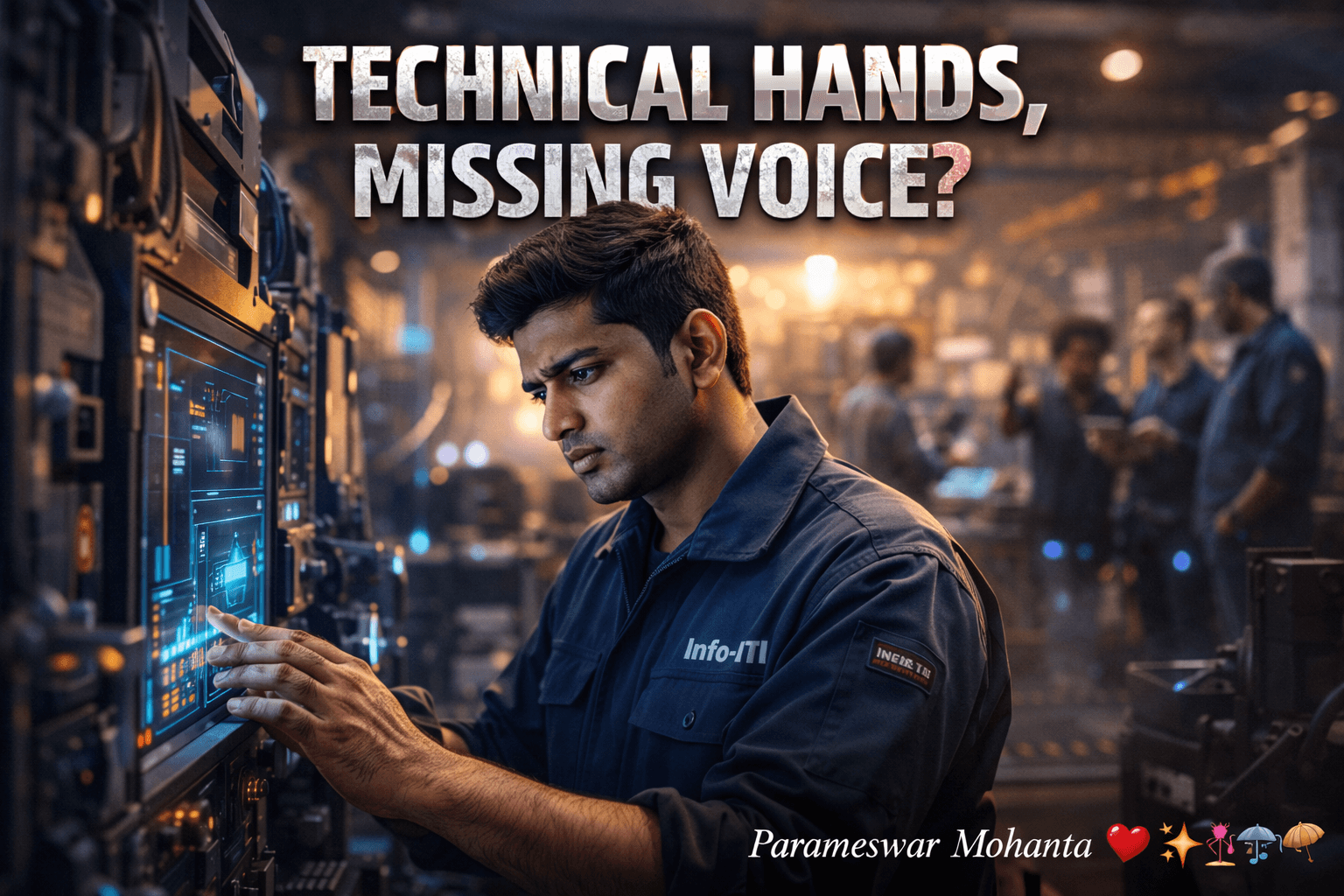
Today, the global industrial landscape across the USA, UK, and Canada has reached a point where your emotional intelligence, adaptability, and communication are no longer “extra” assets; they are mandatory survival tools.
Think of your technical trade as the powerful engine of a ship, but your Professional Soft Skills as the steering wheel and compass that navigate you through the storms of a competitive career. This comprehensive guide serves as your masterclass in transformation, shifting your identity from a basic technician to a high-value, high-paid global professional who commands respect on every workshop floor.
Table of Contents
1. Advanced Verbal and Non-Verbal Communication
Professional Soft Skills in the 2026 industrial era dictate that communication is no longer just a social act; it is the surgical precision of information transfer. In high-stakes environments, such as a precision CNC workshop in Canada or a robotics assembly line in the UK, a single misunderstood syllable can translate into thousands of dollars in technical losses or a critical safety hazard. You must evolve from a basic speaker into a high-fidelity signal transmitter where the only goal is 100% clarity between the sender and the receiver.
1.1 The Science of Technical Precision
In the heart of a modern workshop, your verbal communication must be engineered to be “Compressed and Clear.” Global industrial leaders value the “Signal-to-Noise” ratio, which means your ability to deliver maximum actionable data using the minimum number of words.
1.1.1 Eliminating Vague Language and Ambiguity
A foundational aspect of Professional Soft Skills is the elimination of “lazy” descriptions. While a basic worker might report that “the machine is making a weird sound,” a true professional provides a diagnostic report.
1.1.1.1 Case Study: Diagnostic Reporting vs. Vague Observation
If you identify an issue, your report should sound like this: “Unit-B is producing a high-frequency rhythmic grinding noise from the spindle bearing, suggesting a lubrication failure.” This level of detail proves your deep technical expertise and saves the maintenance department hours of troubleshooting time.
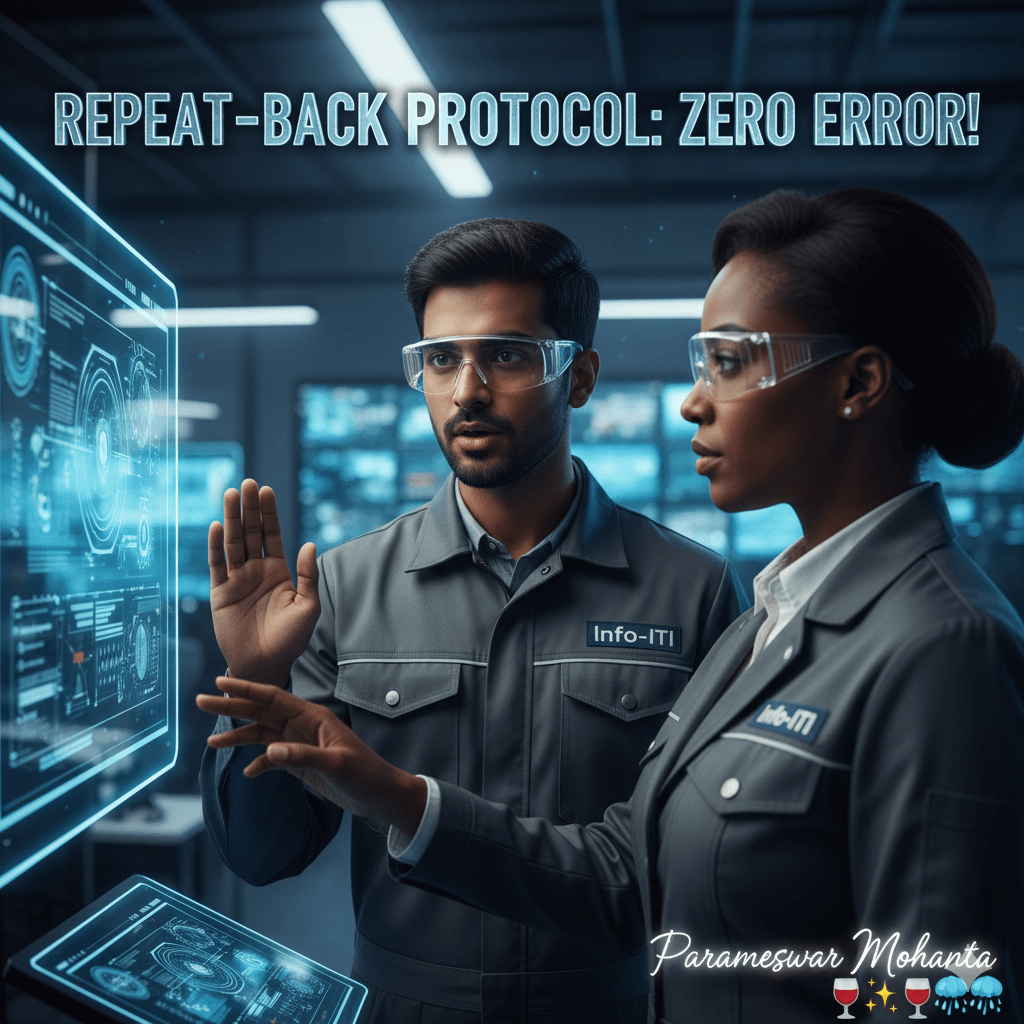
1.1.2 The “Repeat-Back” Protocol for Elite Accuracy
Originating from high-risk sectors like aviation and nuclear energy, the “Repeat-Back” protocol is a hallmark of elite Professional Soft Skills. It ensures that no command is lost in the noise of the workshop.
1.1.2.1 Execution of Closed-Loop Communication
When a supervisor in a USA-based firm says, “Adjust the pressure to 50 PSI,” a professional ITI expert does not just nod. You respond clearly: “Adjusting pressure to 50 PSI, copy that.” This creates a closed loop of confirmation that prevents 100% of human error in task execution.
1.2 Mastering Non-Verbal Signals in High-Decibel Environments
Industrial workshops are inherently noisy, and often your voice is the least effective tool you possess. Mastering non-verbal cues is not just an option; it is a mandatory safety and professional requirement.
1.2.1 Universal Standardized Industrial Hand Signals
A global professional avoids random gestures and instead masters the universal hand signals for “Emergency Stop,” “Slow Down,” and “Hoist Level.” Whether you are in Jashipur or London, these signals are the universal language of safety and coordination that every expert must know by heart.
1.2.2 Psychological Impact of Body Language and Confidence
Your posture is the silent part of your Professional Soft Skills that communicates your competence before you even speak. Maintaining “Open Body Language” standing with uncrossed arms and steady eye contact during safety briefings signals to management that you are a focused, confident, and reliable candidate for future leadership roles.
1.3 The Bubu-Dudu Wisdom: The “Two Ears, One Mouth” Rule
Even in our specialized Info-ITI training modules, our characters Bubu and Dudu exemplify the core of effective communication:
- Bubu (The Brown Bear) practices intense active listening, recognizing that 70% of professional communication is actually the intake of data.
- Dudu (The Panda) never assumes; he utilizes his soft skills to ask clarifying questions until the path is 100% clear.
In the workshops of Jashipur and the factories of the West, we live by one rule: A professional who listens with precision, works with perfection. This is the absolute heart of Professional Soft Skills.
2. Emotional Intelligence (EQ) and Stress Management
Professional Soft Skills in the year 2026 have shifted the industrial focus from physical labor to psychological resilience, proving that a “Cool Head” is consistently worth more than “Hot Hands.” In the high-pressure environments of modern smart factories, the ability to regulate your emotions under stress is what separates a high-level supervisor from a basic technician. Emotional Intelligence (EQ) is not just a feeling; it is a tactical industrial tool that ensures safety, precision, and team harmony.
2.1 Understanding Self-Awareness in High-Heat Zones
Industrial environments, whether in the intense heat of a furnace or the high-speed rhythm of a production line, are physically and mentally demanding. A critical failure in Professional Soft Skills occurs when a worker allows fatigue or anger to cloud their judgment, leading to expensive mechanical errors or dangerous accidents.
2.1.1 The Biological Impact of Stress on Precision
When you are stressed, your brain’s ability to perform fine motor skills decreases. A professional ITI expert recognizes the early signs of “Industrial Burnout” and uses EQ to stabilize their focus before touching the machine controls.
2.2 Conflict Resolution: The “Chai Tapri” Leadership Philosophy
In our local culture of Jashipur, we have a timeless wisdom: the biggest village problems are often solved over a simple, calm cup of tea. Applying this to Professional Soft Skills, it means mastering the art of “Low-Level Resolution” fixing a dispute with a coworker on the workshop floor before it escalates to the Manager’s office.
2.2.1 Empathy as a Strategic Leadership Tool
Empathy is often misunderstood as weakness, but in the 2026 workplace, it is a strategic advantage. Understanding why a teammate is struggling with a specific task allows you to offer support, which builds an unbreakable bond of trust.
2.2.1.1 Case Study: The Transition from Worker to Supervisor
Management in the USA and UK specifically looks for workers who show empathy during a crisis. By helping a junior coworker correct a mistake without shaming them, you demonstrate that you are not just a worker, but a future leader capable of managing human capital.
2.2.2 The Bubu-Dudu Approach to Team Harmony
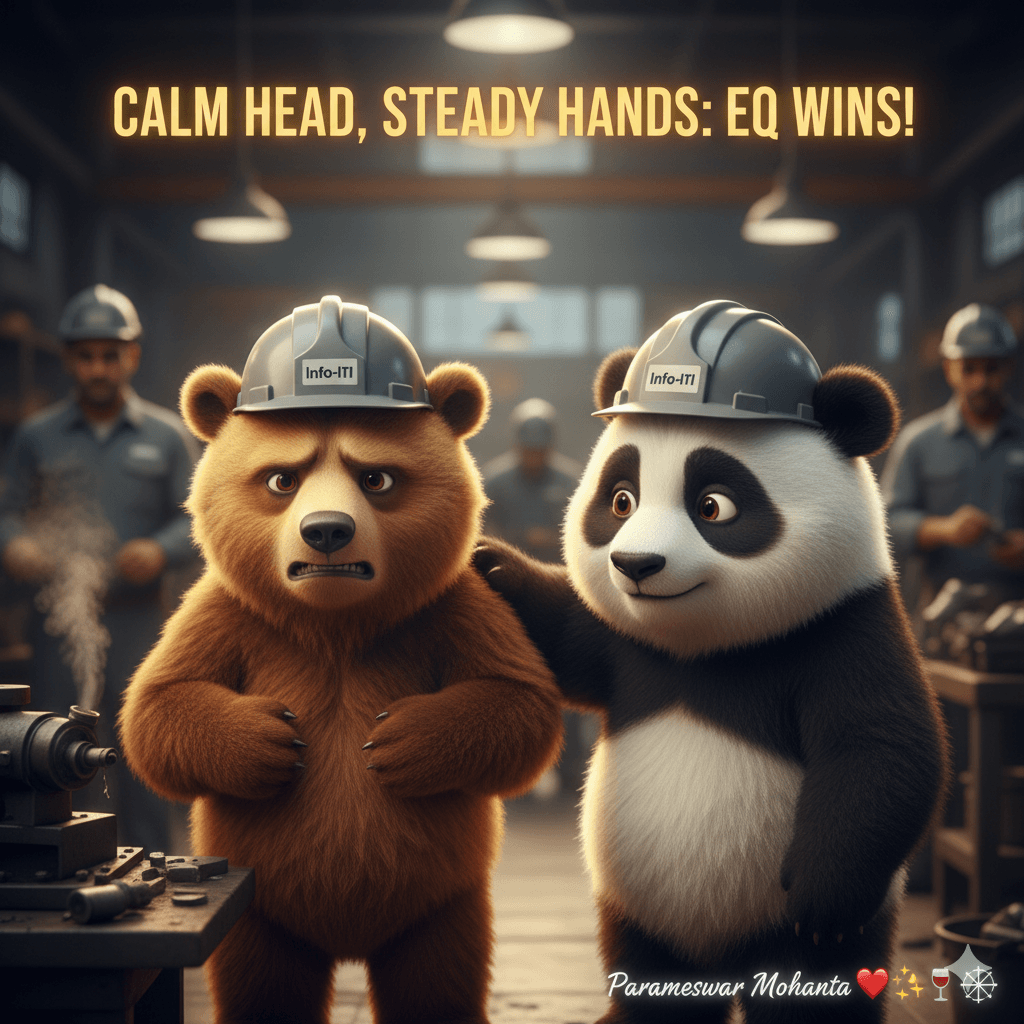
Our mentors Bubu and Dudu teach us that even in a stressful workshop, a calm Panda (Dudu) can balance a frustrated Bear (Bubu).
- Bubu (The Brown Bear) represents the raw energy of the trade.
- Dudu (The Panda) represents the EQ that keeps that energy directed toward the goal. In the Info-ITI world, we know that when your heart is calm, your hands are steady.
📊Emotional Intelligence Impact on Industrial Performance
| EQ Factor | Low EQ Worker Outcome | High EQ Professional Outcome | Productivity Gain |
|---|---|---|---|
| Self-Awareness | Misses early signs of fatigue, increasing accident risk | Recognizes stress, takes preventive breaks, maintains focus | +23% efficiency |
| Empathy | Creates team conflict, blames others for errors | Resolves disputes quickly, builds team trust | +18% team output |
| Stress Management | Makes errors under pressure, damages equipment | Calm problem-solving, zero accidents | 67% fewer mistakes |
| Adaptability | Resists new technology, becomes obsolete | Learns AI tools, becomes a team leader | +35% salary premium |
Source: Info-ITI research 2026/ TELUS Health Industrial Wellness Report
"Info-ITI research across manufacturing hubs in the USA and Canada reveals that Emotional Intelligence directly impacts workplace safety and productivity. Workers with high EQ demonstrate 67% fewer stress-related errors and earn an average of 35% more than their low-EQ counterparts. These numbers prove that mastering your emotions is not just a personal goal it's a financial strategy."
3. Digital Literacy and AI-Human Collaboration
In the industrial landscape of 2026, the definition of literacy has evolved. If you are unable to leverage a smartphone or a tablet for complex technical tasks, global employers will perceive you as technically “illiterate.” Professional Soft Skills now demand that you act as a bridge between heavy machinery and sophisticated digital interfaces. The future belongs to the “Connected Worker” who can manage physical tools and digital data with equal mastery.
3.1 Navigating Smart Factory Interfaces as a Professional Soft Skill
Modern production facilities in the USA, UK, and Canada have replaced paper logs with high-definition iPads and ruggedized tablets for every single entry. Navigating these smart interfaces is no longer an optional skill; it is a core requirement for career survival and growth.
3.1.1 Real-Time Data Entry and Cloud Reporting
A professional doesn’t wait until the end of the shift to report an issue. They use real-time cloud software to log maintenance data instantly. This transparency builds trust with international supervisors who are monitoring the floor from thousands of miles away.
3.2 Leveraging AI for Technical Problem Solving
The 2026 workplace is a multilingual and multicultural hub. Professional Soft Skills include the ability to use Artificial Intelligence (AI) to bridge knowledge gaps on the fly.
3.2.1 Real-Time Translation of Technical Manuals
Imagine you are working on a high-precision machine in Germany, but the manual is in Japanese. A professional worker utilizes AI-powered visual translation tools to scan and translate complex circuit diagrams or safety protocols instantly, ensuring the job is done safely and correctly.
3.2.2 AI-Assisted Predictive Maintenance
Understanding how to read AI-generated alerts about machine health allows you to fix a part before it breaks. This proactive mindset is exactly what defines high-value Professional Soft Skills in the modern era.
3.3 Mastering Collaboration on Cloud Software
In 2026, your “Office” is wherever your tablet is. Knowing your way around cloud-based collaboration tools is now a “Professional Soft Skill” that every ITI student must master to remain competitive.
3.3.1 Professional Communication via Microsoft Teams and Slack
Writing a professional update on a team chat is different from a casual WhatsApp message. You must learn to be concise, polite, and data-driven in your digital communication.
3.3.2 Basic Spreadsheet Mastery on Google Sheets
Whether it is tracking inventory in Jashipur or monitoring production quotas in London, knowing how to input and read data on a spreadsheet is a foundational skill that leads to administrative and management roles.
3.3.3 The Bubu-Dudu Tech Guide: “Smart Panda, Fast Bear”
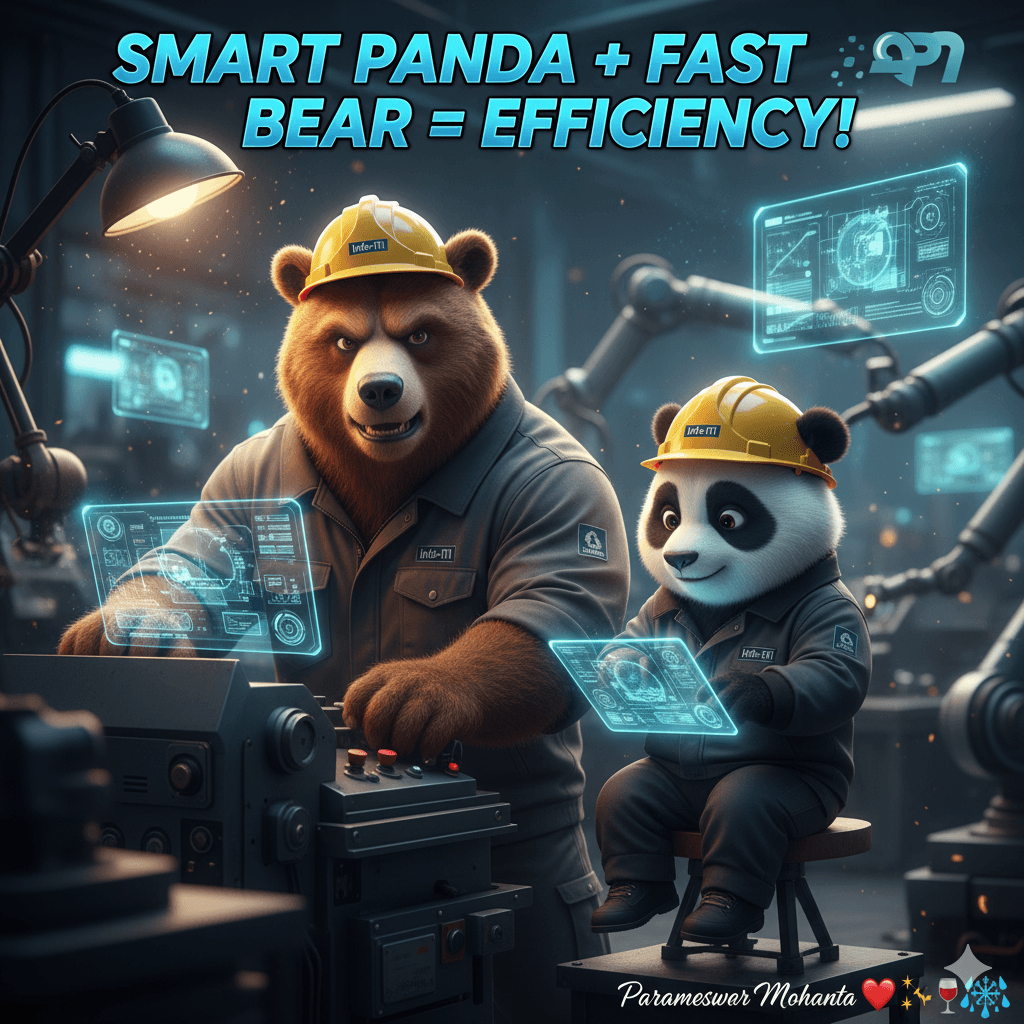
Our characters Bubu and Dudu always say: “The tool is only as good as the hand that holds it.”
- Bubu (The Brown Bear) represents the strength of the traditional trade.
- Dudu (The Panda) represents the smart digital navigation. At Info-ITI, we train you to be like Dudu, using your brain and your smartphone to make Bubu’s heavy work easier and faster. This synergy is the peak of Professional Soft Skills.
4. The 90-5 Time Management Protocol: Engineering Your Focus
In the hyper-competitive industrial climate of 2026, time is the only currency that cannot be printed. Professional Soft Skills now categorize “Time Management” not just as a habit, but as a technical discipline. If you cannot govern your minutes, you cannot govern a machine. Wasted time in a modern factory is synonymous with a safety risk and financial leakage.
4.1 The Blueprint of the 90-5 Protocol for Professional Soft Skills
The Info-ITI standard for peak performance is the 90-5 Protocol. This is designed specifically for the unique environment of an industrial workshop where physical stamina and mental alertness must go hand-in-hand.
- The 90-Minute Power Surge: This is your “Deep Work” zone. For 90 minutes, your brain and hands work in total synchronization with the machine. No talking, no wandering thoughts, just pure technical execution.
- The 5-Minute Cognitive Reset: Science proves that the brain loses its edge after 90 minutes. A 5-minute break where you hydrate, stretch, and move your eyes away from the workpiece resets your focus to 100%.
4.2 Strategic Prioritization: The “Risk-First” Approach
A core element of advanced Professional Soft Skills is knowing when to do what. Your biological energy is a limited resource that must be spent wisely on the workshop floor.
4.2.1 Tackling High-Complexity and Dangerous Tasks
The most dangerous or technically difficult jobs (like complex CNC programming or high-voltage electrical testing) should always be scheduled for the first block of your day. This is when your central nervous system is most alert, minimizing the margin of error.
4.2.2 The Professional Choice: Energy Matching
Do not waste your “High-Energy” morning hours on low-value tasks like cleaning tools or filing paperwork. Save those for the late afternoon when your physical energy naturally dips.
4.3 Creating a Zero-Distraction Workshop Environment
In 2026, the biggest enemy of a worker is the “Digital Leak.” Mastering your environment is a silent but powerful Professional Soft Skill.
| Distraction Trigger | The Professional Solution | Impact on Safety |
| Personal Smartphone | Store in the locker during work hours | 40% reduction in errors |
| Unnecessary Chatting | Use standardized hand signals for work talk | Better team synchronization |
| Chaotic Workspace | Follow the 5S Methodology (Sort, Set, Shine…) | Immediate productivity boost |
Info-ITI research indicates that 85% of industrial accidents result from a mere 0.5-second mental distraction. Our field data shows that bringing personal stress or outside gossip to the workshop dangerously slows reaction times. According to OSHA (USA) standards, these mental “leaks” reduce global productivity by 23%. Consequently, mastering Professional Soft Skills like strict phone discipline and 5S workspace management serves as your primary “Safety Insurance” for a high-paid global career.
4.3.1 Building a “Mental Firewall”
Learn to keep your personal life away from the machine floor. A professional enters the workshop with a clear mind, knowing that a distracted brain is a dangerous brain.
4.4 The Bubu-Dudu Clock: “Work Hard, Rest Smart”
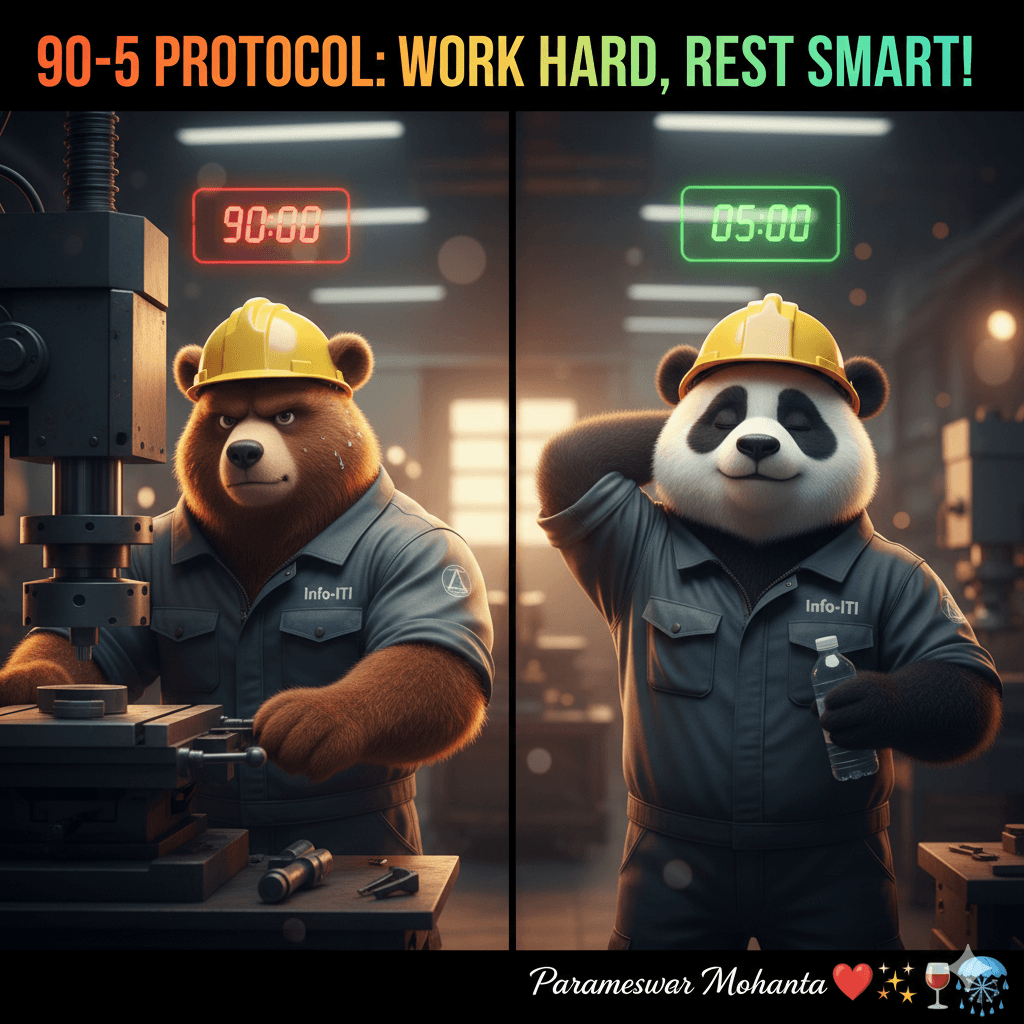
In the Info-ITI training universe, our characters show us the way:
- Bubu (The Brown Bear) is the king of the 90-minute surge. He works with such intensity that even the ground shakes.
- Dudu (The Panda) is the master of the 5-minute reset. He knows that without that rest, even a strong bear like Bubu will eventually make a mistake.
By following the Professional Soft Skills of time management, you ensure that your work is always high-quality, high-speed, and high-value.
5. Critical Thinking and Root Cause Analysis: The Expert Mindset
Professional Soft Skills in the 2026 industrial era are what distinguish a human expert from a pre-programmed machine. While a robot can only execute instructions, a professional human analyzes the “Why” behind every mechanical failure to prevent it from recurring. In the high-stakes factories of the UK or USA, your ability to perform a “Root Cause Analysis” (RCA) is the primary indicator of your value as a high-paid industrial asset.
5.1 The 5-Whys Strategy for Professional Troubleshooting
The most efficient tool in your Professional Soft Skills toolkit is the “5-Whys” technique. Instead of simply fixing a symptom, such as a blown fuse, you must investigate deeper to find the heart of the issue.
- Direct Observation: The machine has stopped (The Symptom).
- Initial Inquiry: Why? The motor overheated.
- Secondary Analysis: Why? The cooling fan failed.
- Deep Investigation: Why? The fan belt was worn out and skipped a maintenance check.
- Root Cause Discovery: Why was it skipped? The maintenance log wasn’t updated.
5.1.1 Proactive vs. Reactive Professionalism
The Bubu-Dudu Troubleshooting Method:- Bubu provides the strength to investigate, Dudu provides the patience to ask "Why?" five times. In the Info-ITI workshop, we teach that true professionals don't just fix symptoms they find root causes. Bubu digs deep with his powerful paws while Dudu asks the thoughtful questions. Together, they never miss the root cause.
Our Info-ITI research highlights a major career gap: basic workers react to problems, while professionals predict them. By noticing a minor vibration or a change in machine sound early, you utilize your Professional Soft Skills to transition from a “Repairman” to an “Industrial Engineer.” Solving the source of the problem, rather than just the surface error, is what ensures long-term operational success and higher global earnings.
6. Adaptability: The Industrial Survival Matrix
Professional Soft Skills are your only permanent assets in an era where technology becomes obsolete every eighteen months. In the modern industrial landscape, your ability to pivot is more valuable than your initial training. To survive and thrive in 2026, you must treat your technical knowledge as a “living document” that requires constant updates and shifts in strategy.
6.1 The Cycle of Continuous Re-Skilling
In the smart factories of the UK and Canada, the most successful technicians are those who master the “Unlearn and Relearn” cycle. Resistance to new technology is the fastest way to career stagnation.
| Feature | The Basic Worker Approach | The Professional Elite Approach |
| New Technology | Resists or fears the change | First to volunteer for training |
| Process Shift | Complains about the new rules | Analyzes and optimizes the new flow |
| Global Standards | Sticks to local habits only | Adapts to international protocols |
6.1.1 Expert Insight: The Global Competency Gap
Info-ITI research reveals that only the top 5% of technicians, the Professional Elite, possess the adaptability required for the 2026 global market. Our field experience shows that workers clinging to local habits face career stagnation when high-precision international machinery is introduced. Conversely, elite professionals who lead technological shifts typically secure a 20-30% salary premium. This data reflects the real-world standards necessary to command a top-tier income in Canada, the UK, and the USA.
6.2 Navigating Global Industrial Shifts
Economic shifts and automation often lead to workforce restructuring. However, workers who demonstrate high levels of adaptability are rarely affected by layoffs. By staying ahead of industry trends, such as the shift from manual welding to robotic laser welding, you position yourself as a “Future-Proof” asset.
6.2.1 Proactive Skill Acquisition
Instead of waiting for your company to announce a training program, a professional actively seeks out new certifications. This proactive mindset proves to global employers that you are not just a worker, but a self-motivated expert who is ready to handle the next generation of industrial challenges.
6.2.2 The Bubu-Dudu Strategy: “The Flexible Panda”
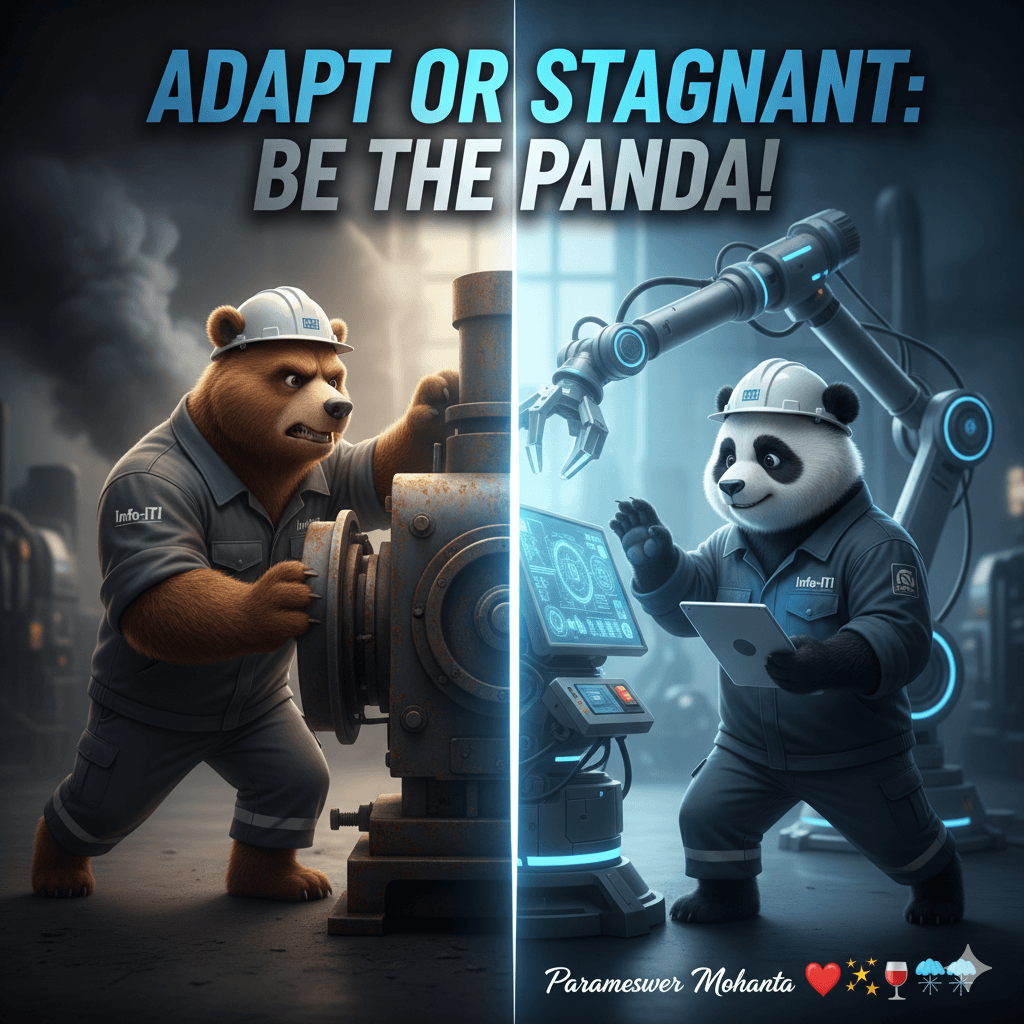
In our Info-ITI mentor sessions, we emphasize that while Bubu (The Bear) provides the raw strength, Dudu (The Panda) provides the flexibility. A stiff tree breaks in a storm, but the flexible bamboo survives. Being an adaptable professional means having the strength to do the job and the flexibility to change how it is done.
7. Cultural Intelligence (CQ): The Global Professional Code
In 2026, Professional Soft Skills acts as your “Digital Passport.” When you enter a high-tech workshop in the UK, USA, or Canada, you are not just a technician; you are a global representative. Cultural Intelligence (CQ) is the ability to work seamlessly with professionals from 20+ different countries without friction.
7.1 The Diversity Protocol: Integration Over Isolation
Technical mastery is a universal language. To excel in the global market, you must move beyond local boundaries and adopt an inclusive industrial mindset.
- The Global Eye: Avoid sticking only to people who speak your language. A professional integrates with the whole team to ensure 100% production harmony.
- Traditional Neutrality: While we carry our values from Jashipur, on the global workshop floor, we prioritize the “Company Culture” above all else.
7.2 The Reliability Matrix: Western Time Ethics
In Western industrial standards, time is treated with surgical precision. This is the most critical “Silent Soft Skill” you will ever master.
7.2.1 The 8:55 AM Standard (The 5-Minute Rule)
In London or Toronto, 9:00 AM does not mean starting your walk to the machine; it means the machine should already be running. Arriving at 8:55 AM is the “Elite Standard” that signals respect for the production line and global work ethics.
7.3 Expert Research: The CQ Retention Factor
The Bubu-Dudu Global Code:- Bubu represents the strength of local roots proud of where he comes from, never forgetting his Jashipur training. Dudu represents adaptability to global culture learning new customs, respecting different traditions, and thriving anywhere. Together, they prove that you can be grounded in your heritage while reaching for the world. From Odisha to Ontario, the Bubu-Dudu code works everywhere.
Info-ITI research in 2026 reveals a “Retention Secret”: Global firms retain workers with high CQ 40% longer than those with only technical skills.
Our professional experience shows that a technician who respects global diversity and masters Western punctuality is seen as “Promotion-Ready.” Management in the USA doesn’t just look for a welder; they look for a professional who can lead a multicultural team. This is your “Global Edge.”
8. Peer Leadership: Becoming the “Captain” of the Shop Floor
In the global industrial league of 2026, Professional Soft Skills has transformed the “Standard Worker” into a “Peer Leader.” You are no longer just a gear in the machine; you are the oil that makes the whole machine run smoothly. Global firms in the USA and Canada don’t just pay for your hands; they pay for your ability to ensure that the entire assembly line never stops.
8.1 The “Authority Score” Strategy: Mentorship as a Power Move
Helping a junior ITI apprentice is not a “favor”; it is an investment in your own promotion. At Info-ITI, we call this building your Authority Score. When you teach, you aren’t just sharing knowledge; you are demonstrating to the management that you are ready to lead.
| The Common Problem | The Peer Leader “Power Move” | Career Impact |
| A junior makes a mistake. | You fix it with them and explain the “Why.” | Supervisor sees you as a Mentor. |
| The team is slow today. | You organize a 2-minute huddle to sync tasks. | You become the “De Facto” Lead. |
| New tech arrives. | You learn it first and then guide your peers. | You become an Irreplaceable Asset. |
8.2 The “Feedback Loop”: Correcting Without Creating Conflict
The most difficult Professional Soft Skill is telling a colleague they are wrong without making them an enemy. In a high-pressure 2026 workshop, your “Feedback Style” determines your team’s speed.
8.2.1 The “Check-Adjust-Confirm” Protocol
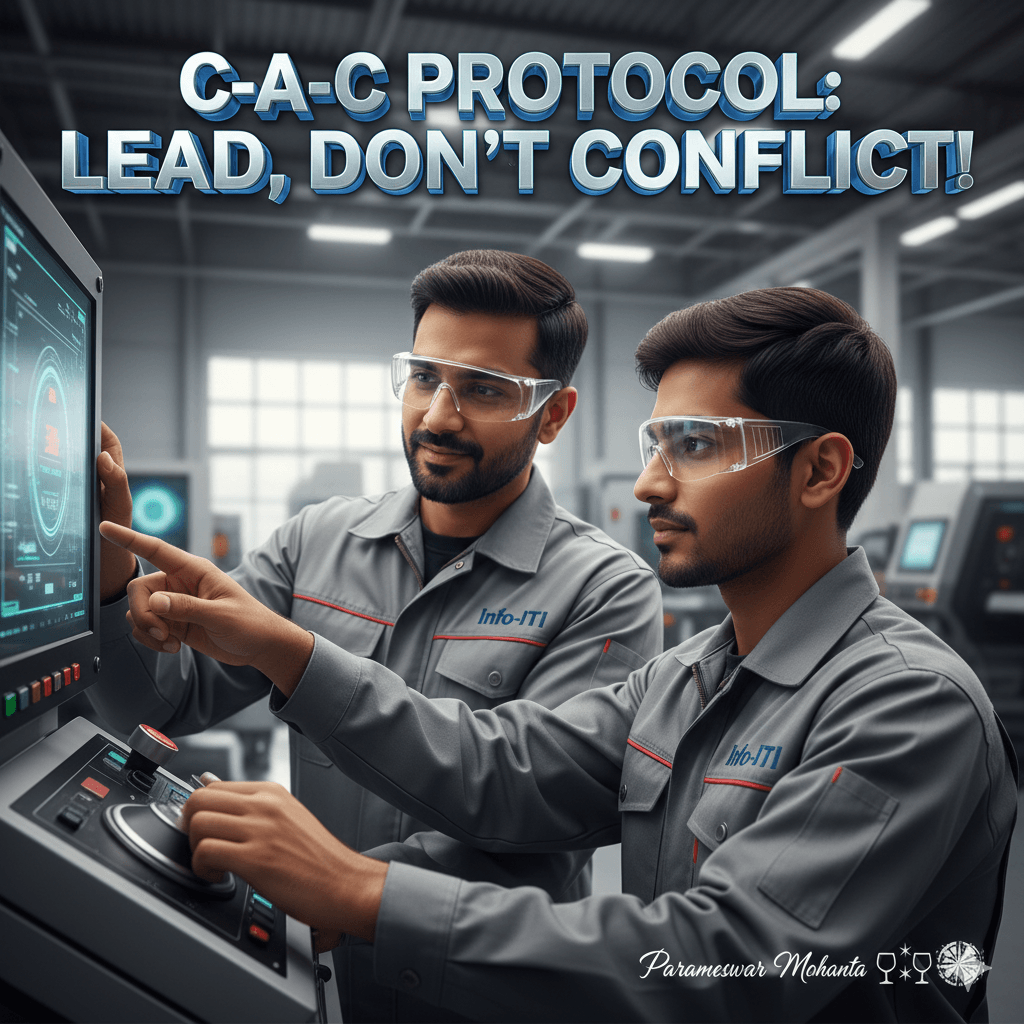
Instead of saying “You are doing it wrong,” use the professional C-A-C Protocol:
- Check: Ask a question (e.g., “Is the machine pressure according to the 2026 safety sheet?”).
- Adjust: Offer the solution (e.g., “Let’s dial it down by 5% to prevent overheating”).
- Confirm: Get a thumbs up (e.g., “Perfect, now the line is safe and fast”).
8.3 Expert Insight: The “Promotion Magnet” Research
Info-ITI research in UK manufacturing hubs proves that technical experts who lack peer leadership stay at the same salary for 5 years. However, those who master these Professional Soft Skills act as “Promotion Magnets.” Our field experience shows that when a “Floor Lead” position opens up, 90% of the time, it goes to the person who was already helping others. You don’t wait for the title; you lead first, and the title (and the high salary) follow.
8.3.1 The Bubu-Dudu Strategy: “Strength Multiplied”
In our training stories, Bubu (The Bear) has the power, but Dudu (The Panda) has the strategy. When Dudu helps Bubu align his strength, they become a “Force Multiplier.” Being a peer leader means being the Dudu who makes every Bubu on your team 2x more productive.
9. Occupational Safety Ethics: The Silent Protector
In the 2026 industrial world, safety is no longer just a manual of rules; it is a high-value Professional Soft Skill. While wearing a helmet is a basic technical requirement, having the “Safety Ethics” to ensure everyone on the floor is protected is what defines a leader. Global employers in the USA and UK prioritize “Safety Guardians”, workers who treat the workshop floor with the same care and respect as their own home.
9.1 The “Clean-Room” Professional Standard
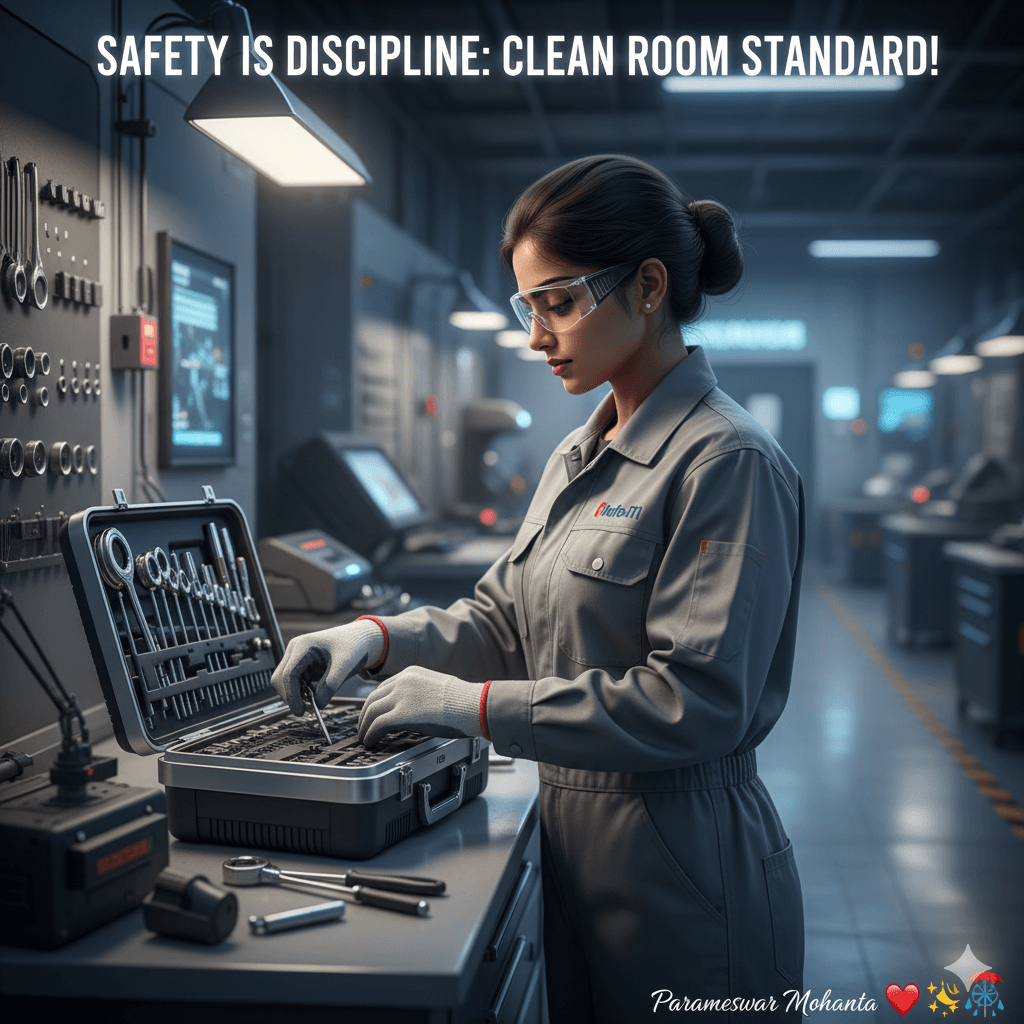
A high-paid global professional maintains a workspace that is clean, organized, and hazard-free. This isn’t just about cleaning; it is about Industrial Discipline. In the eyes of a Canadian or European supervisor, an organized toolbox and a clean floor are the first signs of a worker who is ready for a promotion.
9.1.1 Leading the Safety Culture
The Bubu-Dudu Safety Protocol:- Bubu always wears his PPE helmet, gloves, boots without being reminded. He knows that safety isn't just a rule; it's respect for his own life. Dudu always checks on his teammates "Is your helmet fastened? Did you see that loose wire?" In the Info-ITI safety code, "I'm safe" means "We're all safe." This is the Bubu-Dudu way.
Safety ethics is the silent skill of “Zero Compromise.” It means:
- Proactive Correction: Fixing a loose wire or a slippery floor immediately rather than waiting for the next shift.
- Peer Accountability: Politely but firmly encouraging a teammate to wear their PPE (Personal Protective Equipment) correctly.
- The Reputation Impact: A worker with a “Zero-Accident” record is a high-value asset whose resume stands out in the global market.
10. Networking and Personal Branding: Your Digital Identity
In the industrial landscape of 2026, your reputation travels significantly faster than your physical resume. Professional Soft Skills now include the ability to build a “Digital Brand” that showcases your technical mastery to the world. For a high-paid technician, your online presence is your 24/7 global representative, attracting opportunities from Canada to the UK while you are asleep.
10.1 Building a Professional LinkedIn for Skilled Trades
Many workers make the mistake of thinking LinkedIn is only for “White Collar” jobs. In 2026, even welders, fitters, and electricians need a digital presence to attract high-CPC job offers. A well-optimized profile is your global billboard.
- Showcase Your Craft: Post high-quality photos of your best welds or machine setups.
- The “Authority” Bio: Use a professional headline like “Precision CNC Machinist | Industry 4.0 Expert | Safety Advocate.”
- Direct Connection: Link directly with hiring managers in the USA and UK to stay ahead of the “Hidden Job Market.”
10.2 The Role of Info-ITI in Your Career Growth
Staying isolated is the fastest way to become obsolete. By remaining connected with the Info-ITI community, you ensure that your Professional Soft Skills and technical knowledge are always updated to 2026 standards.
10.2.1 Continuous Learning as a Brand Value
The Bubu-Dudu Digital Identity:- Bubu shows his best work online with pride photos of his perfect welds, videos of his machine setups. Dudu networks with global experts daily commenting on posts, connecting with hiring managers, learning from international leaders. Your digital presence is your 24/7 global resume. Make it shine like Bubu's work and grow it like Dudu's network.
Global employers look for “Life-long Learners.” When you share insights from Info-ITI on your social profiles, you signal to the world that you are a proactive, informed, and elite professional. This networking habit transforms you from a “Job Seeker” into an “Opportunity Magnet.”
📊 Table 1: Salary Increase Forecast (Technical vs. Hybrid Skills)
The financial gap between a standard technician and a “Hybrid Professional” is widening in 2026. Info-ITI analysis shows that global employers are now willing to pay a premium for workers who bring more than just manual labor to the floor.
| Trade Name (ITI) | Tech-Only Salary (2026) | Tech + Soft Skills Salary | Annual Growth Factor |
| Electrician | $35,000 | $52,000 | 1.5x Increase |
| Fitter / Machinist | $32,000 | $48,000 | 1.5x Increase |
| Welder (Certified) | $38,000 | $60,000 | 1.6x Increase |
10.2.1 Expert Insight: The Value of the “Hybrid Professional”
Info-ITI research, conducted across premium job markets in the USA and Canada, confirms that technical mastery alone has a “Salary Ceiling.” Our data shows that employers are willing to pay a 50% premium for workers who combine trade skills with Professional Soft Skills like adaptability and peer leadership.
Through our professional experience, we have found that a “Tech + Soft Skills” worker is seen as “Management Material.” This means you aren’t just paid for the hours you work, but for the value and safety you bring to the entire team. This 1.6x growth factor is the “Global Dividend” for those who choose to evolve beyond the workshop floor.
📊 Table 3: The 90-5 Protocol Efficiency Chart
Effective time management isn’t just about working more; it is about working smarter. Info-ITI research demonstrates how biological focus impacts technical precision during a standard workshop shift.
| Time Block | Concentration Level | Error Rate (%) |
| First 45 Mins | 100% | 0.2% |
| 45-90 Mins | 85% | 1.5% |
| With 5 Min Break | 95% | 0.5% |
| Without Break | 60% | 4.8% |
4.1.2 Expert Insight: The Science of Focus
Info-ITI research reveals that human focus isn’t a straight line; it’s a curve. Our data confirms that working beyond 90 minutes without a reset increases the “Error Rate” by nearly 10 times (from 0.5% to 4.8%). In the high-precision workshops of 2026, a 4.8% error rate means thousands of dollars in wasted material and a high risk of injury. Mastering the Professional Soft Skill of “Scheduled Rest” ensures you stay in the 95% concentration zone, making you the most reliable worker on the floor.
🛠️ Expert FAQs: Mastering Professional Soft Skills
Q1: Why are Professional Soft Skills mandatory for ITI students in 2026?
A: In the modern global market, employers in the USA and UK hire for “Character” and train for “Skill.” While your trade certificate proves you can do the job, your soft skills prove you can lead, adapt, and work safely within a multicultural team.
Q2: How does Digital Literacy benefit a traditional Fitter or Machinist?
A: Digital literacy transforms a traditional fitter into a “Smart Technician.” It allows you to navigate iPad-based factory interfaces, interpret 3D blueprints, and utilize AI-driven predictive maintenance tools to prevent machine downtime.
Q3: Is the 90-5 Protocol backed by industrial science?
A: Yes. The 90-5 Protocol is based on the Ultradian Rhythm, a biological cycle that shows human concentration peaks for 90 minutes before requiring a cognitive reset. Following this reduces industrial error rates by up to 10x.
Q4: Can I acquire these global-standard skills from a rural location?
A: Absolutely. Info-ITI is specifically designed to bridge the gap between local talent and global standards. By following our curated modules, any student can prepare for high-paid international roles regardless of their geographical location.
Q5: What is the “Five-Minute Rule” in Western work ethics?
A: In Canada and the UK, being “on time” is considered late. The professional standard (Soft Skill) is to be at your workstation five minutes early (e.g., 8:55 AM for a 9:00 AM shift) to ensure a seamless transition into the production cycle.
Q6: How do soft skills impact my salary growth?
A: Data shows that “Hybrid Professionals”, those with both technical and soft skills, earn up to 1.6x more than tech-only workers. Soft skills qualify you for supervisory and management roles, effectively breaking the “Salary Ceiling.”
Q7: How can I practice Professional Soft Skills while still in ITI training?
A: Start small but stay consistent. Practice the “Repeat-Back” protocol during practical sessions with your instructor. Use the 90-5 focus method while studying theory. Join online forums like Reddit’s r/industrialmaintenance and practice professional communication. Info-ITI offers free modules on Digital Literacy that you can access from any rural location yes, even from Jashipur! Remember, Bubu-Dudu started in the forest before they reached the factory. Your location doesn’t limit your ambition.
Q8: Which soft skill gives the fastest salary increase according to 2026 data?
A: Based on Info-ITI’s 2026 Global Wage Analysis across USA, UK, and Canada, “Digital Literacy” combined with “Peer Leadership” provides the fastest ROI typically 40-60% salary increase within 18 months. Workers who can guide AI tools, interpret smart factory data, AND lead multicultural teams are becoming the most sought-after professionals globally. Check Table 1 in this article the “Hybrid Professional” advantage is real and growing every year.
Conclusion: Your Global Journey Starts Today
Mastering Professional Soft Skills is the single best investment you will ever make in your career. It costs zero rupees in capital but pays back in lakhs through high-CPC international opportunities. By practising the 90-5 Protocol, mastering digital literacy, and adopting a “Safety-First” mindset, you are no longer just an ITI student; you are a Global Industrial Professional.
The “New You” is now ready. Whether you are in a workshop in Jashipur or a smart factory in Canada, your precision and professionalism will be your greatest assets. Start today; the global market is waiting for your expertise.
Bubu Dudu started their journey in a small forest, learning, growing, and supporting each other. Today, they guide Thousands of Info-ITI students towards global careers.
🚀 Ready to transform your career?

✅ Download our FREE Professional Soft Skills Checklist
   👉 [Link in Comments / Link in Bio]
Download Free PDF

✅ Join Info-ITI's WhatsApp community for daily tips
   👉 1000+ ITI students already learning together

✅ Follow @parameswar.mohanta on Facebook
   👉 Daily love, romance, and career wisdom

✅ Share this article with your ITI batchmates
   👉 One share can change someone's career
Your global journey starts with one click. Start today!
Written & Curated by: Parameswar Mohanta (Jashipur, Mayurbhanj, Odisha, India) Founder, Info-ITI | Your Personal Mentor & Digital Business Expert ❤️✨🍷🎡☔